 ⬇️
⬇️
Key Takeaways
- Next-generation firewalls operate as policy enforcement points within a broader security architecture, not simply as barriers at the network perimeter.
- Managed firewall services help resource-constrained IT teams maintain rules, inspect threats, review logs, and respond to incidents without building an internal security operations center.
- Buyers must assess architecture, operational support, segmentation capabilities, identity integration, and total lifecycle costs before comparing individual appliances or subscriptions.
Executive Summary
Small and midsize businesses once treated the firewall as a static appliance installed between the office network and the internet. Today, corporate applications span cloud services, branch locations, data centers, and remote employee endpoints. Because attackers actively exploit external vulnerabilities, stolen credentials, and legitimate administrative tools, simple perimeter filtering is no longer an effective standalone defense.
Modern firewall strategy centers on managed, next-generation protection. Essential capabilities include intrusion prevention, application awareness, encrypted traffic inspection, network segmentation, centralized logging, remote-access controls, and integration with identity and endpoint security systems.
This analysis examines how SMB and mid-market decision-makers can evaluate network security capabilities while balancing operational realities. It considers managed service models, policy governance, implementation priorities, and the connection between firewall architecture and Zero Trust principles. The objective is to establish a defensible operating model that addresses the organization’s risks, staffing constraints, infrastructure requirements, and growth projections.
The Perimeter Has Become a Policy Problem
Worldwide security and risk management spending reached approximately $215 billion in 2024, according to Gartner. That spending reflects a practical operational concern: organizations have more systems to defend, while their digital environments are becoming significantly harder to map and define.
A modern SMB may operate a headquarters, several regional branches, cloud-hosted business applications, remote workers, third-party contractors, and connected operational technology, meaning there is no single defined perimeter to defend.
The modern firewall can enforce access policy, inspect traffic payloads, isolate sensitive internal systems, and send network telemetry to other security tools. However, these benefits depend entirely on sound configuration and ongoing management. An advanced network appliance running outdated firmware, permissive access rules, or generating unreviewed alerts creates operational confidence without providing proportionate protection.
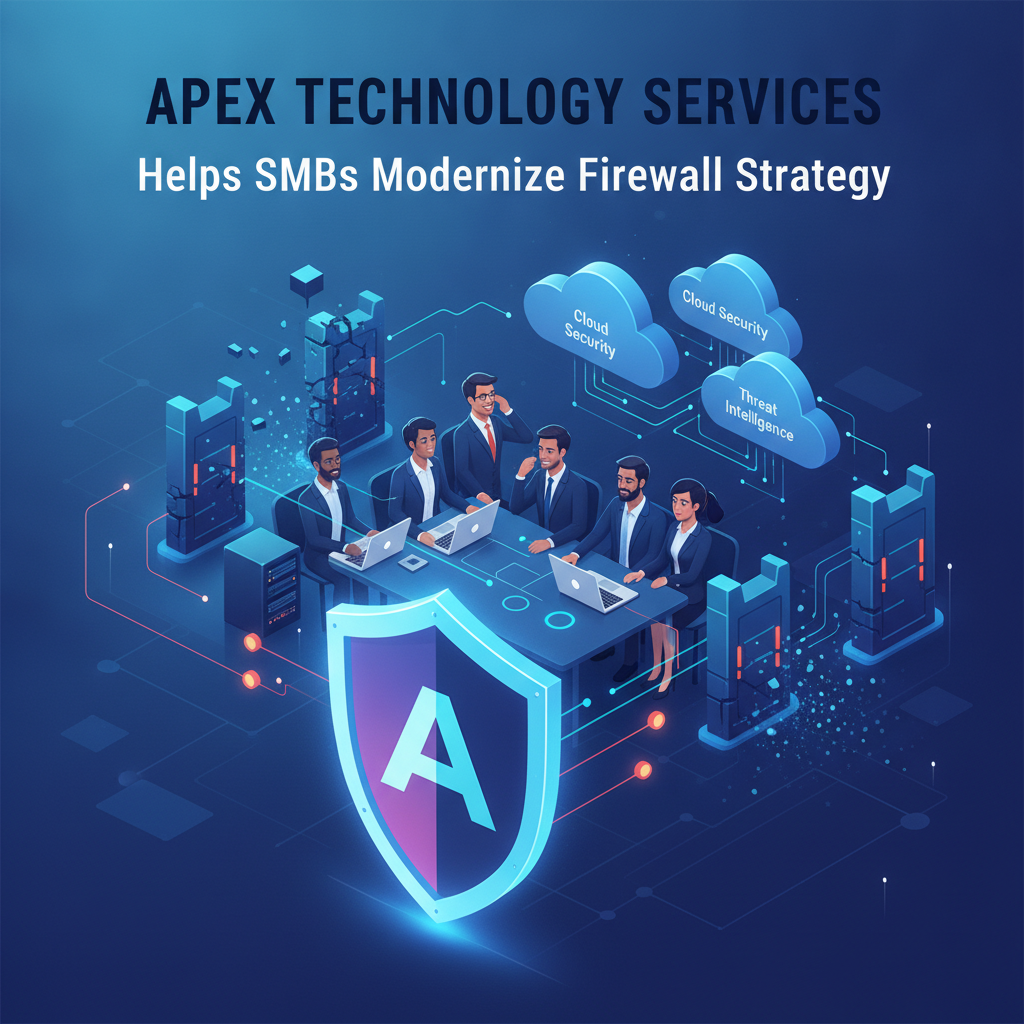
Providers like Apex Technology Services address these challenges by connecting firewall selection with broader operational requirements through IT consulting, managed IT services, and cybersecurity support. Firewall strategy must reflect how the business functions and processes data rather than operating as an isolated hardware purchase.
Why Traditional Firewall Operations Fall Short
Hardware features are rarely the primary constraint in network defense; internal operational capacity ultimately dictates security effectiveness.
The ENISA Threat Landscape 2024 identifies ransomware and exploited vulnerabilities among Europe’s most critical threats. Defending against these attack vectors requires active intrusion prevention, strict network segmentation, applied threat intelligence, centralized logging, and disciplined patching regimens.
When evaluating a network environment, such as a mid-market manufacturer with multiple production plants, a small internal IT team, and remote maintenance vendors, the analysis must begin with access paths and business dependencies. The organization must document which third-party vendors can reach production systems, whether potentially compromised office devices can communicate directly with plant equipment, and how firewall alerting is managed outside of standard business hours.
Products that cannot physically separate operational systems, granularly restrict vendor access, or centralize logs for forensic review should be eliminated from consideration early in the evaluation process. Effective implementations limit lateral movement across the network, preserve highly restricted remote access, and provide administrators with actionable network evidence during security events.
Rule sprawl introduces compounding vulnerabilities over time. Temporary port exceptions become permanent, legacy applications retain unnecessary network access, and broad allow rules accumulate because administrators avoid disrupting active business operations. Organizations must establish clear internal accountability for deciding whether legacy rules remain valid.
NIST SP 800-41 Rev. 1 defines firewalls as policy-enforcing devices and recommends a structured process for rule management. Published in 2009, this foundational operational standard dictates that rules need documented technical purposes, designated business owners, recurring review cycles, mandatory testing protocols, and strict retirement procedures.
Building a Managed, Next-Generation Approach
A practical network architecture starts with mapping risk and traffic flows. Buyers must comprehensively document critical applications, user groups, administrative connections, internet-facing services, and regulated data stores to identify access gaps that standardized product demonstrations frequently overlook.
Next-generation capabilities encompass application-based controls, active intrusion prevention, dynamic web filtering, malware inspection, virtual private network (VPN) or zero-trust access integration, and unified management interfaces. Fortinet, Palo Alto Networks, and SonicWall represent common vendor examples evaluated by SMBs, though product selection must align with specific technical requirements rather than brand familiarity.
Advanced inspection capabilities involve inherent technical tradeoffs. Encrypted traffic analysis significantly improves network visibility but introduces privacy considerations, certificate-management overhead, performance latency, and potential application-compatibility issues. Evaluating realistic traffic loads in the specific environment provides a more accurate performance assessment than relying solely on published vendor throughput figures.
When preparing an infrastructure budget proposal, the total cost comparison extends far beyond the base hardware appliance price. The calculation must account for ongoing licensing subscriptions, deployment labor, 24/7 monitoring, recurring configuration changes, lifecycle hardware replacement, incident support, internal staff time, and the potential cost of unplanned downtime.
A managed service model directly addresses gaps in internal IT capacity. Organizations must reject vendor proposals that obscure exact responsibilities for alert review, incident escalation, policy approval, or after-hours response. A credible managed service definition explicitly details which party patches the device, reviews raw security events, documents configuration changes, and actively intervenes when suspicious network activity occurs.
Implementation, Governance, and Zero Trust
Deployments must proceed in tightly controlled stages. IT teams can establish a configuration baseline, remove obsolete rules, introduce subnet segmentation, validate network failover mechanisms, and tune inspection policies before expanding broad enforcement. Network logging must feed directly into an active, human-led review process rather than simply accumulating in passive storage.
Zero Trust methodologies fundamentally alter network security models. NIST SP 800-207 describes an architecture where network access decisions continuously evaluate user identity, device health, requested resources, and session context rather than inherently trusting users based on their physical network location. Firewalls support this framework through strict segmentation and dynamic policy enforcement, operating alongside identity controls, endpoint protection, and strong authentication protocols.
Operational metrics must measure practical security outcomes, including unauthorized connection attempts blocked, critical security alerts investigated, stale rules safely removed, firmware update currency, disaster recovery test results, and the total time required to execute approved policy changes.
Future Outlook
Firewall functions will continue migrating across physical hardware appliances, virtualized network systems, cloud controls, and security service edge (SSE) platforms. Centralized policy management and identity-aware access enforcement will grow in operational importance as workforces and enterprise applications remain highly distributed.
Managed services will provide vital coverage for SMBs requiring continuous network monitoring without the prohibitively high expense of staffing an internal, around-the-clock security operations center. However, outsourcing tactical execution does not transfer ultimate organizational accountability; business leaders retain full responsibility for defining enterprise risk priorities, determining acceptable access parameters, and maintaining active service provider oversight.
Conclusion
The modern firewall operates as a foundational component within a layered organizational security program. Its operational value relies entirely on clear policy definitions, sound network architecture, meticulously maintained configurations, active event monitoring, and rapid, coordinated incident response.
SMB and mid-market buyers must build their technical evaluations around core assets, documented traffic flows, digital identities, and internal operational constraints before comparing next-generation hardware products or managed service tiers. The resulting deployment establishes a manageable control system that enforces internal segmentation, strictly restricts unauthorized access, generates actionable diagnostic evidence, and scales efficiently alongside enterprise business requirements.