 ⬇️
⬇️
Automating the Complex Web of Modern Telecom and Utility Expense Management
Key Takeaways
- Cloud Age Solutions addresses the critical bottleneck of data ingestion in the telecom expense management lifecycle.
- The software normalizes disparately formatted invoices across network, UCaaS, and utility sectors into a unified data structure.
- Automation in this sector eliminates the high error rates associated with manual swivel-chair data entry processes.
- Including power and data center costs alongside traditional telecom allows for a holistic view of total cost of ownership for IT infrastructure.
The digital transformation of the enterprise has fundamentally altered the financial landscape of IT. What was once a relatively straightforward task of managing fixed-line and mobile telephony costs has exploded into a fragmented ecosystem of digital services. Modern enterprises now grapple with a convergence of costs that includes traditional networks, Unified Communications as a Service (UCaaS), colocation fees, and the substantial energy requirements of data centers. In this environment, the ability to accurately capture and process financial data is paramount.
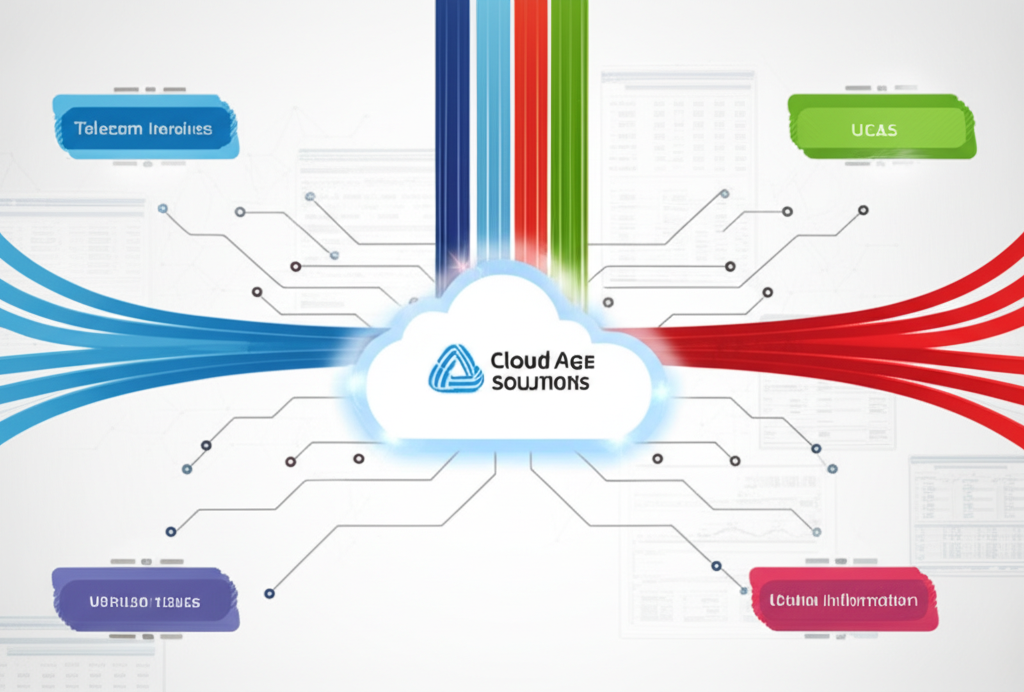
Cloud Age Solutions has positioned its platform to solve the most persistent friction point in this ecosystem: the ingestion and normalization of complex invoices. For B2B technology leaders and financial officers, understanding the mechanics of this automation is essential to realizing the difference between simple bill payment and true technology expense management (TEM).
The primary challenge in modern TEM is not merely the volume of invoices but the variability of the data. A legacy carrier invoice looks nothing like a bill from a cloud-native UCaaS provider, which in turn bears little resemblance to a utility bill for a data center. When human operators are forced to manually bridge these gaps—often referred to as "swivel-chair" processes—the risk of error increases exponentially. Data entry mistakes lead to overpayments, missed dispute windows, and skewed financial reporting.
Cloud Age addresses this by automating the ingestion layer. By deploying software capable of interpreting diverse invoice formats, the system removes the manual barrier to entry. This is particularly vital for the UCaaS sector. Unlike traditional telecom, where costs were often usage-based or fixed per line, UCaaS billing involves complex licensing structures, tiered feature sets, and hybrid usage models. Automating the ingestion of these invoices ensures that an enterprise is paying only for the licenses effectively deployed, preventing the common issue of "shelfware," where companies pay for software seats that no longer have active users.
However, ingestion is only the first step. The true analytical value is derived from normalization. Normalization is the process of translating disparate data points into a standard, comparable format. For example, one vendor might bill internet services as "Access," while another bills it as "Connectivity," and a third bundles it under "Managed Services." Without normalization, a CIO cannot run an accurate report on total internet spend. Cloud Age’s software standardizes this taxonomy, creating a "single pane of glass" view of the IT estate.
The inclusion of power and data center expenses in this automation workflow represents a significant evolution in the market. Historically, energy costs were the domain of facilities management, while server and network costs belonged to IT. In the era of hybrid cloud and colocation, this siloed approach is obsolete. The cost of powering a rack is as much a part of the IT budget as the hardware sitting in it. By automating the ingestion of power and data center invoices alongside network charges, the software provides organizations with a true Total Cost of Ownership (TCO) calculation. This is increasingly critical for organizations attempting to track sustainability metrics and carbon footprints associated with their digital infrastructure.
Furthermore, the automation of managed services invoices adds another layer of financial control. Managed services billing can be notoriously opaque, often hiding specific line items under general service descriptions. Automating the breakdown of these invoices allows for granular auditing. It ensures that service level agreements (SLAs) are being met and that billing aligns strictly with the contract terms.
From a strategic perspective, automating these back-office functions liberates talent. When financial analysts and IT managers are relieved of the drudgery of data entry and bill scraping, they can pivot to high-value activities. They shift from asking "Is this bill correct?" to asking "Is this spend optimized?" This transition from operational validation to strategic analysis is the hallmark of a mature digital enterprise.
Ultimately, the goal of deploying such software is data integrity. In a data-driven business environment, financial decisions are only as good as the data that informs them. If the input data regarding telecom, cloud, and utility spend is fragmented or error-prone, the resulting budget forecasts and procurement strategies will be flawed. By securing the ingestion point and ensuring rigorous normalization, enterprises build a foundation of financial truth. This allows for precise forecasting, more leverage in vendor negotiations, and a clearer understanding of the ROI for digital transformation initiatives.