 ⬇️
⬇️
Key Takeaways
- Healthcare organizations are facing escalating cyberattacks that interrupt patient care and expose sensitive data
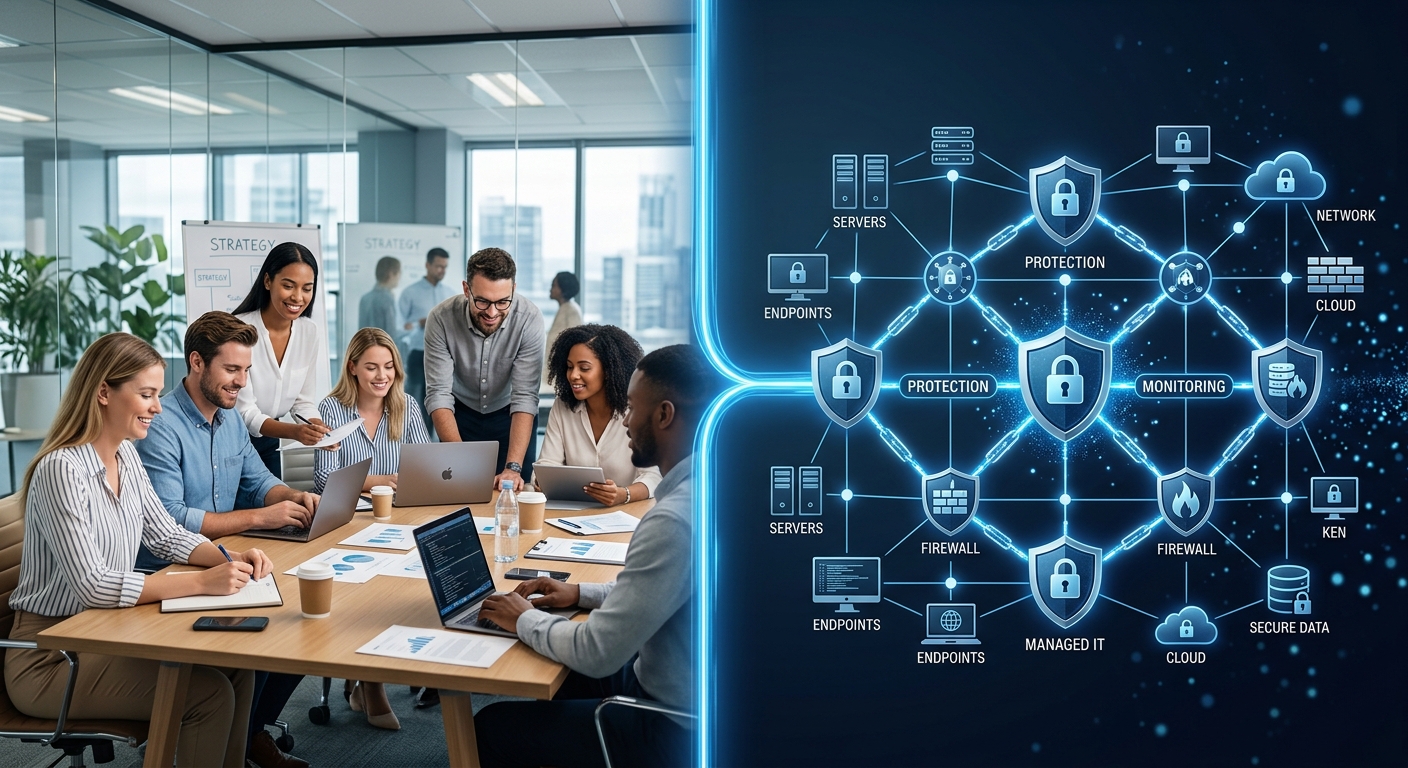
- Providers are turning to layered cybersecurity strategies that blend consulting, managed services, and continuous monitoring
- A practical use case shows how one healthcare group addressed vulnerabilities and improved resilience
The Challenge
Healthcare cybersecurity has always been complex, but something shifted over the past few years. Clinical systems became more interconnected, remote care expanded, and digital workflows took root everywhere from primary care to outpatient imaging. Today, most providers feel that technology now sits at the center of patient care. That is a good thing, mostly. Yet it also means an outage or data breach can stop care delivery for hours, sometimes days.
Ransomware operators know this. They target healthcare precisely because downtime carries such high stakes. During one incident earlier this year, a regional health group found its scheduling platform encrypted overnight. Patients were still showing up for morning visits, but staff could not access past visit notes or even verify insurance coverage. The issue was not just inconvenience. It was risk, both clinical and operational.
Here is the thing. Healthcare IT teams are trying to keep pace with growing digital complexity while juggling compliance, shrinking budgets, and staffing gaps. Cybersecurity ends up feeling reactive. And with attackers using more automated techniques each month, the margin for error is shrinking. It raises an uncomfortable question: how do you protect a system that can never go offline?
The Approach
Most providers start by stabilizing what they already have. They look at gaps in endpoint protection, network architecture, identity management, and outdated clinical systems that are notoriously difficult to patch. But solving the problem requires more than tools. It requires a security model that assumes breaches will happen and focuses on minimizing spread, speeding detection, and improving recovery.
A common starting point is a risk assessment, something many enterprise buyers revisit annually now. This gives a clearer picture of vulnerabilities across EHR platforms, connected medical devices, remote-work endpoints, and vendor-access channels. Some organizations try to handle this with internal teams, but mid-market groups often lean on outside partners. One example is engaging a firm such as Apex Technology Services for consulting and managed security support.
There is usually a discussion around zero trust, too. Not as a buzzword but as a practical blueprint. Limiting lateral movement inside the network, improving identity controls, and segmenting medical devices are typical early steps. They are not glamorous. They do reduce risk quickly.
Interestingly, some providers also revisit backup strategies because modern ransomware attackers hit backups first. Immutable storage is becoming a staple. A few even add tabletop exercises to test response procedures because theory rarely matches practice.
The Implementation
Consider a mid-sized healthcare provider with several clinics spread across two states. The organization had strong clinical leadership but a small IT team and faced recurring pressure from insurers and regulators to tighten security. After an assessment highlighted gaps in network segmentation and endpoint protection, the group committed to a phased improvement plan.
The first phase focused on identity and access management. Privileged accounts were audited and reduced. Multi-factor authentication was extended to clinical staff, which generated some initial pushback, although it settled down surprisingly fast once physicians realized it took only seconds to complete.
Next came network segmentation. Rather than overhaul everything at once, the IT team isolated the EHR environment and then grouped medical devices into a monitored zone. This required coordination with clinical engineering departments, which operate quite differently from IT. That collaboration took time. Yet it prevented devices with outdated firmware from communicating freely with sensitive systems.
Continuous monitoring tools were added to detect suspicious behavior across endpoints and servers. This gave the security team more visibility and faster alerts when anomalies appeared. A third-party security operations center supplemented overnight coverage. It was not perfect on day one. There were false positives and some learning curves. But within a few weeks, the alert quality improved significantly.
Backup modernization became the final step. Immutable backups were added alongside traditional storage, and a new recovery plan was drafted. The team ran a live recovery exercise to validate timing assumptions. They discovered the process took longer than planned, so they refined scripts and reduced the number of manual steps. This is where many organizations stumble. Practicing recovery is tedious, but it is the only way to know whether the plan works.
The Results
The healthcare provider saw meaningful improvements relatively quickly. Not dramatic headlines, but steady gains. Investigations that once took hours now took minutes because the monitoring system provided better context. The segmentation work limited potential attack pathways, which reduced the likelihood of widespread impact if malware entered the network. And staff grew more comfortable with identity controls than anyone expected.
One of the most telling moments came during a phishing simulation. In the past, a significant number of staff clicked malicious links. After training and monitoring improvements, the click rate dropped sharply. Not perfect, but a clear improvement. More importantly, suspicious emails were reported faster, giving the security team the chance to act early.
Operationally, downtime risk decreased. The leadership team felt more confident during vendor audits and compliance reviews. They did not declare victory, of course. Cybersecurity is never finished. But the shift from reactive firefighting to proactive risk management was noticeable.
Lessons Learned
A few insights stand out from this scenario.
- Start with visibility before anything else. You cannot protect what you cannot see, especially in healthcare where devices vary wildly in age and capability.
- Expect cultural resistance, particularly around identity controls. It fades with communication and consistency.
- Segmentation pays dividends, even when done incrementally. Progress matters more than perfection.
- Testing recovery procedures is just as important as improving prevention. Many organizations overlook this step.
- Partnering with external experts helps fill gaps, especially when internal teams are stretched thin.
And perhaps the most important lesson is this. Cybersecurity in healthcare is not simply an IT challenge. It is a patient safety imperative. Providers who recognize this earlier tend to adapt faster and with fewer surprises along the way.