 ⬇️
⬇️
Key Takeaways
- Eli Lilly is advancing a $3.7 billion project to construct a new pharmaceutical manufacturing site in the LEAP Innovation District in Lebanon, Indiana.
- The facility is expected to support growing demand for next‑generation therapies, active ingredients, and biologics.
- Large-scale pharma builds are influencing regional infrastructure, workforce development, and digital modernization in the Midwest.
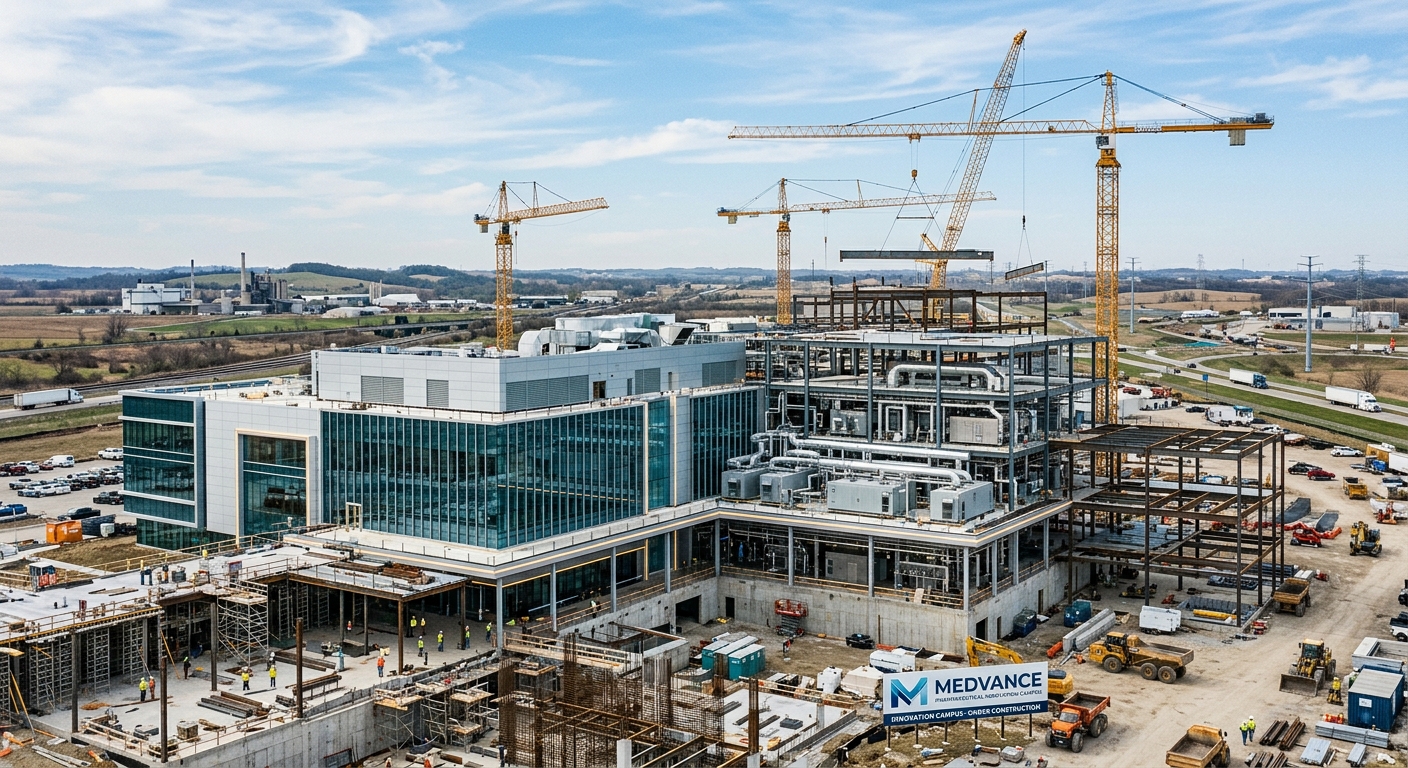
Eli Lilly’s decision to move forward with a massive $3.7 billion manufacturing expansion in the LEAP Innovation District in Lebanon, Indiana, didn’t exactly come out of nowhere. Demand for biologics has been climbing for years, and the company has been scaling its production footprint to match. Still, the size of the investment — one of the company’s largest active projects — puts it in a different category. It signals the way major pharmaceutical players are thinking about capacity, resilience, and the broader supply chain challenges that have become impossible to ignore.
Construction plans call for a state‑of‑the‑art site designed around advanced manufacturing principles. That includes automation, digital quality tools, and the kind of modular layout that supports newer classes of medicines. These decisions may sound like inside‑baseball topics, but they are shaping the next decade of drug production. And not just for Eli Lilly. The entire sector is watching how these builds come together.
What’s interesting is how much regional impact a single facility like this can have. The Central Indiana region has been working for years to attract more high‑tech and life‑sciences investment. A multibillion‑dollar project accelerates that trajectory, nudging local governments and workforce programs to adapt. It’s not uncommon for training pipelines to shift almost overnight when a company of this scale stakes a claim in a community.
There’s also a somewhat overlooked point about infrastructure. Large pharmaceutical sites don’t just need square footage; they need robust energy, water, logistics, and digital backbones. In some regions, cloud‑connected operational systems are gradually blending with traditional plant utilities, creating something closer to hybrid industrial campuses. That may not be the headline, but it ends up influencing every piece of development planning.
The Lebanon facility is expected to produce active pharmaceutical ingredients (API) and injectable medicines, an area where demand has been especially strong. Many of these therapies rely on complex biologic processes that require careful handling and precise environmental control. Why does this matter? Because building for biologics isn’t the same as building for small‑molecule drugs. The footprint is different. The talent mix is different. Even the lifecycle of equipment upgrades has a different cadence.
Some observers point to the speed at which pharmaceutical companies are breaking ground on new manufacturing campuses. Others wonder whether the industry is overbuilding. But in practice, the opposite seems to be happening: companies are moving to avoid the capacity bottlenecks that slowed down production during earlier global supply chain disruptions. Would anyone have expected that capacity planning would become board‑level strategy? Probably not a decade ago.
Here’s the thing — these projects also serve as testbeds for more digital-first manufacturing approaches. While the facility is still years from full operation, the underlying design typically integrates automation, process analytical technologies, and data platforms that tie into global quality systems. It’s not flashy, but it reduces downtime and improves traceability, both of which are becoming must‑haves rather than nice‑to‑haves.
On the workforce side, the ripple effects can be significant. Biomanufacturing requires engineers, technicians, data specialists, and operational staff who are comfortable with both laboratory and factory environments. Universities and technical colleges in the region may see new partnerships emerge as hiring ramps up. This isn’t automatic, of course, but these collaborations tend to form quickly when the demand is clear.
Another detail worth mentioning is the broader competition among states to attract major pharmaceutical infrastructure. Incentive packages, land availability, and proximity to transportation corridors all play a role. The Lebanon site sits within Indiana's "Crossroads of America" logistics network, which likely helped tip the scales. And for companies ramping up distribution models that rely on speed, that proximity matters.
The project also arrives at a time when many pharmaceutical firms are reassessing their geographic footprint. Distributed manufacturing — smaller, more flexible plants closer to patient populations — gets a lot of attention. Yet the pendulum hasn’t fully swung away from mega‑facilities like this one. When demand forecasts justify it, large-scale builds remain viable. The industry is essentially running both models at once.
That said, timelines for these facilities tend to stretch into years. Regulatory validation, equipment commissioning, and technology integration each introduce their own complexities. It’s one thing to pour concrete; it’s another to bring a biologics line fully online. But the long-term payoff can be substantial, especially if the facility is built with future therapeutic modalities in mind.
As the Lebanon project moves through early stages, its role in the region’s economic and technological landscape will become more visible. Whether the facility eventually becomes a flagship for next‑generation manufacturing remains to be seen, but the groundwork suggests that’s the direction of travel. And for an industry still navigating demand fluctuations and supply chain pressures, new capacity isn’t just welcome — it’s increasingly essential.