 ⬇️
⬇️
Key Takeaways
- Helsing SE is scaling secretive drone manufacturing in Germany to meet rising demand shaped by the Russia-Ukraine War.
- Ukraine’s distributed drone industry has pushed European defense suppliers toward faster, lower-cost unmanned systems.
- Shifts in Pentagon and E.U. budgets signal a long-term pivot toward privately developed, A.I.-driven arsenals.
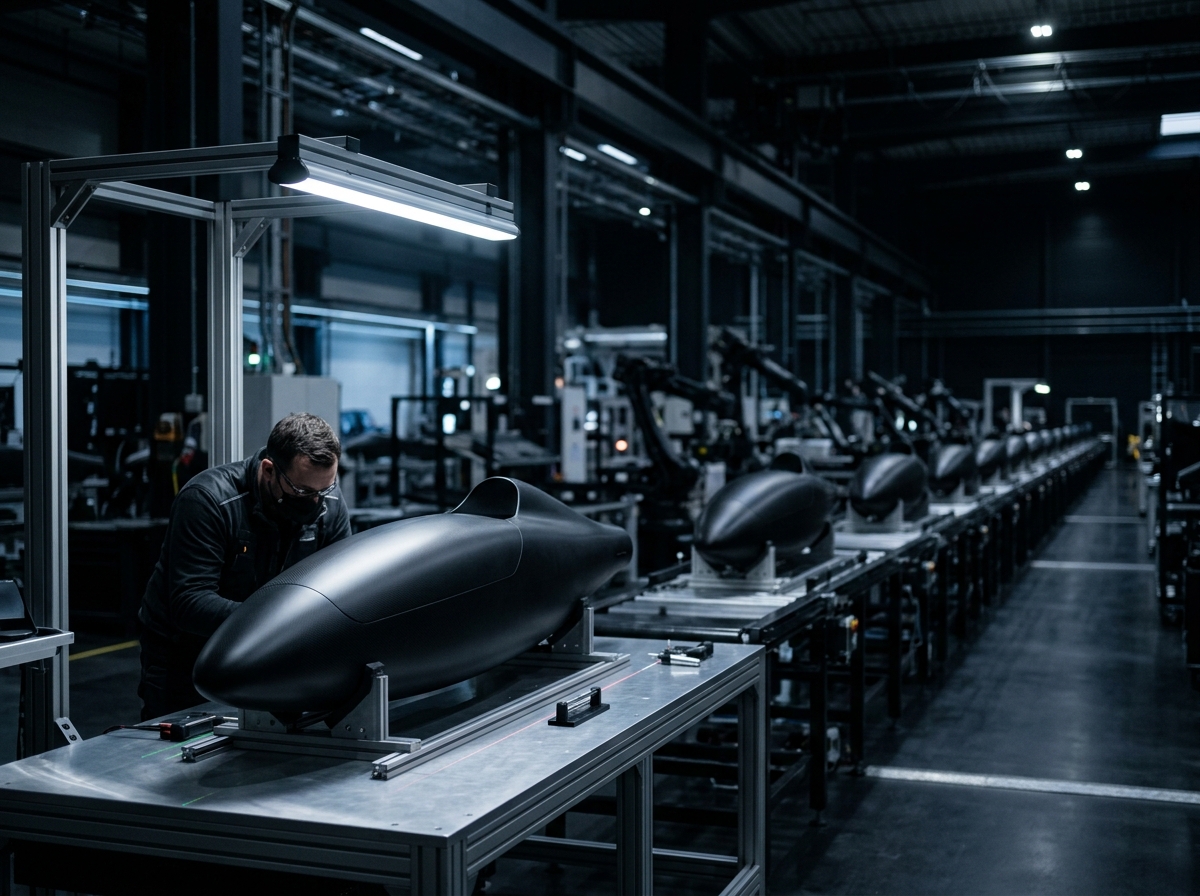
The factory sits in southern Germany, hidden behind layers of industrial anonymity. Inside, Helsing SE's team hands over a 26-pound black foam attack drone that highlights a broader transformation in defense economics and military procurement.
These production sites tend to attract little attention, yet they are part of a rapidly changing landscape driven by Ukraine's wartime drone boom. Ukrainian forces now operate in an environment where dispersed workshops and secret manufacturing lines produce everything from $400 kamikaze drones to long-range platforms capable of flying roughly 2,000 miles. That context shaped the incentives European companies, including Helsing SE, now face daily.
Helsing SE has become Europe's most valuable artificial-intelligence defense start-up, reflecting a procurement cycle that looks noticeably different from even five years ago. Traditional suppliers like Lockheed Martin and Northrop Grumman continue to build high-end platforms that take years to deliver, but those timelines often conflict with the tempo of drone-centric warfare. A modern F-35 jet costs over $100 million, while the unmanned aircraft coming off Helsing SE's lines are manufactured at a fraction of that price and pace.
The shift did not start in Europe. Ukraine's defense industry now supplies over half of the weapons used on its own front lines, and local companies such as Buntar Aerospace and General Cherry have normalized mass production under battlefield pressure. According to military analysts, Ukrainian units launch an estimated 200 to 300 drones per night at Russian targets. This staggering pace illustrates why high-volume, low-cost platforms influence strategy at both national and industry levels.
The Pentagon has requested a budget of $1.5 trillion for next year, with roughly $55 billion earmarked for building a new unmanned, A.I.-powered arsenal. The E.U., moving on a more modest scale, is piloting a €115 million program to fund A.I. defense companies and accelerate the development of similar systems. Venture capital interest in defense has grown faster than in most security-adjacent markets, a point highlighted across recent reporting from outlets like Reuters and Bloomberg.
Inside Helsing SE's factory, drones are packed into specialized transport cases and prepared for deployment moments after assembly. That rapid output echoes the distributed Ukrainian model, where around 250 domestic manufacturers now operate across the country. Some produce reconnaissance craft, while others focus on land-based UGVs that Ukrainian planners reportedly hope will reach 20,000 units this year. These companies share a core logic: they build small, inexpensive systems in high quantities, utilizing intentionally fragmented facilities to avoid becoming targets.
Reports from the MIT Technology Review have noted that privately funded defense A.I. companies tend to innovate faster than traditional contractors because they do not depend on multi-year procurement cycles. Meanwhile, European defense think tanks point out that NATO standards like the STANAG series and ISO 21384-3 provide the backbone that keeps these diverse systems interoperable on the battlefield, though speed remains the primary driver of development.
Nations are redesigning their arsenals around attrition-tolerant systems and flexible supply chains. The drone the Helsing SE manager displayed looks simple, but it is the direct product of that logic. It can be built and replaced quickly, and its autonomy relies on software that can be updated far faster than any physical airframe.
Strategists debate whether this shift will reduce reliance on the legacy defense industrial base or simply create another layer on top of it. Many argue that both tracks will continue in parallel, as heavy platforms still have roles in deterrence and strategic missions. Yet conflicts shaped by constant drone use prioritize reliability, lower costs, and rapid retooling over the specifications of any single legacy aircraft.
Helsing SE addresses these dual priorities by developing autonomous drones and jets designed to integrate with larger, traditional systems while still meeting the low-cost, fast-delivery benchmarks of modern combat. The company's ascent indicates where European defense sectors anticipate future conflicts might be fought and how quickly their industrial bases are adjusting.
The factory in southern Germany is one node in a growing network that symbolizes a broader shift in defense technology. Emerging systems are lighter, more fragmented, software-defined, and driven by private innovators working on accelerated timelines. The result is a market operating fundamentally differently from the procurement models that dominated previous decades, with Helsing SE exemplifying the new direction.