 ⬇️
Key Takeaways
- Goldman Sachs Group Inc. appeared in three major AI financing transactions announced Monday morning, part of a reported $210 billion in transactions.
- Capital is increasingly flowing toward data centers, accelerated servers, power capacity, and other physical infrastructure rather than software alone.
- The financing boom creates opportunities for Microsoft, Meta, Nvidia, and their partners, but also raises utilization, energy, supply, and debt risks.
Three large artificial intelligence financing transactions announced Monday morning shared a central participant: Goldman Sachs Group Inc. Together, the activity adds to a reported $210 billion in transactions and highlights how quickly AI has become a capital-markets story, not simply a software investment cycle.
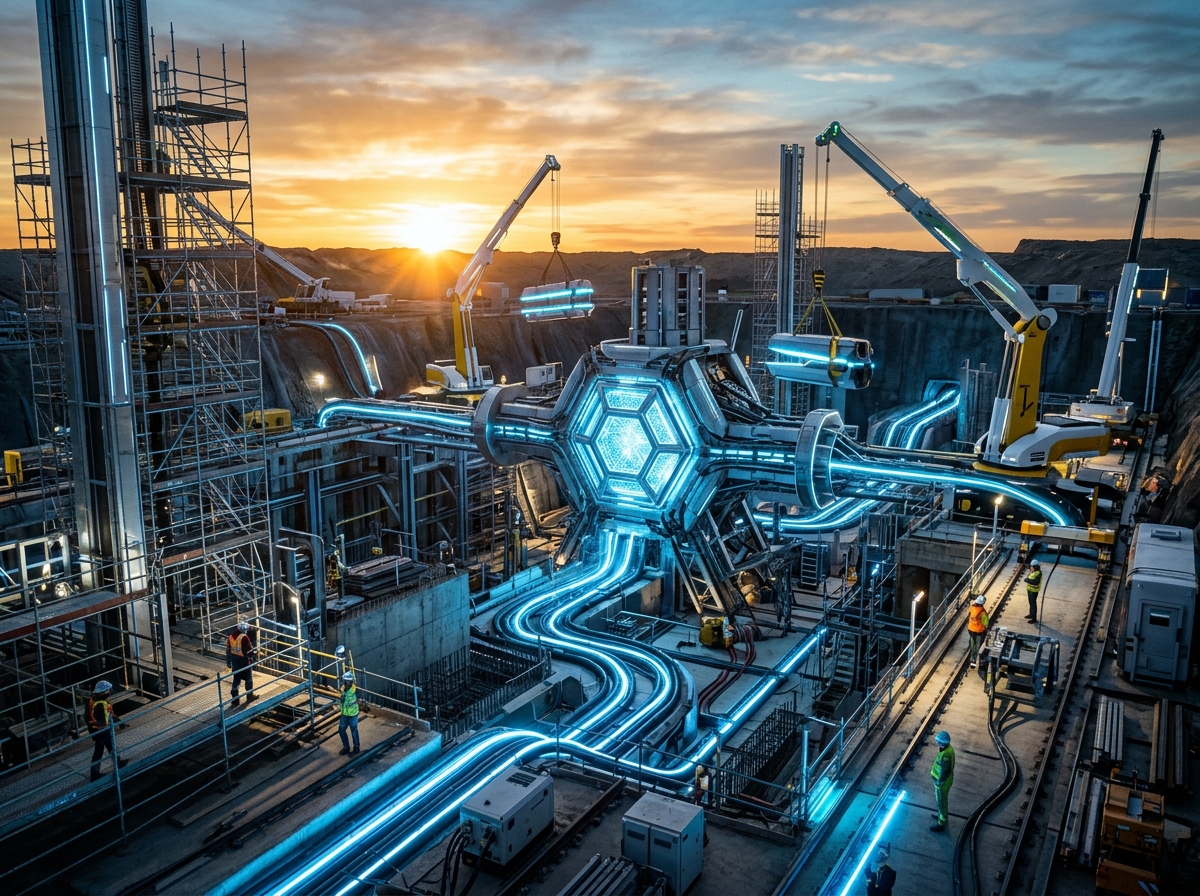
The significance lies partly in the type of assets now attracting money. Early enthusiasm around generative AI centered on models, applications, and venture-backed startups. Those areas continue to draw investment, but the largest capital requirements increasingly sit underneath them: data centers, servers, networking equipment, energy systems, and the accelerated computing hardware used to train and operate AI models.
That shift changes the financing equation. Software companies can often expand without building vast portfolios of physical assets. AI infrastructure is different. Data-center campuses can require substantial upfront investment, lengthy construction schedules, access to electricity, cooling equipment, specialized chips, and long-term customer commitments. The investment bank's involvement across three mega deals indicates that these projects are becoming important business for institutions able to arrange complex pools of capital.
The spending data helps explain the scale. IDC reported that AI infrastructure spending reached $82 billion in Q2 2025, an increase of 166% year over year. Cloud and shared environments represented 84.1% of that spending, while servers accounted for 98%. Spending on accelerated servers rose 207.3%.
This shift largely reflects a hardware and capacity buildout. IDC also projected global AI infrastructure spending could reach $758 billion by 2029. The U.S. represented 76% of Q2 2025 spending, reinforcing its position as the primary center of near-term construction and financing activity.
While AI demand remains strong, individual projects still carry substantial financial risk. A facility built around current hardware assumptions could face changes in chip performance, model efficiency, customer demand, or electricity pricing before its financing reaches maturity. If computing efficiency improves faster than expected, some planned capacity could become less valuable.
Goldman Sachs Group Inc. and other capital providers therefore have to assess more than the credit quality of a well-known technology customer. Financing structures may also depend on construction progress, power availability, equipment delivery, lease commitments, utilization expectations, and the residual value of specialized infrastructure. A transaction carrying the name of Microsoft, Meta, or Nvidia can still have project-level risks that differ from the balance-sheet strength of those companies.
The broader spending environment remains supportive. Gartner forecast global data-center systems spending of $405.5 billion in 2025, up 23.2% year over year, reflecting demand associated with AI workloads. Microsoft and Meta are major buyers of computing capacity, while Nvidia supplies much of the accelerated-computing layer that makes new facilities strategically valuable.
Private investment provides another piece of the picture. Stanford HAI's AI Index 2025 reported that private generative-AI investment reached $33.9 billion in 2024, up 18.7% from 2023 and more than eight times the 2022 level. That money can support model developers and application companies, but those businesses ultimately rely on infrastructure financed elsewhere in the ecosystem.
Execution introduces additional complexities. Deloitte has highlighted hidden risks emerging from the expansion of AI-related physical assets. Power constraints, chip supply, construction delays, uncertain utilization, and debt-service obligations can interact in ways that are difficult to model. Even a modest delay can affect revenue timing and financing costs.
For enterprise technology leaders, the transactions offer a useful signal. AI capacity is being treated as long-lived strategic infrastructure, and financing institutions are helping convert future demand expectations into facilities being built today. The reported $210 billion in activity shows the size of that opportunity. It also raises a sharper question: how much of today's capital can produce durable, well-utilized capacity rather than expensive infrastructure waiting for workloads to arrive?