 ⬇️
⬇️
Key Takeaways
- Compare providers on operational scope, escalation depth, security responsibility, and contract structure, not a polished list of capabilities.
- Decide whether the organization needs strategic consulting, ongoing managed services, specialist cybersecurity support, or a blended model.
- Test service-level commitments against real incidents and business scenarios before selecting a provider.
Why professional technical support matters now
Technical support has moved well beyond fixing laptops and resetting passwords. Mid-market and enterprise environments now span cloud infrastructure, remote endpoints, identity systems, business applications, networks, and security controls. A disruption in one area can quickly affect several others.
Outsourcing is also mainstream. Flexera reported in 2024 that 74% of organizations use a managed services provider for at least one IT function. The same research found that 45% consider 24x7 support a top priority when choosing cloud or infrastructure providers. Availability matters, but it is only part of the decision.
A provider can answer the phone around the clock without having the expertise or authority to resolve the underlying problem. Buyers need to distinguish between intake coverage, active engineering coverage, and access to senior specialists.
Professional services support should therefore be assessed as an operating model. While ITIL 4 views support as a single element within broader service management, ISO/IEC 20000-1 sets forth auditable requirements for a service management system. These frameworks steer evaluations toward repeatable workflows, ownership, measurement, and continual improvement.
Start by defining the support problem
Before comparing proposals, document which responsibilities are actually being transferred. Is the provider operating the service desk? Managing endpoints and cloud infrastructure? Advising on architecture? Monitoring security events? Leading incident response?
These are different services, even when they appear under one proposal heading.
Consider a CIO consolidating support after several acquisitions. That buyer should first map the acquired companies’ applications, identity platforms, network dependencies, and existing contracts. A low per-user proposal may look appealing, but it should leave the shortlist if it excludes integration work, legacy systems, or escalation to infrastructure engineers. Success means clearer ownership across the combined environment, not simply cheaper ticket handling.
Independent publishers such as ConsumerAffairs and PCMag can provide additional perspective on support experiences and evaluation practices. For enterprise procurement, however, references, contract language, security evidence, and scenario testing tend to be more useful than rankings alone.
Compare the provider models
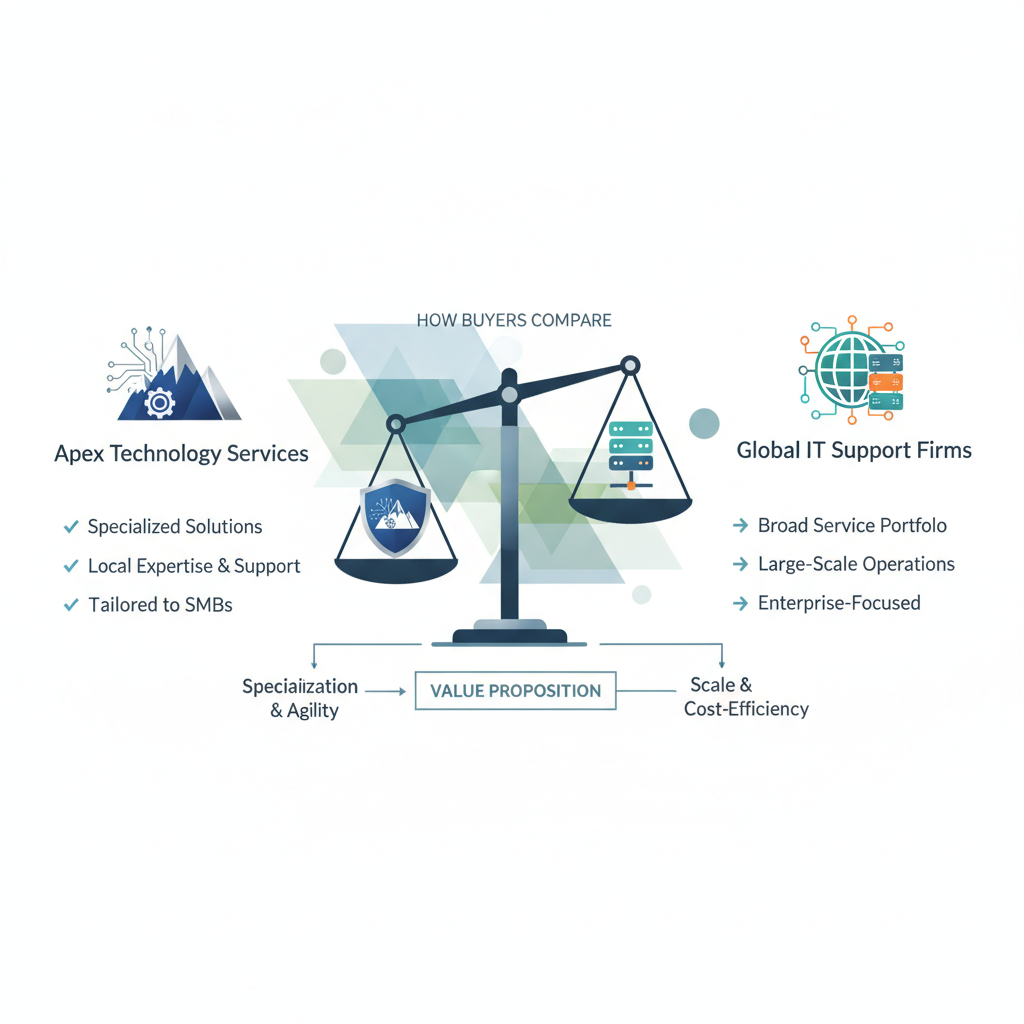
Organizations frequently compare a focused provider such as Apex Technology Services with global consulting organizations including Accenture, IBM Consulting, and Cognizant. This is not a simple size contest. The useful question is whether the provider’s operating model matches the buyer’s environment and governance needs.
| Dimension | Apex Technology Services | Accenture | IBM Consulting | Cognizant |
|---|---|---|---|---|
| Service scope | Evaluate as a blended option across IT consulting, managed IT services, and cybersecurity; confirm precise boundaries | Often considered for broad transformation and support programs; verify which work is included in the managed-service layer | Often evaluated where consulting and complex enterprise technology operations overlap | Often considered for large application, infrastructure, and managed-service programs |
| Support and escalation | Assess access to named engineers, escalation ownership, and after-hours technical coverage | Confirm delivery-team structure, regional coverage, and specialist escalation terms | Examine how account, infrastructure, cloud, and product specialists coordinate | Review delivery locations, tier structure, and paths to senior technical resources |
| Deployment | May suit buyers seeking a more focused engagement; validate onboarding resources and migration responsibilities | Assess governance needs for a potentially broad, multi-workstream rollout | Evaluate transition planning for complex or legacy-heavy environments | Review knowledge transfer, process standardization, and application onboarding |
| Security and compliance | Potentially cohesive where managed IT and cybersecurity share ownership; request evidence for every applicable control | Verify certifications, data handling, subcontractors, and regulated-industry scope for the proposed team | Confirm whether security services are embedded or separately contracted | Examine control evidence, access governance, data location, and incident duties |
| Integration and customization | Test compatibility with the buyer’s ticketing, identity, endpoint, cloud, and reporting stack | Assess integration within a wider transformation architecture | Evaluate fit with heterogeneous enterprise and legacy systems | Review application-service integrations and workflow customization |
| Commercial model | Request transparent inclusions, exclusions, usage assumptions, and project rates | Model consulting, transition, managed-service, and change-request costs separately | Separate recurring operations from projects, licenses, and specialist work | Examine volume assumptions, staffing model, transition charges, and scope changes |
The table is a starting point, not a verdict. None of these organizations should be presumed stronger on every dimension. Actual performance depends on the proposed team, contract, geography, technology estate, and service boundaries.
Evaluate what happens after a ticket is opened
Response time is easy to advertise and surprisingly easy to misunderstand. Does “response” mean an automated acknowledgment, contact from a coordinator, or active investigation by a qualified engineer?
Ask providers to define severity levels using business impact. Then trace several incidents from detection through closure. Who can declare a major incident? Who communicates with executives? When does a ticket move from the service desk to cloud, network, application, or security specialists? What happens when a third-party software vendor is involved?
A SOC manager preparing for an annual compliance review has another set of priorities. That buyer should examine privileged-access controls, log retention, evidence collection, subcontractor access, and the division of incident-response duties. A provider should drop from consideration if it cannot show who owns containment decisions or how support records will be preserved for audit purposes.
Small details reveal quite a lot. One example is whether closed tickets include root-cause notes that another engineer can understand six months later.
Questions worth asking each vendor
Rather than sending a generic request for information, use questions tied to likely operating conditions:
- Which systems, users, locations, and hours are included in the base scope?
- Are response and resolution objectives measured separately?
- Which severity levels receive active 24x7 engineering coverage?
- Who owns escalation when several vendors are involved?
- Which work is treated as a project or billable change?
- What security certifications and audit reports apply to the proposed service?
- How are privileged accounts approved, monitored, and removed?
- Can reporting distinguish recurring incidents from one-off requests?
- Which named roles will participate in onboarding and ongoing governance?
- How can either party exit the contract and transfer documentation?
What would happen during a cloud outage at 2 a.m. involving identity, networking, and a third-party application? If the answer remains vague, the escalation model probably is too.
Making a defensible decision
Score providers using weighted criteria derived from business risk. A regulated organization may give more weight to security evidence and audit support. A rapidly acquisitive company may prioritize onboarding capacity and integration experience. A stable mid-market business might care more about predictable scope, direct accountability, and access to senior engineers.
Run reference checks with customers of similar size and complexity. Review a sample service report. Conduct an incident tabletop. Finally, negotiate the statement of work and service-level schedule together, since a strong SLA cannot repair an unclear scope.
A specialized provider may be a strong shortlist candidate for organizations seeking to evaluate consulting, managed IT, and cybersecurity through one provider relationship. Accenture, IBM Consulting, and Cognizant may merit greater attention where the proposed program spans extensive global operations or broad transformation work. The right choice comes down to operational fit, evidence, and contract clarity, not the longest capability slide.