 ⬇️
⬇️
Key Takeaways
- Design at least two independent communications paths, such as terrestrial fiber plus LTE or 5G, rather than relying on two circuits that share one carrier or conduit.
- Test 911 outage workflows against the FCC’s 30-minute notification requirement, including escalation contacts, status updates, and manual dispatch procedures.
- Evaluate Cloud PBX, unified communications, and contact center platforms at the session border controller, SIP, E911, identity, and carrier-failover layers.
Problem to Solve: Keeping Municipal Services Reachable
A fiber cut near a municipal building can affect more than desk phones. If voice, contact center queues, dispatch administration, and remote access all use the same circuit, one damaged conduit may isolate several public services at once.
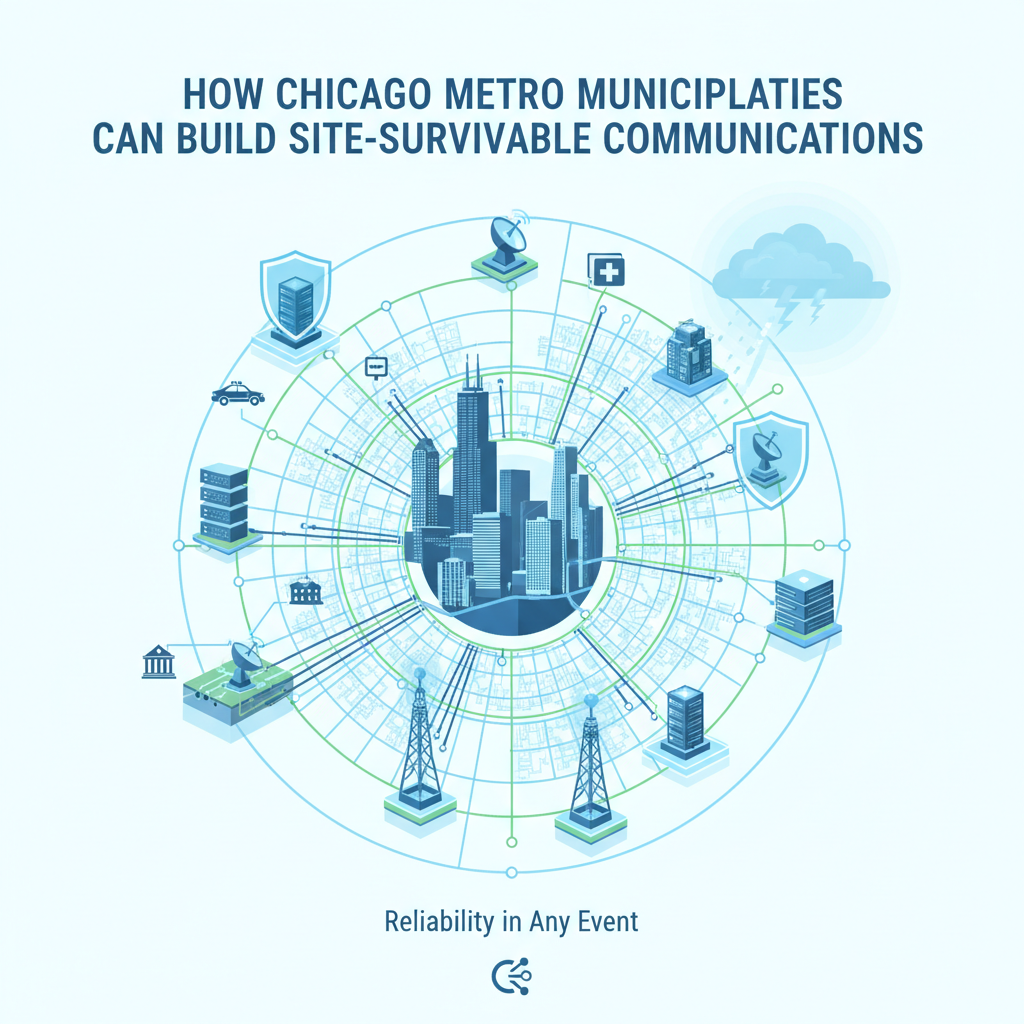
Chicago Metro municipalities face an unusually broad continuity problem. A city or village may operate a primary administrative building, police and fire facilities, public works garages, water sites, libraries, and seasonal locations. Some buildings have fiber; others depend on coaxial cable, fixed wireless, or cellular service. Older analog lines may still support elevators, alarms, fax devices, or emergency call boxes.
Power is only part of the equation. A generator can keep switches running, but it cannot restore a failed carrier route, an inaccessible cloud identity provider, an expired DNS record, or a damaged SIP trunk. Buyers therefore need to map each service from the handset or contact center agent through Power over Ethernet (PoE) switches, local firewalls, session border controllers, WAN circuits, cloud platforms, and the public switched telephone network.
The regulatory clock matters too. Under FCC rules adopted in 2023, covered communications providers generally need to notify affected 911 facilities within 30 minutes of discovering an outage and provide updates until restoration. Municipal plans should identify who receives those notices, who validates local impact, and how dispatch or public-information teams shift to alternate channels.
Evaluating a Survivable Architecture
A useful evaluation begins with failure domains, not product demonstrations. Buyers can ask vendors to diagram what happens when the primary building loses power, the main fiber route fails, the Cloud PBX region becomes unavailable, or Microsoft Entra ID cannot authenticate users.
Physical diversity should be verified in writing. AT&T fiber and Comcast Business cable may provide carrier diversity, but buyers should still determine whether both services enter through the same building wall, local conduit, or upstream facility. A cellular router using LTE or 5G can add another path, provided antennas, data plans, signal strength, and battery runtime are tested.
Cloud voice options such as RingCentral, Zoom Phone, and 8x8 can move call control away from a vulnerable municipal site. That does not eliminate local dependencies. Phones still require LAN connectivity, DNS, DHCP, PoE, internet access, and an E911 configuration that associates users with dispatchable locations.
Providers such as 101VOICE can be assessed on how their Cloud PBX, unified communications, and contact center designs handle SIP failover, emergency-location records, alternate numbers, mobile clients, and carrier diversity. Buyers should request architecture diagrams and live failover demonstrations rather than accepting general claims of redundancy.
The Alliance for Telecommunications Industry Solutions publishes FCC CSRIC materials addressing 911 reliability and resiliency during the transition to NG911. Those recommendations can help procurement teams examine network monitoring, diverse routing, backup power, and incident coordination with public safety answering points.
Planning the Rollout in Operational Phases
During discovery, the project team should inventory direct inward dial numbers, hunt groups, auto attendants, contact center queues, analog devices, E911 locations, and carrier contracts. Typical participants include municipal IT, police and fire communications, facilities, public works, procurement, legal counsel, and the organization responsible for the local PSAP.
The design phase should produce a call-flow matrix for normal and degraded operations. For example, if City Hall becomes unreachable, the main public number might route to a cloud contact center queue, designated mobile clients, or an alternate facility. If internet service fails at a police administration building, an SD-WAN appliance could shift SIP and HTTPS traffic to cellular service while preserving quality-of-service markings.
During migration, number porting deserves special attention. Buyers should validate port dates, temporary forwarding, caller ID, toll-free numbers, text-enabled numbers, and rollback procedures. Analog telephone adapters may temporarily support fax or door-entry systems, although replacing those devices with IP-based alternatives often produces a cleaner long-term design.
Before launch, the selected provider, such as 101VOICE, should be asked to demonstrate how its proposed configuration behaves when the primary circuit, local firewall, or hosted call-control component is deliberately made unavailable. The test should include inbound calls, outbound calls, voicemail, contact center routing, mobile clients, and E911 records.
Pulling a cable is not a complete continuity test. A comprehensive exercise also simulates inaccessible buildings, unavailable administrators, and overloaded public-information queues.
Measures That Reveal Whether the Design Works
Buyers should define observable acceptance criteria before signing off. Useful measures include automatic failover time, the percentage of critical numbers reachable through an alternate path, backup-power runtime, successful E911 location validation, and the time required to publish a recorded emergency message.
Incident reporting also needs timestamps. FCC rules call for an Initial Communications Outage Report within 72 hours and a Final Report within 30 days for qualifying events. Even when those carrier obligations do not apply directly to a municipality, comparable internal records can reveal recurring circuit, equipment, and escalation problems.
NASCIO continuity resources can also inform public-sector governance, particularly where municipal systems exchange data with county or state services. A dashboard might track SIP registration status, packet loss, jitter, LTE signal strength, UPS runtime, and contact center queue availability through SNMP, syslog, and platform APIs.
Strategic Takeaways From the Scenario
Procurement teams must recognize that two invoices do not prove path diversity. Organizations should require carriers to document entrance facilities, last-mile media, and known shared dependencies to ensure true redundancy.
Identity management also introduces operational risk. If every mobile and desktop client depends on a single sign-on service, an identity outage can neutralize an otherwise redundant Cloud PBX. Emergency administrator accounts, protected by hardware security keys and tested under controlled conditions, can preserve access during an incident.
Manual fallback plans require specific documentation. A printed call tree, battery-powered radios, alternate public numbers, and documented PSAP contacts remain necessary when cloud dashboards or municipal email systems become unavailable.
Broader Applicability
Counties, school districts, park districts, and regional utilities can adapt this model by mapping essential call flows and separating carrier, facility, power, identity, and cloud failure domains. Smaller teams can begin with critical sites and public-facing numbers before extending testing to every department.
How long does a municipal Cloud PBX rollout take?
Timing depends heavily on number porting, procurement, E911 validation, and analog-device replacement. Buyers should organize work into discovery, design, pilot, migration, and continuity-testing phases, with additional time for carrier coordination and public-safety review.
What should municipalities test during a voice failover exercise?
Test inbound and outbound calls, 911 location presentation, auto attendants, contact center queues, voicemail, mobile clients, and alternate carrier routing. Record failover time, packet loss, jitter, and whether staff can execute the manual call tree when email and the primary building are unavailable.
Is cellular backup enough for municipal site survivability?
Cellular backup can protect against a terrestrial last-mile failure, but it does not address every dependency. Buyers should also examine antenna placement, battery runtime, data-plan limits, carrier congestion, SIP compatibility, identity access, and whether the cellular path shares upstream infrastructure with the primary service.