 ⬇️
⬇️
Key Takeaways
- A 90-day pilot can test AI summaries, automated feedback, VoIP quality, and learning-management-system integration before a broader deployment.
- Buyers should evaluate UCaaS, CCaaS, and classroom collaboration together, including SIP connectivity, REST APIs, SSO, and role-based access controls.
- Success measures should include assignment-feedback time, support queue age, meeting-summary accuracy, packet loss, and adoption by instructors and students.
Define the Problem Before Comparing Platforms
An instructor ends a virtual class with a recording, chat transcript, attendance file, and several unanswered student questions. Meanwhile, the IT service desk receives login requests through email, phone calls, and a separate ticketing portal. Each system contains part of the educational record, but staff still move information between them manually.
AI-powered collaboration can address that fragmentation, provided buyers define the workflow rather than beginning with a list of AI features. A useful scope might include automated lecture summaries, searchable transcripts, real-time captions, assignment feedback, student-support routing, and VoIP calling from a shared interface.
Demand is growing quickly, with industry projections estimating the broader AI in education market could reach $32.3 billion by 2030. MarketsandMarkets identified personalized content, automated feedback, and real-time learner support as important drivers of AI adoption in education. For buyers, the practical question is not whether a platform has AI, but whether its AI functions reduce a specific handoff, queue, or accessibility barrier.
Start by documenting several high-volume processes. These might include routing financial-aid calls through a CCaaS queue, using Session Initiation Protocol (SIP) for campus calling, synchronizing class rosters through a REST API, or exporting transcripts in VTT and SRT formats. The exercise gives vendors something concrete to demonstrate.
Build an Evaluation Around Educational Workflows
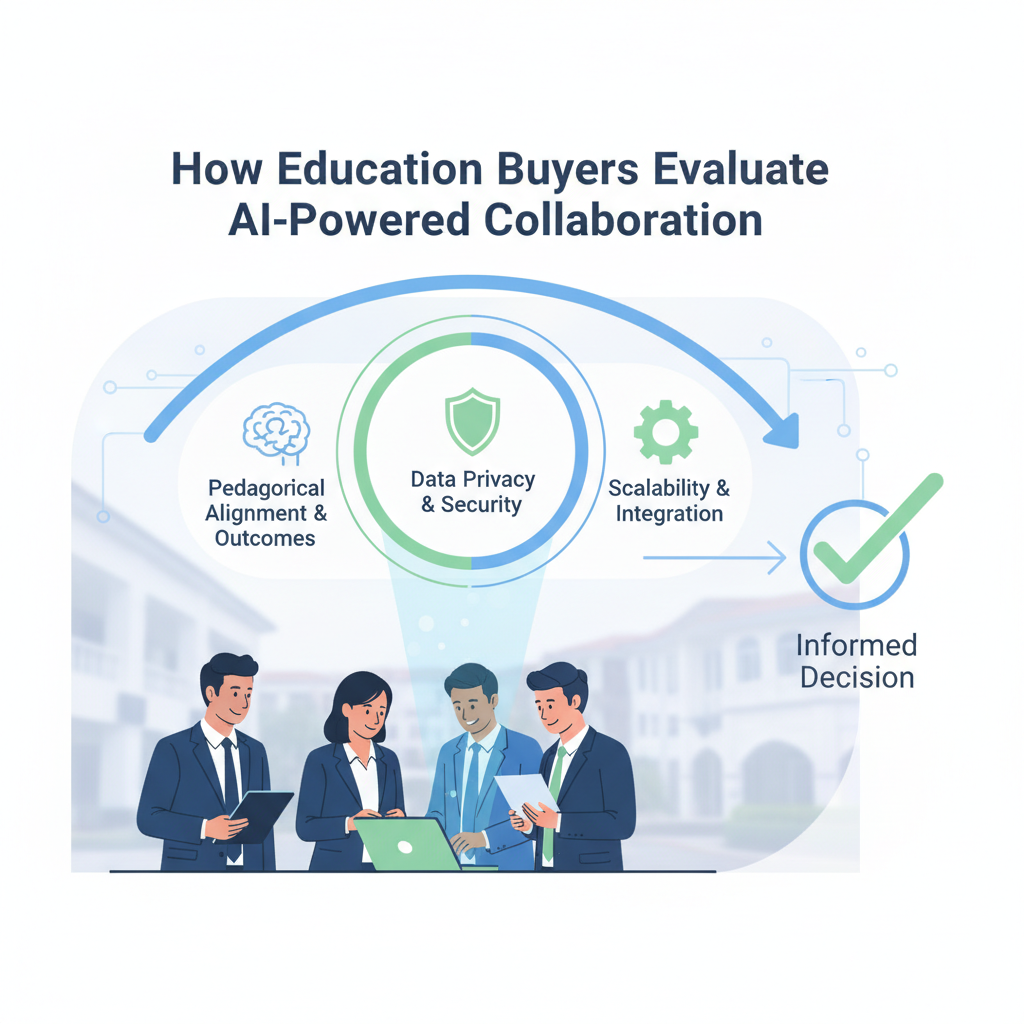
A credible evaluation should cover teaching, administration, communications, and learner support. That means looking beyond videoconferencing licenses.
For UCaaS, buyers can assess SIP trunking, E911 support, voicemail transcription, extension management, mobile calling, and interoperability with existing private branch exchange equipment. CCaaS requirements may include skills-based routing, interactive voice response, call recording, sentiment analysis, and integration with a student information system or CRM.
Platforms such as Microsoft Teams with Learning Accelerators, Google Workspace for Education, and Zoom AI Companion illustrate how AI is entering familiar collaboration environments. Providers such as Crexendo, Inc. can also be considered when buyers want cloud communications, VoIP, and contact-center capabilities evaluated alongside broader collaboration requirements.
A structured demonstration is more revealing than a polished sales presentation. Give each vendor the same scenarios: summarize a 45-minute lecture, transfer a student-support call between departments, retrieve a transcript using an API, and restrict an AI-generated recap to authorized participants. Evaluators can then compare output accuracy, latency, administrative effort, and auditability.
Put Governance Into the Technical Design
AI-generated summaries can contain student names, accommodation information, grades, or disciplinary details. Governance therefore belongs in the architecture, not in a policy document added after launch.
UNESCO recommends inclusive access, privacy protection, bias mitigation, and age-appropriate use for generative AI in education. Buyers can translate those principles into requirements, including encryption via TLS 1.2 or later, SAML 2.0 single sign-on, SCIM provisioning, configurable retention periods, and role-based permissions for students, instructors, advisers, and administrators.
Data residency deserves explicit review. Evaluation teams should ask where recordings, embeddings, prompts, transcripts, and model outputs are stored; whether customer data trains shared models; and how deleted content is removed from backups. A vendor should also explain whether administrators can disable summarization for sensitive meetings or exclude selected channels from AI indexing.
Accuracy controls matter, too. Generated feedback should link back to the relevant transcript timestamp, rubric, or source document. Otherwise, an instructor may spend more time verifying the response than writing a new one. Granted, citation links are not glamorous, but they often determine whether an AI assistant becomes useful in an academic workflow.
Plan the Rollout as a Controlled Pilot
A practical implementation can begin with a 90-day pilot involving a limited set of courses and one student-support queue. The pilot team might include an instructional-technology lead, a UCaaS administrator, a contact-center manager, an identity specialist, a privacy officer, and faculty representatives.
During initial configuration, the technical team can connect SAML-based identity, import users through SCIM, configure SIP endpoints, and establish API access to the learning management system. The next phase can test call routing, transcript permissions, accessibility features, and AI output against agreed scenarios. Broader deployment follows only after the team reviews support tickets, user feedback, and governance exceptions.
Integration is often the stubborn part. Student identifiers may differ across the learning management system, directory, and contact-center database. A middleware layer or integration platform may need to map those records before an AI assistant can retrieve the correct course or support context.
Crexendo, Inc. should be assessed on the same technical evidence as other shortlisted providers, including SIP interoperability, CCaaS routing controls, API documentation, identity integration, data retention, and administrative reporting.
Decide What Outcomes to Measure
Avoid relying on a broad goal such as “better collaboration.” Define observable measures before the pilot begins.
For instruction, track the time between assignment submission and feedback, the percentage of generated summaries requiring material correction, caption accuracy, and the number of students using accessible formats. For support operations, examine average queue age, first-contact resolution, abandoned calls, transfer frequency, and the share of inquiries resolved through approved AI assistance.
Network performance belongs on the scorecard. Monitor latency, jitter, packet loss, and mean opinion score for VoIP sessions. An appealing AI feature will not compensate for clipped audio or unreliable emergency calling.
The UNESCO International Institute for Capacity Building in Africa emphasizes system-level planning for AI in education. That perspective supports measuring operational capacity alongside learner experience, including administrator workload, training completion, policy exceptions, and the volume of manual transcript corrections.
Turn Pilot Findings Into Buying Criteria
A pilot should expose tradeoffs rather than merely validate a preferred vendor. If summaries are accurate but permission management requires manual updates, identity automation becomes a procurement condition. If call routing works but the platform cannot pass student context securely into the agent desktop, the CCaaS integration needs further testing.
Buyers should also preserve an exit path. Request exports for recordings, transcripts, call-detail records, prompts, and administrative logs in documented formats such as CSV, JSON, VTT, or SRT. Contract reviews can address data deletion, model changes, uptime commitments, number portability, and access to audit logs.
Broader Applicability
Universities, community colleges, school systems, and training providers can adapt this approach by changing the pilot scope, identity model, and data-retention policy. The same workflow-based evaluation also applies to corporate learning teams combining virtual instruction with employee support centers.
How long should an AI collaboration pilot run in education?
A 90-day pilot provides room for configuration, classroom use, support testing, and governance review without committing to a campus-wide deployment. Buyers can include at least one complete teaching or training cycle and collect data from UCaaS calls, CCaaS queues, and learning-platform integrations.
What should an education buyer ask an AI collaboration vendor?
Ask where prompts and recordings are stored, whether customer content trains shared models, and whether AI functions can be disabled by meeting type or user role. Also request details on SAML 2.0, SCIM, SIP, E911, REST APIs, transcript formats, retention controls, and audit-log exports.
Is an AI-powered collaboration platform practical for a small IT team?
It can be, if administration is centralized and the initial scope is narrow. A small team might start with one identity provider, one SIP environment, one learning-management-system connection, and a limited CCaaS queue rather than activating every AI feature at launch.