 ⬇️
⬇️
Key Takeaways
- Start with one bounded workflow, such as FNOL ingestion through ACORD APIs, rather than moving policy, billing, and claims systems at once.
- Evaluate AWS, Microsoft Azure, Google Cloud, and insurance SaaS platforms against recovery objectives, data residency, encryption, and integration requirements.
- Measure observable changes, including same-day claims-data availability, deployment frequency, batch completion time, and the number of manual reconciliation queues.
Define the Insurance Problem Before Selecting a Cloud
A claims adjuster should not have to wait for an overnight batch before viewing photographs uploaded through a customer portal. Yet that delay remains common when a web application, document repository, and claims platform exchange data through scheduled files rather than APIs.
Cloud computing can address that bottleneck, but only when the buyer defines the workflow first. “Move to the cloud” is not a sufficient project objective. A more useful scope might be reducing the time between first notice of loss (FNOL) and adjuster access by sending ACORD-formatted claim data through a REST API, storing images in encrypted object storage, and publishing an event to the claims system through Apache Kafka or a managed message bus.
The financial context is substantial. McKinsey estimates that cloud could generate a $70 billion to $110 billion EBITDA run-rate impact for insurance by 2030, equivalent to 43% to 70% of sector EBITDA. That value does not come from infrastructure substitution alone. It depends on changes to underwriting, distribution, policy servicing, and claims processes.
Buyers should document current dependencies, including COBOL applications, Oracle or SQL Server databases, SFTP exchanges, identity directories, and nightly ETL jobs. A dependency map often exposes the real constraint: the target application may be cloud-ready while a downstream actuarial process still expects a fixed-width file every morning.
Match the Deployment Model to the Workload
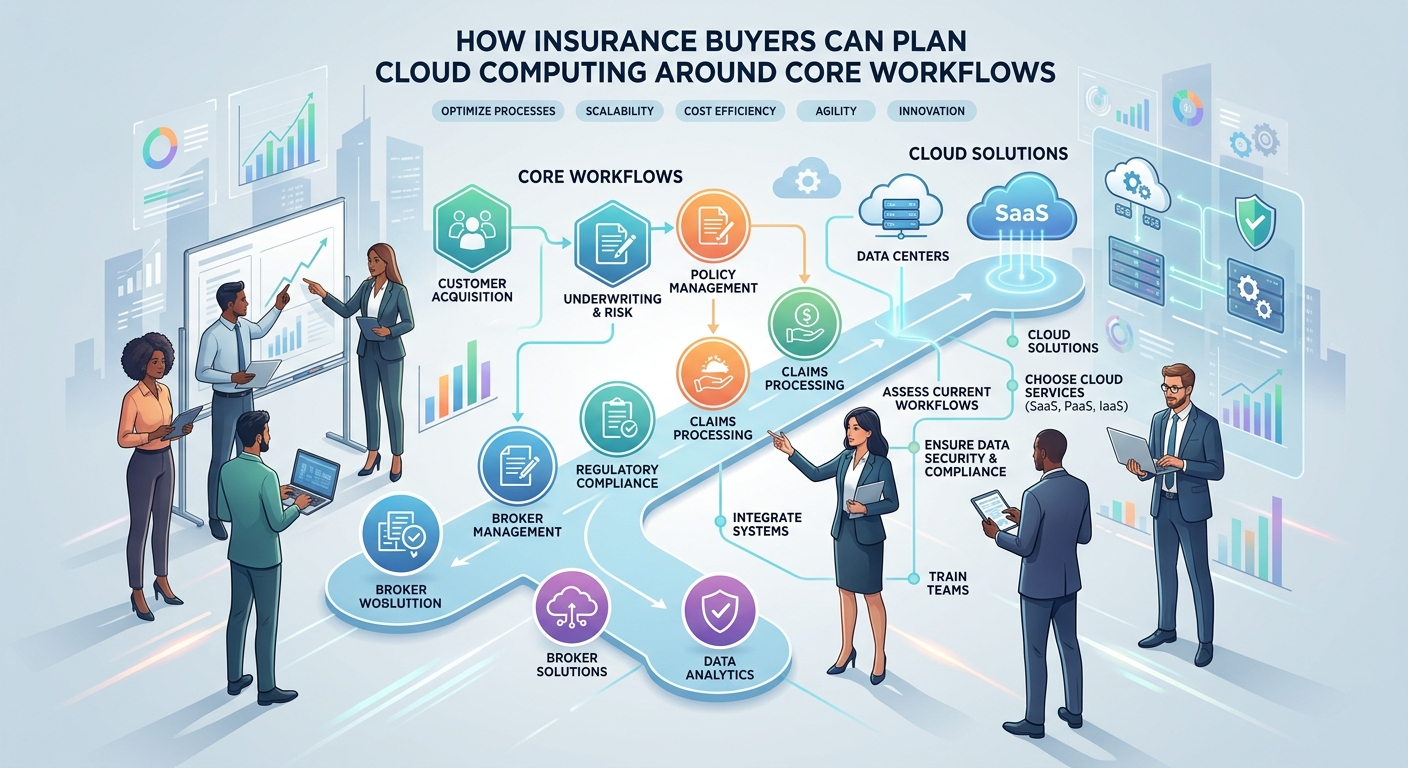
Core insurance workloads rarely move through a single migration pattern. A carrier might retain a mainframe policy system while placing a customer portal in Azure, a claims image archive in AWS, and actuarial models in Google Cloud. Guidewire, Majesco, and Duck Creek Technologies also provide SaaS options for policy, billing, and claims functions.
According to Gartner, insurance CIO priorities include application modernization, data science, cybersecurity, and cloud. Gartner also forecasts insurance IT services spending to grow at a 9.4% compound annual rate from 2022 through 2027, while infrastructure and integration as a service is projected to grow at 23.6%.
A practical evaluation compares rehosting, refactoring, and SaaS replacement at the application level. Rehosting a stable virtual machine can shorten a data-center exit, but it preserves the application’s patching and scaling model. Refactoring into containers or serverless functions can improve deployment flexibility, although it changes testing, observability, and support requirements. SaaS transfers more platform operations to the provider but can constrain database access and custom code.
During this assessment, IT consulting and managed IT services providers like Apex Technology Services can augment internal architecture and cybersecurity teams during workload discovery, cloud controls design, and operational support planning. Buyers should still require a documented responsibility matrix covering identity, backups, vulnerability remediation, logging, and incident response.
Build an Evaluation Checklist Around Insurance Controls
The shortlist should be tested against specific technical and regulatory requirements. Those include encryption with customer-managed keys, private network connectivity, multifactor authentication, role-based access control, immutable audit logs, and defined recovery point and recovery time objectives.
KPMG describes industry cloud for financial services as a combination of cloud technology, sector-specific capabilities, and partner ecosystems. For an insurer, that framing supports a deeper vendor review than a basic feature comparison.
Ask whether claim documents can remain in a required jurisdiction, whether database snapshots are encrypted with keys held in an insurer-controlled vault, and whether logs can stream to Microsoft Sentinel, Splunk, or another SIEM through syslog or API integration. Buyers should also align controls with NIST SP 800-37, NIST SP 500-292, ISO/IEC 27001, and ISO/IEC 27017.
Data portability deserves attention. A useful contract specifies export formats such as JSON, CSV, Parquet, or ACORD XML, along with API rate limits and the process for retrieving documents and metadata at termination. An untested exit process can limit a carrier’s negotiating position for years.
Plan the Rollout in Operational Phases
Initial preparation typically covers application inventory, data classification, dependency mapping, and a landing-zone design. The landing zone should define network segmentation, identity federation through SAML or OpenID Connect, centralized logging, approved regions, tagging standards, and infrastructure-as-code templates using Terraform or native cloud tooling.
A bounded pilot can then validate one workflow. Claims document ingestion is a useful candidate because the team can test object storage, malware scanning, retention rules, API integration, and access controls without immediately replacing the claims ledger.
During migration, Apex Technology Services may support technical work such as firewall policy configuration, endpoint protection, backup validation, and monitoring integration. The carrier’s security lead, cloud architect, claims application owner, data engineer, compliance representative, and service-desk manager should retain clear approval and escalation roles.
Obstacles commonly emerge around legacy interfaces. A mainframe may support MQ messaging but not REST, requiring an API gateway or integration layer to translate requests. Parallel runs can compare policy counts, financial totals, document hashes, and exception records before traffic shifts to the cloud service.
Measure Outcomes Buyers Can Observe
Success measures should connect directly to the original workflow. For claims ingestion, buyers can track the interval from customer upload to adjuster availability, failed API calls, malware quarantine events, duplicate-document exceptions, and hours spent reconciling SFTP batches.
For underwriting analytics, relevant measures include model execution time, data freshness, feature-pipeline failures, and the time required to provision an isolated development environment. For customer portals, teams can monitor page latency, authentication failures, abandonment at specific screens, and recovery behavior during load tests.
The available industry research does not establish a universal implementation-level benchmark for these measures. Each insurer should capture a baseline before migration and compare it with production telemetry after launch using cloud monitoring, application performance management, SIEM logs, and service-desk records.
Buyer Takeaways From the Planning Process
A dependency map can prevent a portal migration from failing because an actuarial system still relies on a fixed-width overnight file. Likewise, testing ACORD payloads and document hashes during parallel operation gives business owners evidence that records remain complete.
Control ownership also needs to be explicit. If the cloud provider secures the physical infrastructure while the insurer configures IAM roles, storage permissions, and retention policies, the responsibility matrix should name the team accountable for each setting.
Finally, contract review should happen before architecture hardens. API quotas, egress charges, backup retention, support response targets, and export formats can affect both operating cost and the feasibility of switching providers later.
How long does an insurance cloud implementation take?
Duration depends on whether the scope is a portal, data platform, or core policy replacement. Buyers should request phase-specific estimates for discovery, control design, integration testing, parallel operation, and production transition rather than accepting one aggregate date.
Should an insurer choose SaaS or public-cloud infrastructure?
SaaS can reduce responsibility for application upgrades and core-platform operations, while infrastructure as a service offers more control over networks, databases, and deployment pipelines. The decision should compare required customization, API coverage, data access, recovery objectives, and internal support capacity.
Which insurance workload should move first?
A bounded service with measurable inputs and outputs is often a sensible candidate. Document ingestion, analytics sandboxes, and customer self-service portals can expose identity, networking, logging, and data-governance issues before a carrier considers moving policy administration or claims accounting.