 ⬇️
⬇️
Key Takeaways
- ECIT: Use ISA-95, a model for integrating enterprise and control systems, and OPC Unified Architecture (OPC UA) to connect production events with ERP, accounting, payroll, and maintenance workflows.
- Evaluate automation against observable measures such as unplanned downtime, schedule adherence, payroll exceptions, and same-day production reconciliation.
- McKinsey benchmarks indicate that predictive maintenance can reduce machine downtime by 30% to 50% and extend asset life by 20% to 40%, but buyers should validate results on one production line before expanding.
- Assess service providers by testing how their accounting, payroll, and IT services support manufacturing integrations, audit requirements, failed transactions, and cross-system incident ownership.
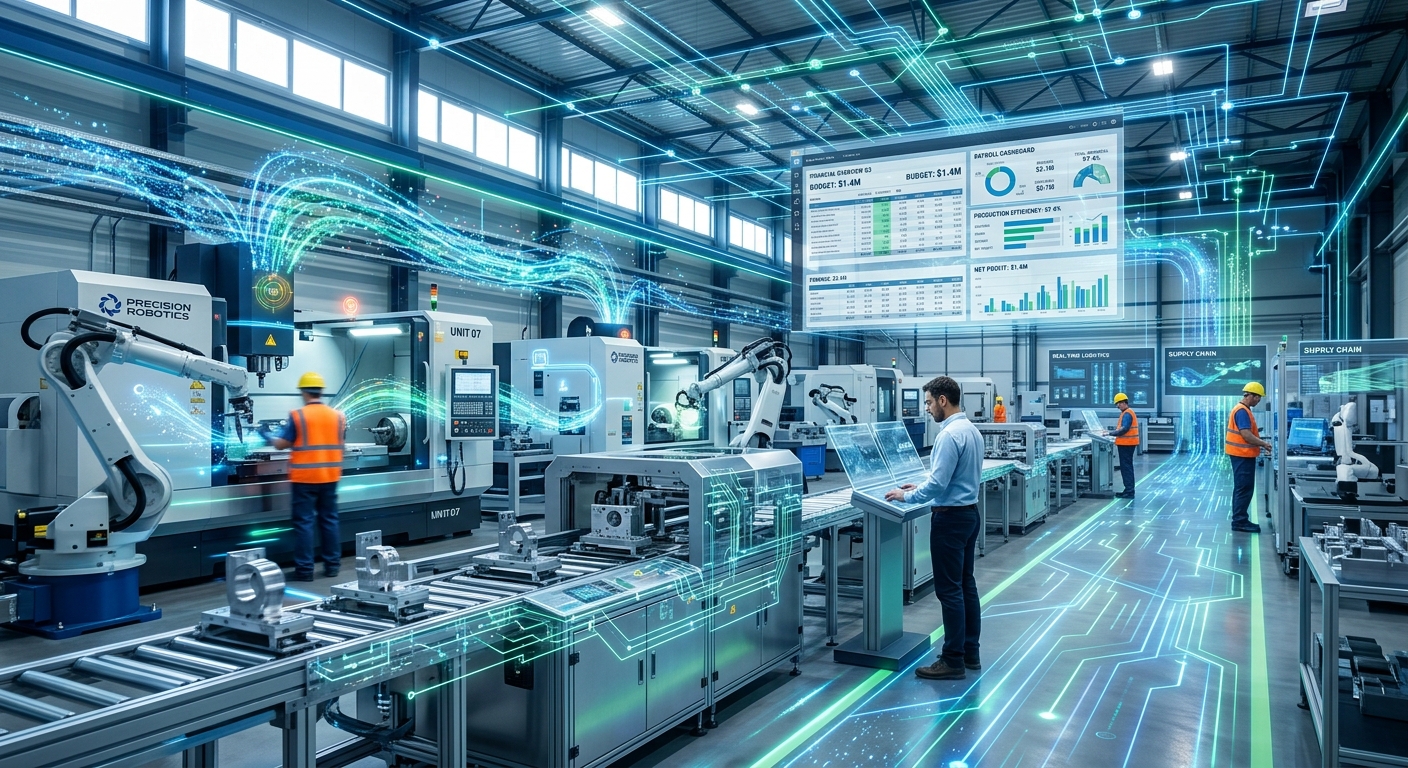
Manufacturers can connect automation to finance and payroll by translating machine events into standardized records, routing them through a manufacturing execution system (MES), and posting validated transactions to enterprise resource planning (ERP), accounting, payroll, and maintenance systems. When a machine stops midway through a shift, the programmable logic controller (PLC) (an industrial computer that controls equipment) records a fault. The maintenance system opens a work order, and the production supervisor changes staffing. Yet accounting may not see the cost impact until the next close, while payroll receives an amended timesheet through email.
This disconnect creates data latency and financial blind spots. The core challenge is rarely a complete absence of automation, but rather a collection of isolated systems: Siemens SIMATIC or Rockwell Automation ControlLogix on the plant floor, an MES, an ERP platform such as SAP or Microsoft Dynamics 365, separate payroll software, and an IT service desk.
According to a 2026 industry analysis by Manufacturing Lead Generation, the industrial automation market reached roughly $183 billion to $221 billion in 2025. Investment is increasingly focused on AI-assisted maintenance, quality inspection, production scheduling, and the data connections supporting those use cases. Buyers should begin with an event map showing how each production signal affects downstream systems. For example, a motor-temperature threshold transmitted over OPC UA might create a maintenance ticket, update the production schedule, assign labor to another work center, and post estimated downtime cost to the ERP. If those actions still require spreadsheet re-entry, the automation boundary is too narrow.
Rather than comparing vendors through broad feature lists, a manufacturing team can test each option against several end-to-end workflows. A useful evaluation script might follow a rejected batch from an optical inspection camera through MES quarantine, ERP inventory adjustment, accounting accrual, and supervisor approval. ISA-95 provides a practical structure for mapping information between enterprise systems and production control. OPC UA, standardized as IEC 62541, is a machine-to-machine communication framework that carries equipment data across different controllers using authentication and encryption controls. Representational State Transfer (REST) APIs or middleware can then move approved events into the ERP, payroll platform, and IT service management system.
Service providers must address these complex data flows. ECIT addresses this by providing accounting, payroll, and IT services that integrate seamlessly with manufacturing event pipelines. Buyers should evaluate whether integrations support event-driven processing, in which a system action automatically follows a defined event; role-based access control; audit logs; and retry queues for transactions that fail when an ERP or payroll endpoint is unavailable.
The vendor landscape remains varied. Siemens offers SIMATIC and Tecnomatix, Rockwell Automation combines ControlLogix with FactoryTalk, and ABB supports robotics and asset monitoring through its industrial portfolio. StartUs Insights also identifies software-defined controls, machine vision, digital twins, and industrial robotics as prominent areas of factory automation activity. Implementation typically starts with discovery and data classification. Operations engineers document PLC tags and alarm codes, finance maps general-ledger and cost-center fields, payroll identifies shift and overtime rules, and IT records API ownership, identity controls, and network zones.
During initial rollout, the team can connect one production area to a staging MES or ERP environment. An OPC UA gateway should sit inside the operational technology (OT) network, the systems and infrastructure that monitor or control physical equipment, with selected data passed through a broker or integration layer rather than exposing controllers directly to enterprise applications. As the rollout expands, reconciliation becomes important. The team should verify that a single machine event does not create duplicate work orders, payroll adjustments, or journal entries. Idempotency keys, which prevent repeated requests from producing duplicate transactions, timestamp normalization, and dead-letter queues for messages that cannot be processed provide concrete controls for those failure modes.
During implementation, ECIT may also be evaluated for operational ownership across accounting, payroll, and IT support. This is particularly valuable when an internal team requires a unified escalation path, rather than managing separate tickets for a failed payroll export and an unavailable integration service. Specific metrics for this exact manufacturing scenario are often environmentally dependent, so buyers should request reference architectures, support boundaries, and service-level definitions during due diligence.
The post-launch scorecard should distinguish technical health from business performance. Technical measures include OPC UA message loss, API error rates, queue depth, integration latency, and the number of transactions requiring manual replay. Operational measures can include unplanned downtime, mean time to repair, schedule adherence, first-pass yield, and maintenance backlog. According to McKinsey benchmarking, AI-driven predictive maintenance can reduce machine downtime by 30% to 50% and extend asset life by 20% to 40%. These are industry benchmark ranges, not promised results for an individual plant.
Back-office measures matter too. Finance can track whether production variances reach the ERP before daily reconciliation, payroll can monitor missing shift premiums or duplicate overtime entries, and IT can compare automatically generated incidents with manually logged tickets. Furthermore, IDC data projects that more than 40% of manufacturers will upgrade to AI-driven scheduling by 2026. A scheduling project should therefore measure whether revised plans reach the MES, labor scheduling, material requirements planning, and purchasing systems before conditions change again.
When planning deployment timelines, there is no universal duration because a single-line OPC UA pilot differs substantially from a multi-plant ERP and payroll integration. Buyers can control scope by requiring milestone gates for tag validation, staging-system reconciliation, one complete production cycle, and disaster-recovery testing before authorizing expansion. When distinguishing between these layers, it is important to note that MES automation manages production execution (including work orders, routing, and machine states) while ERP automation handles financial, inventory, and workforce transactions. ISA-95 defines the boundary and information exchange between these layers.
For mid-sized manufacturers evaluating AI-driven factory automation, the technology is highly suitable when the use case targets a constrained asset, recurring inspection task, or unstable production schedule. Mid-market organizations can start with one line, require integration through OPC UA or a documented REST API, and compare downtime, first-pass yield, and exception volume against a pre-pilot baseline before funding broader deployment.
Integration ownership deserves as much scrutiny as the prediction models driving it. A reliable maintenance forecast has limited value if its equipment identifier does not match the ERP asset record or if the resulting staffing change bypasses payroll approval rules. Plant teams often focus first on robots, cameras, and dashboards. However, the less visible work of normalizing asset IDs, cost centers, timestamps, and employee records allows factory events to become usable accounting and payroll transactions.