 ⬇️
⬇️
Key Takeaways
- Map at least five distinct trust zones, including EHR, PACS, billing, guest Wi-Fi, and medical devices, before comparing firewall appliances.
- Test application-aware policies against healthcare protocols such as DICOM, HL7, FHIR, and vendor-specific device traffic.
- Measure blocked lateral connections, rule-review time, access exceptions, and mean time to investigate alerts after deployment.
Define the Clinical Problem Before Comparing Products
A radiology workstation needs to retrieve DICOM studies from a PACS archive. An infusion pump may communicate with a management server using an older protocol. A billing application exchanges data with the EHR, while a third-party technician connects remotely to maintain imaging equipment. Treating all this traffic as part of one trusted internal network leaves too many pathways open.
The firewall is therefore a control layer, not a complete security program. It can enforce boundaries, inspect applications, record traffic, and limit remote access. It does not replace identity management, endpoint protection, vulnerability management, or tested incident-response procedures.
A useful starting point is a traffic-flow inventory. Buyers can document source and destination IP ranges, ports, applications, data classifications, and system owners for workflows involving EHR platforms, PACS archives, laboratory systems, pharmacy applications, VoIP, billing, guest Wi-Fi, and Internet of Medical Things devices.
That inventory should also record protocols such as DICOM, HL7 v2, FHIR over HTTPS, SMB, DNS, NTP, and vendor-specific management traffic. The technical detail matters because a default-deny policy is only practical when the team knows which connections clinical care actually depends on.
Build an Evaluation Around Segmentation and Visibility
A medical institution can translate its inventory into security zones or virtual routing and forwarding instances. A representative design might place clinical workstations, EHR servers, PACS, biomedical devices, administrative systems, guest wireless networks, and vendor-access services in separate VLANs, with firewall policy controlling traffic between them.
Guidance summarized by SecurityMetrics emphasizes firewalls as part of layered healthcare security rather than an isolated safeguard. That distinction should influence the request for proposal. Buyers should ask how each platform handles inter-VLAN inspection, identity-aware rules, intrusion prevention, malware analysis, DNS filtering, high availability, and centralized policy management.
Fortinet FortiGate, Palo Alto Networks NGFW, and Cisco Secure Firewall are among the commonly evaluated platforms for this use case. Product comparisons should focus on operational fit rather than feature counts. For example, a hospital with limited security staffing may value centralized templates and managed monitoring, while a larger health system may prioritize multi-tenant administration, API access, and integration with an existing SIEM.
An IT consulting and managed security provider such as Apex Technology Services can help translate clinical traffic requirements into firewall objects, zone policies, logging rules, and change-control documentation. The initial deliverable should be a reviewable policy matrix, not merely an appliance recommendation.
Test Medical Devices Before Enforcing Default-Deny Rules
Medical devices complicate segmentation because they may have long service lives, narrow maintenance windows, and operating systems that cannot support current endpoint agents. Research published through MDPI discusses dynamic, regulation-aware firewall architectures for smart healthcare and IoT traffic, reflecting the need to monitor device behavior without interrupting clinical functions.
During a proof of concept, the team should mirror traffic through a network packet broker or switch SPAN port and establish a baseline before blocking connections. Packet captures can identify hard-coded IP addresses, unexpected Internet destinations, obsolete TLS versions, and dependencies on local DNS or NTP servers.
Policy testing should include DICOM transfers, medication administration workflows, laboratory interfaces, EHR authentication, printing, and emergency downtime procedures. If TLS inspection is proposed, buyers should verify whether certificate pinning or proprietary device software will reject re-signed certificates.
That said, segmentation does not require replacing every medical device. A device that cannot support modern controls can often be placed in a restricted VLAN, permitted to contact only its management server, DNS resolver, and approved clinical destinations. Network access control can supplement the firewall by identifying devices through MAC address, DHCP fingerprint, or 802.1X authentication.
Plan the Rollout Around Clinical Change Windows
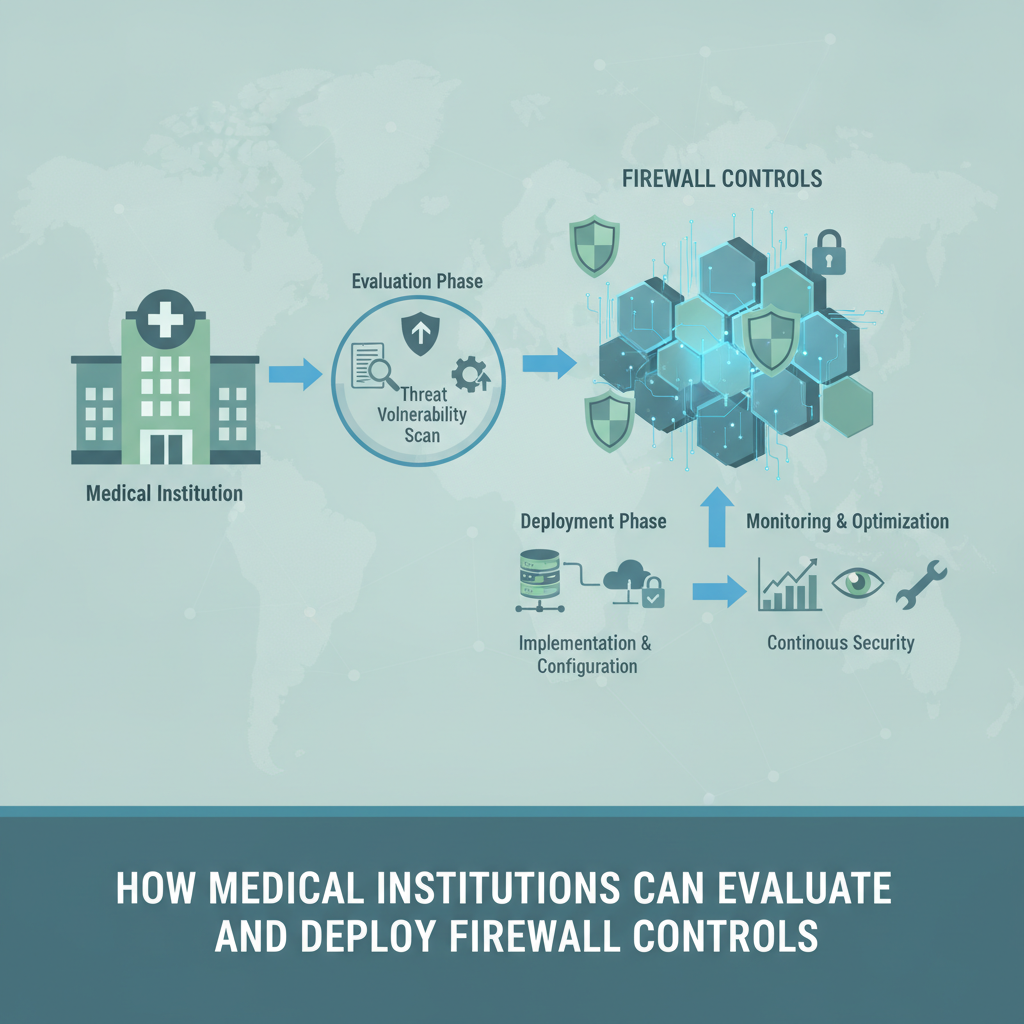
Implementation usually works better as a sequence of discovery, passive observation, limited enforcement, and broader policy activation. The schedule should be expressed in months and coordinated with clinical maintenance windows, accreditation activity, and planned EHR or PACS upgrades.
The working group commonly includes network engineering, security operations, clinical informatics, biomedical engineering, compliance, application owners, and the service desk. Biomedical engineering is especially important because firewall logs may show an unfamiliar connection that is actually required for calibration, telemetry, or manufacturer support.
During limited enforcement, rules can begin in alert-only mode before being changed to block. Exceptions should have an owner, business justification, expiration date, and related change ticket. Firewall events should flow over syslog or an API into a SIEM such as Microsoft Sentinel, Splunk, or IBM QRadar, where analysts can correlate network events with identity and endpoint telemetry.
Apex Technology Services can support this phase by documenting rule ownership, testing failover between high-availability appliances, and configuring escalation paths for alerts involving PHI systems. The service boundary should state who approves emergency rules, who contacts clinical owners, and how quickly temporary access is reviewed.
Measure Outcomes That Operators Can Observe
Buyers should define success measures before policy enforcement begins. Useful indicators include the number of permitted pathways between zones, blocked lateral connection attempts, expired exceptions, rules without identified owners, and alerts that receive analyst review within the agreed service level.
Operational measures matter too. Teams can track how long it takes to approve a vendor-access request, investigate an anomalous IoMT connection, or determine which application depends on a proposed rule change. A searchable SIEM record containing source IP, destination IP, application, user identity, action, and policy name should shorten that investigation compared with manually reviewing appliance logs.
Medical institutions should establish their own baseline, then compare monthly trends rather than relying on generalized savings claims.
Apply the Lessons to the Buying Decision
The traffic inventory should precede product selection. Otherwise, demonstrations tend to focus on dashboard features while overlooking DICOM flows, old device protocols, and remote-maintenance requirements.
Clinical testing also deserves its own acceptance criteria. A firewall policy that blocks malware but interrupts image retrieval is not ready for production. Buyers should require documented rollback procedures, redundant paths, configuration backups, and failover testing for every enforcement stage.
Finally, managed services should be evaluated at the workflow level. Ask who reviews IDS alerts, how rule requests enter the ticketing system, whether logs remain available for the institution’s required retention period, and how provider access is authenticated through MFA, VPN, or zero-trust network access.
Broader Applicability
The same model can support outpatient networks, dental groups, diagnostic laboratories, and senior-care organizations. Smaller institutions may consolidate zones on one high-availability firewall pair, while enterprise systems may distribute enforcement across data centers, campuses, cloud networks, and SD-WAN edges.
How long does a healthcare firewall implementation take?
The duration depends on device discovery, site count, and clinical testing rather than appliance installation alone. Buyers should plan for a multi-month program covering traffic baselining, policy design, alert-only testing, staged blocking, high-availability validation, and SIEM integration.
What firewall features matter most for a hospital?
Prioritize application-aware filtering, inter-VLAN inspection, IPS, centralized management, redundant deployment, and detailed syslog or API export. The platform should also recognize or safely pass healthcare traffic such as DICOM, HL7, and FHIR without disrupting clinical workflows.
Is a managed firewall appropriate for a small medical team?
It can be appropriate when internal staff cannot provide continuous monitoring or routine rule review. The contract should specify alert triage, emergency change authority, log retention, MFA-protected administration, response targets, and ownership of firewall configurations if the service ends.