 ⬇️
⬇️
Key Takeaways
- Microsoft is typically evaluated as a healthcare cloud, data, AI, productivity, and engagement ecosystem rather than as a replacement for a core EHR.
- Epic, AWS, Salesforce Health Cloud, and Microsoft address overlapping needs, but they enter the provider architecture from different starting points.
- Buyers should compare implementation approaches as carefully as products, particularly regarding interoperability, cybersecurity, governance, and operating costs.
Why healthcare providers are reassessing their technology stacks
Healthcare technology decisions previously revolved primarily around the EHR. While the EHR remains central, providers now need to connect clinical records with imaging, claims, contact centers, remote care, analytics, workforce tools, and a growing number of AI-enabled applications.
Microsoft’s healthcare stack combines Azure, Microsoft 365, Dynamics 365, Power Platform, and healthcare data services. That breadth makes it relevant when an organization requires a common cloud foundation for interoperability, analytics, patient engagement, and hybrid infrastructure. It is less relevant as a direct substitute for Epic or another system of record.
Industry assessments for 2025-2026 place Microsoft among the leaders in U.S. healthcare cloud infrastructure, with Azure Arc receiving particular attention for hybrid and edge deployments. Earlier healthcare customer research also found strong interest in Azure and broad use of Microsoft SaaS, PaaS, and infrastructure services for care coordination, genomics analytics, and digital health applications.
Providers are currently tasked with pursuing AI while controlling sensitive data, modernizing applications without disrupting care, and supporting facilities where cloud-only architecture may be impractical. The market outlook tracked by MarketsandMarkets reflects continuing investment in cloud, analytics, AI, and cybersecurity across healthcare technology categories to meet these demands.
Comparing the main solution approaches
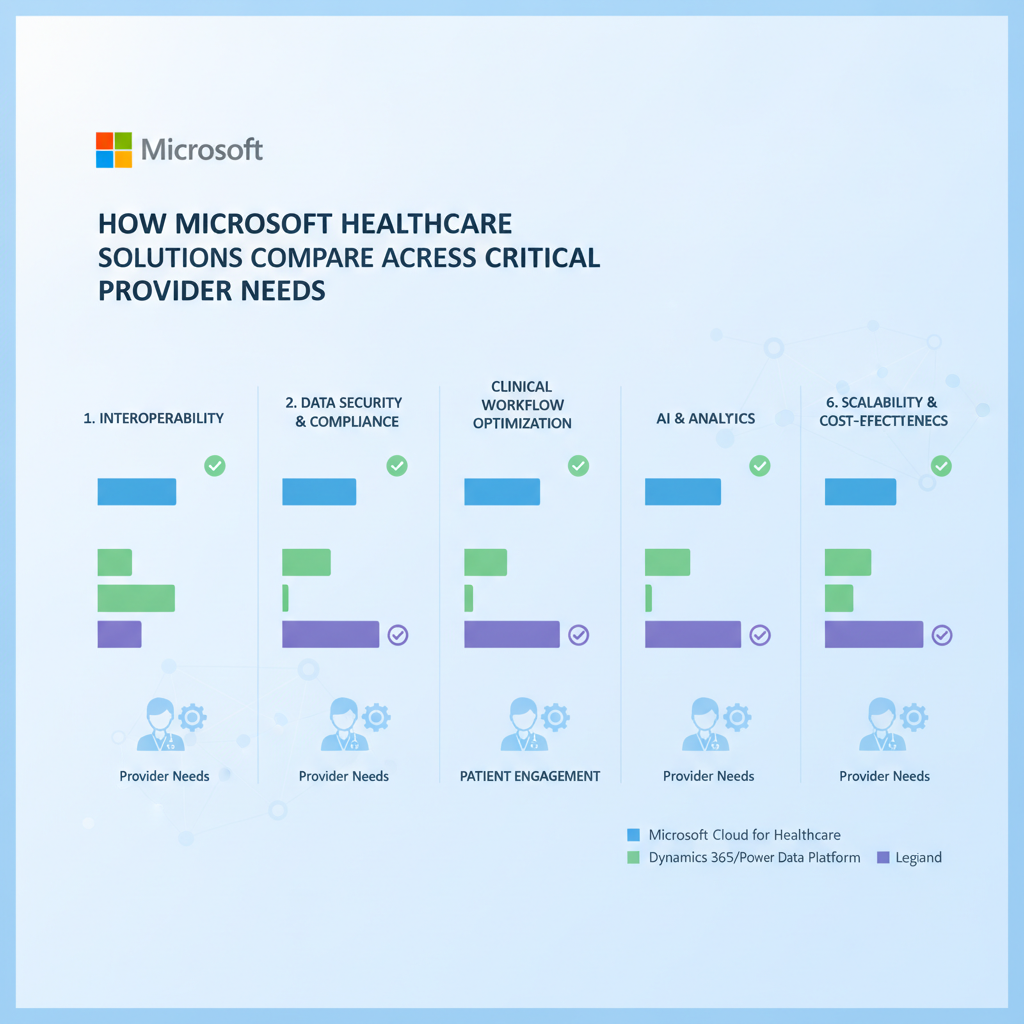
A useful comparison begins with architecture rather than a feature checklist. Epic is typically the clinical system-of-record anchor. AWS and Microsoft are broad cloud ecosystems. Salesforce Health Cloud generally enters through CRM, service, and patient engagement. An implementation partner such as Sogeti US represents a different choice: an integration and transformation path across Microsoft technologies and existing healthcare systems.
| Dimension | Sogeti US | Microsoft direct ecosystem | Epic | AWS | Salesforce Health Cloud |
|---|---|---|---|---|---|
| Primary role | Implementation, integration, cloud, AI, and security support | Cloud, productivity, data, AI, low-code, and engagement foundation | Core clinical and operational system of record | Cloud infrastructure, data, analytics, and AI services | CRM, service, outreach, and patient engagement |
| Integration depth | Oriented toward connecting Microsoft services with existing enterprise and clinical environments | Strong within Azure, Microsoft 365, Dynamics 365, and Power Platform | Deep clinical workflow and EHR data integration | Broad service portfolio and API-based architecture | Strong CRM workflow and customer data integration |
| Security and compliance | Translates controls into architecture and operating processes | Extensive identity, security, hybrid, and governance capabilities requiring careful configuration | Strong healthcare context centered on the clinical environment | Broad cloud security controls with shared-responsibility requirements | Enterprise CRM security applied to healthcare engagement workflows |
| AI and automation | Useful where buyers need implementation, governance, and workflow redesign around AI | Broad AI, data, automation, and productivity options | AI is evaluated in the context of clinical and EHR workflows | Broad infrastructure and managed services for developing AI solutions | AI and automation centered largely on CRM and service workflows |
| Deployment model | Project and managed-service scope depends on buyer requirements | Cloud, SaaS, hybrid, and edge options | Major enterprise clinical deployment with substantial operational implications | Cloud-centered, with hybrid patterns available | Predominantly SaaS-centered |
| Commercial evaluation | Services scope, skills mix, transition support, and ongoing operations | Licensing, consumption, support, and integration costs | Enterprise agreement plus implementation and operational costs | Consumption, architecture, support, and data movement costs | Subscription, implementation, integration, and customization costs |
A health system might retain Epic, run analytics and AI services on Azure, use Microsoft 365 for workforce collaboration, and add Dynamics 365 or Salesforce for selected engagement workflows. Evaluating how these platforms integrate is just as important as selecting the products themselves.
Criteria that should shape the shortlist
Start with interoperability. HL7 FHIR support is essential for exchanging clinical and administrative data, while DICOM remains central to imaging. Buyers should test actual workflows, including identity matching, consent, terminology mapping, error handling, and data lineage. A connector existing on paper does not guarantee the surrounding workflow is production-ready.
A chief data officer at a regional health system consolidating information from Epic, imaging archives, claims feeds, and acquired physician practices should evaluate ingestion patterns and governance before comparing AI demonstrations. Solutions that cannot preserve provenance, access controls, and clinical context should be eliminated from the shortlist early. Success requires trusted, reusable data services, not simply a larger data lake.
Cybersecurity requires the same discipline. NIST SP 800-66 remains a widely used reference for translating HIPAA obligations into security practices. U.S. providers must also account for interoperability, claims, and reporting expectations associated with CMS programs. Technical controls should map directly to operational ownership, identifying exactly who reviews privileged access, investigates alerts, validates backups, and approves AI data use.
Hospitals must also examine hybrid requirements. Facilities may have latency-sensitive systems, medical devices, imaging workloads, or connectivity constraints. Azure Arc provides consistent management across cloud, data center, and edge environments. AWS offers its own hybrid patterns, while EHR-centered infrastructure decisions may remain closely tied to Epic’s supported architecture.
What to look for in an implementation provider
An integration partner must understand that healthcare modernization involves clinical risk, data classification, identity management, interoperability testing, workload sequencing, and operational handoff.
Although AI pilots are frequently announced, sustainable enterprise AI requires strict governance. Providers must detail how they handle model access, protected health information, human review, prompt and output logging, data retention, and performance monitoring.
When an IT leader prepares to introduce generative AI into contact-center and care-coordination workflows, the initial evaluation should focus on permitted data, escalation paths, accuracy review, and integration with existing work queues. Solutions lacking governance or workflow ownership should be cut from consideration. Success requires measurable operational usefulness combined with controls that clinicians, compliance teams, and security leaders can inspect.
Questions to ask vendors
Ask each shortlisted vendor these practical questions to clarify operational responsibilities and technical capabilities:
- Which systems remain authoritative for patients, encounters, orders, and consent?
- How are HL7 FHIR, DICOM, batch data, and event-driven integration supported?
- What runs in SaaS, public cloud, private infrastructure, and at the edge?
- How are AI inputs, outputs, model changes, and human approvals governed?
- Which costs are license-based, consumption-based, or tied to implementation?
- What migration, testing, training, and post-launch support are included?
- How will the architecture avoid unnecessary data copies and vendor lock-in?
Interface failures require clear accountability for post-launch support and overnight troubleshooting, so defining service ownership is critical before contracts are signed.
Making the decision
The strongest decision process separates system-of-record needs from cloud, engagement, analytics, and AI needs. Epic often anchors clinical operations. Microsoft and AWS compete more directly as broad cloud foundations, while Salesforce Health Cloud is commonly strongest when CRM and patient engagement lead the business case.
Microsoft becomes particularly compelling when a provider already relies heavily on Microsoft identity, productivity, data, and developer services, or when hybrid management is a priority. Ecosystem familiarity should never replace technical validation. Run scenario-based evaluations, model total operating costs, test security controls, and confirm exactly how the chosen architecture will be supported after go-live.