 ⬇️
⬇️
Key Takeaways
- Newark Metro can use HL7 FHIR APIs to connect appointment scheduling and patient communications with Epic or Oracle Health while limiting duplicate data entry.
- Because 42% of U.S. healthcare organizations identify multi-EHR integration as their largest interoperability obstacle, buyers should test identity matching and write-back behavior before selecting a communications platform.
- A phased rollout can measure call abandonment, scheduling completion, transfer frequency, and SMS delivery rather than relying on a broad efficiency target.
Problem to Solve: Communications Outside the Clinical Record
A patient calls to reschedule an appointment. The contact-center agent opens the phone console, searches a separate scheduling application, confirms the patient's date of birth, and manually records the outcome in the EHR. If the call transfers to a clinical department, the patient may repeat the same information.
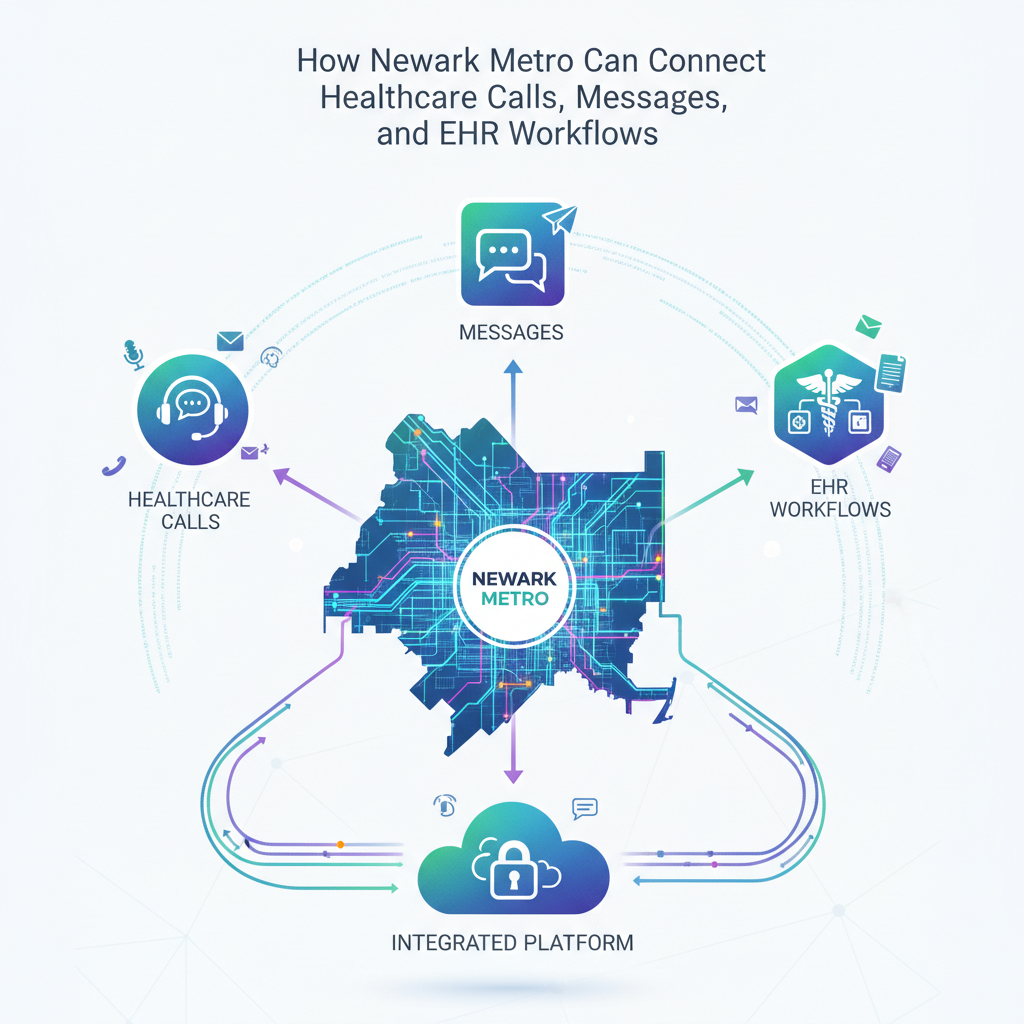
That fragmented process is the integration problem Newark Metro should define before comparing VoIP platforms. The objective is not merely replacing desk phones. It is connecting voice, video, SMS, MMS, appointment scheduling, and call routing to the systems where provider staff already work.
The industry evidence supports that focus. HIMSS reported in its 2026 survey summary that 42% of U.S. healthcare organizations considered integration across multiple EHR systems their biggest interoperability obstacle. Another 41% cited the difficulty of integrating new solutions into existing workflows.
For Newark Metro, that means documenting specific failure points: appointments booked in one application but absent from another, voicemail messages copied into Epic manually, or SMS reminders that lack delivery status in the scheduling record. Newark Metro has not disclosed its current platforms, call volumes, staffing levels, or performance metrics, so buyers should treat these as evaluation scenarios rather than established conditions.
Evaluation Approach: Start With Workflows, Not Feature Lists
A useful evaluation begins with representative transactions. Examples include an inbound call routed by location and specialty, an SMS appointment confirmation, a video visit invitation, and an after-hours message escalated to an on-call queue.
For each transaction, Newark Metro should identify the system of record and required integration method. Epic and Oracle Health commonly expose healthcare data through HL7 FHIR or vendor-specific APIs. Hyland may hold scanned referrals, consent forms, or other unstructured content. A communications platform may use REST APIs and webhooks to send call events, while SIP handles voice sessions and OAuth 2.0 controls application access.
Solutions such as Phone.com can be evaluated against that architecture for cloud voice, video, messaging, routing, and scheduling use cases. The practical questions concern API coverage, business associate agreement availability, audit logging, encryption, number portability, SMS consent management, and whether call metadata can be written back to the appropriate workflow.
Buyers should also ask vendors to demonstrate failure handling. If an EHR API is unavailable, does the integration queue the update, retry it with an idempotency key, and alert an administrator? A polished call interface matters less if failed appointment updates disappear silently.
Architecture and Data Exchange Considerations
Interoperability requirements extend beyond sending a patient's name between applications. Newark Metro should establish which data elements may cross each interface and how identities will be matched.
The Office of the National Coordinator for Health Information Technology identifies USCDI as the required exchange dataset in several regulated and federally supported programs, including TEFCA. That makes standards-based exchange relevant to provider communications projects, particularly when messages initiate referrals, appointment requests, or transitions of care.
A FHIR-based design might query Patient, Appointment, Practitioner, and Location resources. The communications layer could receive only the minimum fields required for routing and scheduling, such as appointment time, clinic location, preferred language, and communication preference. It should not pull an entire clinical record merely to send a reminder.
Identity matching deserves close scrutiny. Phone numbers change, family members share devices, and patient names can appear differently across EHR instances. Newark Metro can reduce mismatches by combining multiple attributes, logging uncertain matches for staff review, and preventing an SMS from exposing protected information before identity and consent are confirmed.
Rollout Planning and Integration Testing
Rather than switching every number and workflow at once, Newark Metro can organize deployment around controlled operational phases. Discovery maps call flows, extensions, queues, fax dependencies, EHR interfaces, and retention rules. A pilot then tests a limited set of scheduling and routing scenarios before broader number porting and staff migration.
The implementation team typically includes telecommunications, EHR integration, security, compliance, contact-center operations, and clinical representatives. Technical testing should cover SIP call quality, webhook latency, FHIR authorization, API rate limits, SMS opt-out processing, emergency calling configuration, and role-based access.
During broader deployment, Phone.com would need to fit Newark Metro's identity, logging, and workflow controls rather than operate as an isolated communications console. For example, single sign-on could use SAML 2.0, while call and message events could feed a centralized log repository through an API or syslog-compatible intermediary.
Duration will vary with the number of locations, carriers, EHR instances, and custom interfaces. Newark Metro has not published a rollout schedule, so evaluation documents should request vendor estimates by dependency, including number-porting lead time and EHR sandbox access.
Outcomes Newark Metro Should Measure
Post-launch measurement should connect technical behavior with visible workflow changes. Useful indicators include abandoned-call rate, average transfers per call, appointment completion after an SMS interaction, failed-message rate, API retry volume, and the share of calls documented automatically in the relevant system.
The 2026 HIMSS summary found that 85% of respondents were using or likely to adopt digital collaboration tools to support interoperability and connected care. Adoption alone, however, does not show whether integration works. Newark Metro should compare queue reports, EHR audit logs, and scheduling records to determine whether staff still re-enter information or maintain side spreadsheets.
Observable improvement might include fewer calls transferred between scheduling and clinic queues, more appointments completed during the initial interaction, and same-day handling of failed integrations. Those are evaluation targets, not reported Newark Metro results.
Buyer Takeaways
A detailed workflow inventory can prevent scope drift. If fax, voicemail, SMS, and video are omitted during discovery, they often reappear as separate projects with different retention and access controls.
API demonstrations should use realistic error cases, not only successful transactions. Testing an expired OAuth token, duplicate webhook, unavailable FHIR endpoint, and ambiguous patient match reveals how much manual intervention the production environment may require.
Finally, governance should cover message content as well as transport. An encrypted platform can still expose sensitive information if appointment reminders include excessive clinical detail or reach a shared device.
Broader Applicability
Multi-site physician groups, ambulatory networks, and specialty providers can adapt Newark Metro's evaluation model by mapping communications events to FHIR resources and measurable contact-center outcomes. Smaller teams may begin with appointment reminders and inbound routing before adding EHR write-back or AI-assisted scheduling.
How does a healthcare phone system integrate with Epic or Oracle Health?
Integration commonly uses HL7 FHIR APIs, vendor-specific REST endpoints, and webhooks that pass call or appointment events. Buyers should verify support for Patient, Appointment, Practitioner, and Location resources, along with OAuth 2.0 authorization and retry handling.
What should Newark Metro test before moving healthcare calls to the cloud?
Testing should cover SIP call quality, emergency calling, number porting, queue routing, SMS consent, API failures, and EHR identity matching. A pilot should also confirm that audit logs show who accessed a message and whether an appointment update reached the system of record.
Can a smaller healthcare provider use the same integration approach?
Yes, but the initial scope can be narrower. A smaller provider might connect cloud voice and SMS reminders to one scheduling system first, then add FHIR-based EHR updates after call routing and consent workflows are stable.