 ⬇️
⬇️
Key Takeaways
- Short range wireless standards face limits when applied to massive scale IoT
- LoRaWAN adoption is growing for low power, long range industrial and municipal deployments
- Organizations are reassessing connectivity architectures as IoT footprints expand
The discussion around wireless connectivity for connected devices keeps circling back to the same tension point. Many popular standards were never designed for the type of large scale, low power IoT networks that enterprises and public agencies are now trying to stand up. Bluetooth, for example, works well for wearables or peripherals that sit within a few meters of a host device, but its footprint stays intentionally short. That design choice makes sense for consumer electronics, although it becomes limiting in distributed sensing environments.
Some organizations still try to extend those short range technologies with mesh approaches. It can work, at least in smaller environments, yet it often creates new problems. More nodes are required, more maintenance is needed and power budgeting becomes unpredictable. Anyone who has tried to maintain a mesh network in an outdoor industrial site knows the frustration. Connectivity seems fine one day, then suddenly half the sensors stop reporting because a relay node lost battery power. Why risk that at scale?
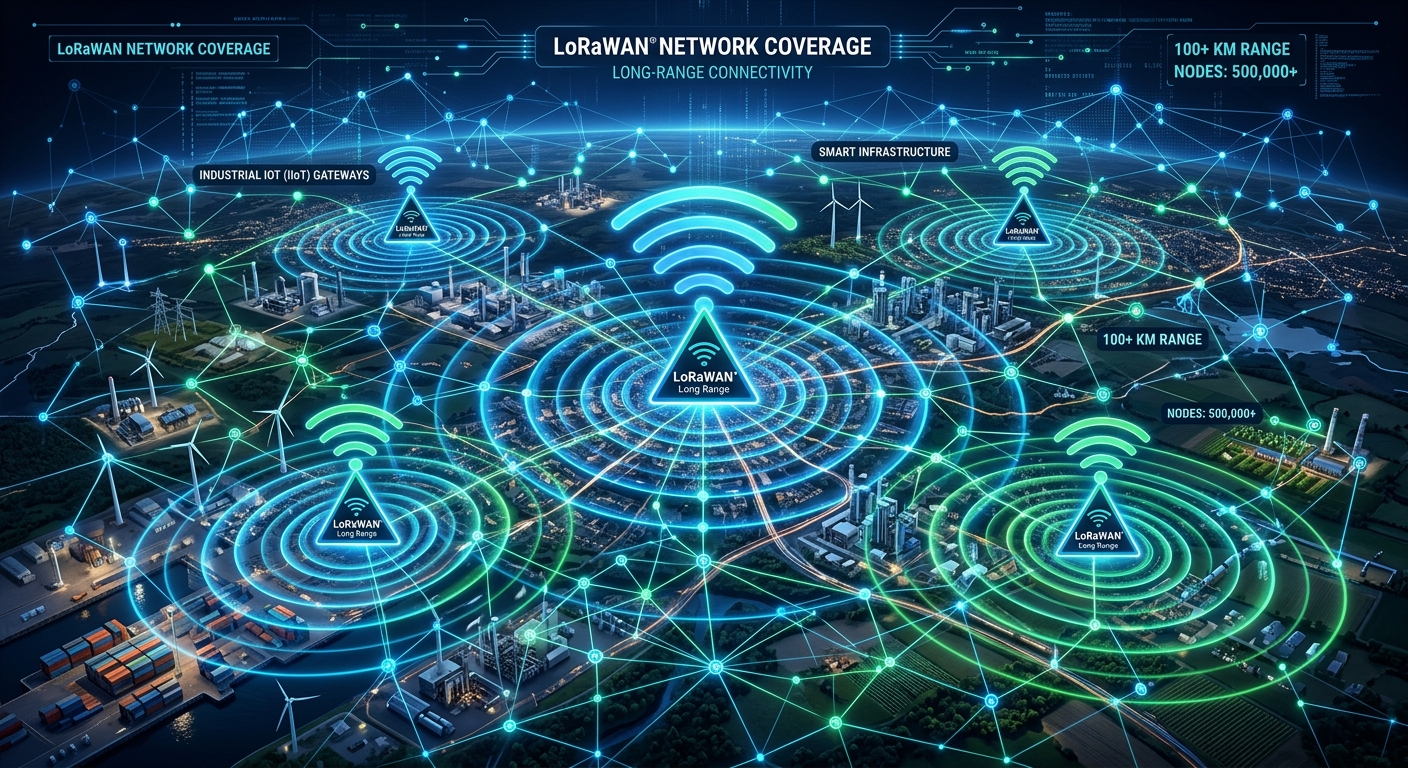
Here is where LoRaWAN enters the conversation. Industry reports and technical assessments have increasingly pointed to LoRaWAN as a fit for applications that need both long range and low power operation. It was architected with exactly that type of deployment in mind. Devices can transmit over several kilometers in open environments, sometimes more, depending on terrain and gateway placement. That characteristic alone shifts the economics because a single gateway can cover a large physical footprint.
Although long range does not solve every design question, the shift has implications for infrastructure planning. Instead of wiring up dozens of access points or Bluetooth relay nodes, organizations can deploy far fewer LoRaWAN gateways. Some city governments that have tested early smart city initiatives found this difference surprisingly helpful. Not everyone expects a wireless protocol intended for wide area sensing to simplify budgeting, but it often does.
A small tangent helps illustrate this. In agricultural IoT, growers often need soil moisture data from fields that span hundreds of acres. Running WiFi or Bluetooth repeaters across that land would be impractical. Cellular connectivity is often possible, sometimes preferred, yet the recurring fees and power requirements make it heavy for simple sensor telemetry. LoRaWAN, by contrast, allows battery powered sensors to operate for long periods with minimal signaling overhead. It is not glamorous technology, although reliability tends to matter more than glamour when the use case is monitoring crops or water flow.
Still, connectivity decisions are rarely just technical. Enterprises have to think about ecosystem maturity, security frameworks and integration with cloud platforms. LoRaWAN has benefited from growing adoption in industrial IoT circles, which has encouraged more vendors to support the protocol. Even so, organizations considering it must balance tradeoffs. Data rates, for example, are intentionally low. LoRaWAN was built for small, periodic messages, not video or rich telemetry. That said, many IoT deployments simply do not require high throughput.
One question that often surfaces is whether LoRaWAN competes directly with cellular IoT technologies like LTE-M or NB-IoT. The short answer is that they tend to complement each other. Each protocol fits different operational profiles. Cellular IoT excels when mobility, global roaming or higher reliability guarantees are needed. LoRaWAN fits best when power longevity, cost control and local coverage management are the priority. Choosing between them sometimes feels like choosing between hiking boots and cycling shoes. They serve different purposes.
The growing spotlight on LoRaWAN does not diminish the role of other short range protocols either. Bluetooth continues to dominate consumer device connectivity. WiFi remains foundational for enterprise networks. Zigbee and Z-Wave still have loyal bases in home automation and building systems. The real change is that decision makers are no longer assuming those standards can stretch into every new IoT scenario. With edge sensing expanding into utility grids, environmental monitoring, logistics yards and rural infrastructure, range and power consumption become first order requirements instead of afterthoughts.
One more angle deserves attention. As organizations roll out more distributed sensing projects, the operational overhead of maintaining these networks becomes a measurable cost. If technicians need to replace batteries constantly or troubleshoot mesh links every few weeks, the total cost of ownership spikes. This is part of the reason why long range, low power solutions are gaining momentum. They reduce the number of failure points. They also simplify network design because coverage is easier to predict.
In the end, the broader shift in IoT connectivity conversations is less about hype and more about pragmatism. Organizations are recognizing that legacy short range protocols, while excellent for their original use cases, do not scale gracefully into sprawling sensor networks. LoRaWAN, purpose built for long range IoT, is stepping into that gap. Whether it becomes the dominant standard is yet to be seen. Still, many enterprises are now treating it as a serious tool in the connectivity toolbox, and that alone signals a meaningful change in how wide area IoT systems are being architected.