 ⬇️
⬇️
Key Takeaways
- The global lithium-ion battery safety systems market is projected to reach USD 28.84 billion by 2031, driven by the critical need to contain thermal runaway in E-mobility and energy storage.
- A surge in battery fires, including 550 U.S. incidents reported in 2024 resulting in 126 injuries and 14 deaths, according to UL Solutions, is forcing manufacturers to adopt advanced suppression and cooling technologies.
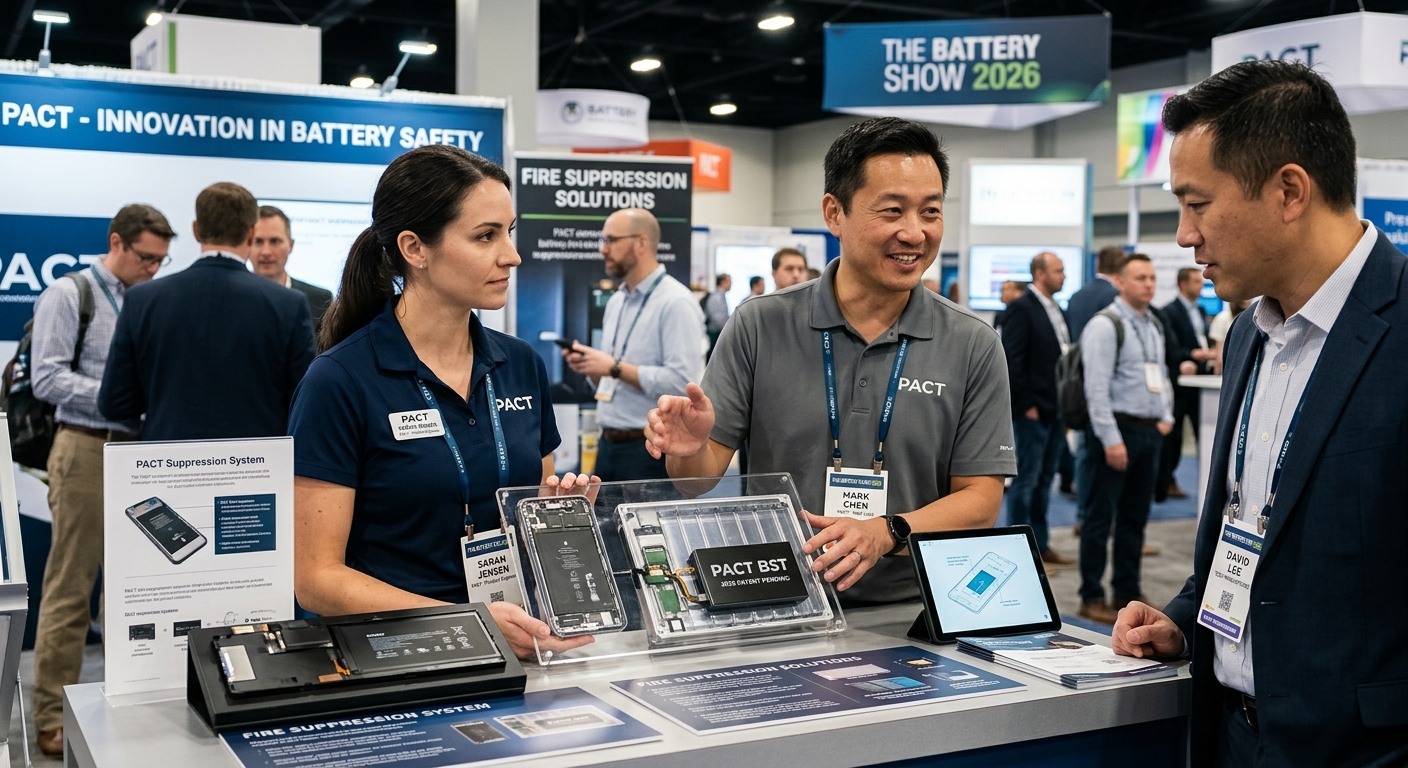
- Packaging and Crating Technologies (PACT) is debuting its newest portfolio of specialized fire-suppression materials, including its TR Envelope and PACT Lion-X extinguisher, at The Battery Show in Detroit to address these escalating hazards.
The mass adoption of lithium-ion batteries across the E-mobility, consumer electronics, and grid-scale energy storage sectors has created a high concentration of portable power. However, this deployment scale has introduced serious fire risks. When subjected to physical damage, overheating, or manufacturing defects, lithium-ion cells can enter a self-heating cycle known as thermal runaway. This process ejects shrapnel, particulate matter, and toxic gases, frequently resulting in fires that are difficult to extinguish using conventional methods.
UL Solutions data shows that in the U.S. there were approximately 550 reported incidents involving lithium-ion batteries in 2024, leading to 126 injuries and 14 deaths. The consequences of these fires are becoming increasingly visible in municipal data. According to NYC Lithium-Ion Battery Fires: 30 Deaths, New York City has recorded more than 800 lithium-ion battery fires since 2022, resulting in 30 deaths and over 400 injuries, with 268 fires logged in 2023 and 277 in 2024. The threat profile is expanding similarly in other metropolitan areas. According to a report summarizing Toronto Fire Services data, building fire risks associated with these cells rose from 11 incidents in 2020 to 76 in 2024, with a 38% year-over-year increase from 2023 to 2024, making lithium-ion one of the fastest-growing hazards for local first responders.
In response, regulatory bodies and standards organizations, including the National Fire Protection Association (NFPA) and UL, are strengthening safety mandates. The 2026 edition of NFPA 855 now explicitly requires automatic fire-extinguishing, gas detection, and explosion control for energy storage systems above defined thresholds. This regulatory push is fueling significant capital investment in safety technologies. The commercial landscape is detailed in Lithium-Ion Battery Safety Systems Market Size and Share, which values the sector at USD 11.67 billion in 2025, with projections indicating growth to USD 28.84 billion by 2031.
New Containment Strategies for a Growing Hazard
Against this backdrop of escalating risk and tighter regulation, manufacturers are engineering targeted thermal management materials designed specifically for the unique chemistry of lithium-ion fires. One such manufacturer, PACT (Packaging and Crating Technologies), based in Watertown, Connecticut, is preparing to demonstrate its patented suppression product line at The Battery Show in Detroit, Michigan, from October 12-15, 2026.
The scope of the problem requires interventions that do more than simply douse flames; they must arrest the underlying chemical reaction and prevent unit-to-unit propagation.
"As of early 2026, lithium-ion battery fires are on the rise among E-mobility, micromobility and handheld electronics, causing frequent incidents on land, sea and in the air. These fires are nearly impossible to extinguish and must smolder out on their own after burning for many hours and days, all while emitting lethal fumes and gases. Our proven innovations are critical safety solutions for first responders and the general public from a major catastrophic event." Rodger Mort, chief operating officer, Packaging And Crating Technologies
Intervening at the Cellular Level
To address thermal runaway before it compromises adjacent cells or entire structures, the company is showcasing multiple proprietary solutions at the Detroit convention, which according to event organizers attracts more than 19,000 engineers and business leaders annually. The event highlights how rapidly the sector must adapt. According to organizers, "the battery and EV industry is moving faster than ever and staying ahead means having the right knowledge, the right connections, and the right strategies. The Battery Show Detroit 2026 delivers all three!"
Among the technologies being presented is PACT Thermo Shield, a lightweight paper packaging material embedded with a moisture-enhancing ink. When a battery begins to burn and vent gas, the material creates a vapor cloud that instantly cools the internal package environment below 780ºC. Crucially, the shield limits available oxygen to prevent the battery temperature from reaching 820°C, the thermal threshold where highly explosive chlorine carbides and acids form.
For original equipment manufacturers integrating dense battery packs in E-bikes and EVs, the company has adapted this technology into the TR Sleeve. By wrapping individual cells in a layer of Thermo Shield, the sleeve mitigates thermal propagation between units. The sleeve adds just 0.009 inches to each cell's diameter, allowing manufacturers to tightly press or stack cells without needing separate potting materials. A consumer-facing variant, the TR Envelope, provides a safe transport and storage format for smaller electronics like cell phones, smartwatches, and pagers, which increasingly pose hazards on commercial flights.
Chemical Quenching and Next-Generation Extinguishers
Beyond passive packaging and cellular shielding, active suppression remains critical for active fires. The company's portfolio includes PACT Lion-X, a pre-mixed, water-based suppression formula engineered to quench lithium-ion fires at temperatures up to 1,600 degrees Fahrenheit. The formula operates by absorbing significant heat energy and altering smoke formation to suppress the production of highly flammable hydrogen and methane gases.
Once deployed, the agent prevents thermal propagation by maintaining low temperatures in surrounding cells. After the fire is fully smothered, the formula leaves only a fine powder residue that continues to actively cool the surface and can be wiped away with standard materials. The product has already passed testing at the Litchfield County Fire Center, the Polk County Oregon Fire Center, the Vtec Upstate Test Center, and the UL-A Test, and is currently undergoing rigorous evaluation by the Environmental Protection Agency.
Common Questions
What triggers thermal runaway in lithium-ion batteries?
Thermal runaway is an uncontrollable, self-heating state within a lithium-ion cell. It is typically triggered by extreme high temperatures, physical puncturing, heavy vibration, or internal manufacturing defects, which cause a chemical chain reaction that ejects fire, shrapnel, and toxic gas.
How does PACT Lion-X differ from traditional fire suppressants?
Unlike standard suppressants that merely smother flames, PACT Lion-X is a specialized water-based formula that actively quenches fires up to 1,600 degrees Fahrenheit while transforming smoke composition to reduce explosive hydrogen and methane production. It also leaves behind a fine cooling powder to prevent surrounding cells from igniting.
What regulatory standards govern lithium-ion battery energy storage safety?
Standards like NFPA 855 and UL 9540/UL 9540A establish the baseline for battery safety. The 2026 edition of NFPA 855 requires extensive hazard mitigation, including automatic fire suppression and gas detection, while UL 9540A mandates large-scale thermal runaway fire propagation testing.
Securing the Future of High-Density Energy
As urban centers densify and rely more heavily on lithium-powered micromobility, often utilizing uncertified, imported batteries or dangerous charging habits in enclosed spaces, the risk of rapid fire propagation continues to multiply. Organizations operating within the Department of Defense and the Department of Transportation, both of which the company says already engage with its transit solutions, recognize that mitigating these fires requires specialized containment systems rather than standard emergency response tactics.
By addressing the specific chemical thresholds of battery fires, vendors are shifting the industry's approach from reactive firefighting to proactive thermal containment.
"We are proud to have developed these innovative safety containment solutions that help protect property and human lives from dangerous and deadly lithium battery fires. We believe they will become critical gamechangers as lithium battery usage continues to grow worldwide and new micromobility products emerge in the marketplace." said Mort.