 ⬇️
⬇️
PowerLight Moves Laser Power Beaming From Lab Components to Integrated UAS System Tests
Key Takeaways
- PowerLight Technologies has completed subsystem testing of its autonomous high‑power laser transmitter and lightweight airborne receiver.
- The system, developed under the CENTCOM‑supported PTROL‑UAS program, aims to wirelessly recharge UAS in flight using kilowatt‑class laser energy.
- Integrated flight demonstrations with Kraus Hamdani Aerospace’s K1000ULE are planned for early 2026.
PowerLight Technologies is pushing laser power beaming from an intriguing concept into something that looks operationally plausible. The company announced it has finished subsystem testing for an end‑to‑end wireless power beaming system designed for unmanned aerial systems (UAS). This moves the PTROL‑UAS program into a phase where individual components start behaving like a unified platform rather than isolated engineering exercises. It sounds like a small distinction, but anyone who has lived through a hardware integration cycle knows the difference between "parts on a bench" and "systems talking to each other."
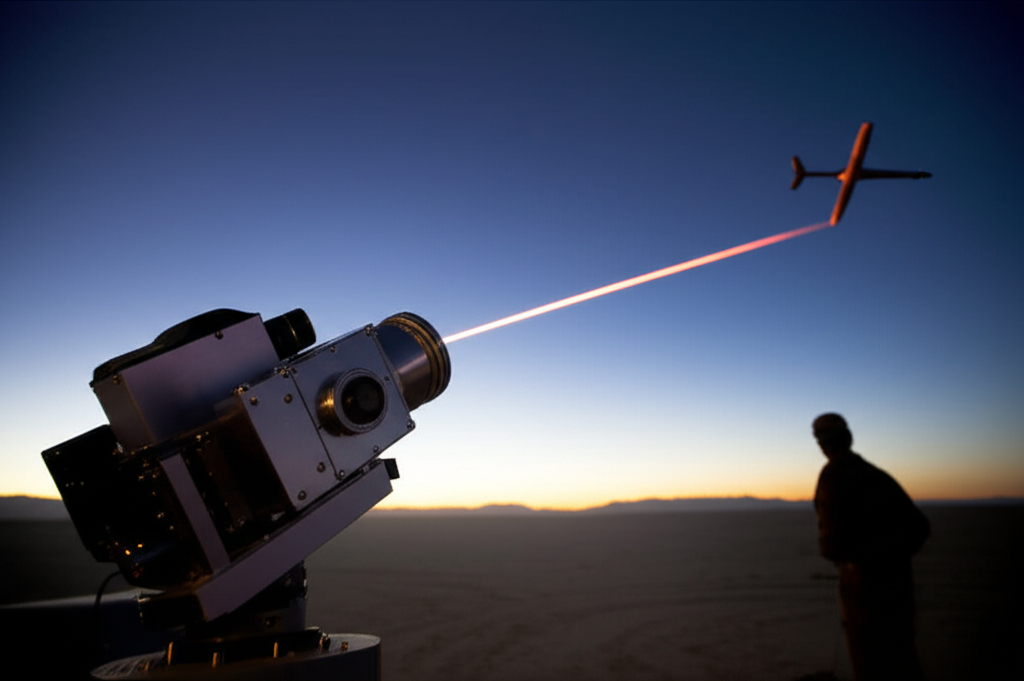
At the center of the effort is an autonomous high‑power transmitter—PowerLight’s ground‑based unit that handles precision tracking and power delivery. The company says it can maintain kilowatt‑level laser output, track cooperative airborne receivers, and operate in forward‑deployed conditions where environmental stability is often an afterthought. That mix is unusual; most industrial high‑power laser systems expect to stay bolted to a factory floor.
PowerLight verified several core capabilities during testing. Active target tracking is one of the big ones. The transmitter uses high‑precision optical tracking to lock onto a receiver mounted on an aircraft in flight. The system is engineered for long‑range operation up to roughly 5,000 feet of altitude. It also layers multiple safety interlocks—autonomous and operator‑in‑the‑loop—to manage risk in mixed-use airspace. For readers familiar with laser safety regimes, that last part matters a lot; kilowatt-class lasers don’t get deployed casually. It serves as a reminder of how much engineering goes into the "don’t hit anything you shouldn’t" side of these systems.
The transmitter is backed by integrated control software that handles real‑time monitoring, analytics, and interface points with UAS control tools and ground power infrastructure. PowerLight describes the system not simply as a point‑to‑point beam but as the foundation of an "intelligent mesh energy network capability." CTO and Co‑Founder Tom Nugent reinforced that idea, noting that the transmitter communicates with the UAS, tracks its velocity and vector, and delivers energy precisely where it’s needed. His comment signals a shift from static beams toward adaptive, feedback‑driven energy delivery. One could argue that’s where power beaming starts to look like a logistics system instead of a science experiment.
On the aircraft side, the company developed a six‑pound onboard receiver that converts non-visible laser light into electricity to charge the drone’s battery. It uses laser power converters, plus an embedded control module that collects telemetry and sends data back to the ground station. That module also sets up a bi‑directional optical data link—hinting at future integrations where power and communications share an optical channel. It’s not uncommon for defense‑oriented platforms to combine capabilities this way, but seeing it designed in from the start suggests PowerLight is thinking ahead about bandwidth and command links. A quick tangent: the dual‑use interest in optical communication has been rising since early demonstrations by NASA and others, as highlighted by work from the Space Development Agency on optical inter-satellite links. It’s not the exact same application, but it shows the broader momentum around optical channels in contested environments.
The PTROL‑UAS program itself, supported in part by U.S. Central Command, is structured around delivering operational energy to unmanned systems in flight. Not metaphorically—literally beaming kilowatts of power to drones so they don’t have to land. If successful, it reframes how long‑endurance UAS are deployed. Persistent coverage stops being a function of battery chemistry or swap cycles and instead becomes a matter of maintaining line-of-sight to a ground‑based power node. Still, that raises a practical question: how will commanders balance the promise of "infinite flight" with the realities of airspace control and beam scheduling?
PowerLight isn’t working alone. The company has partnered with Kraus Hamdani Aerospace to integrate the receiver into the K1000ULE, an ultra‑long endurance aircraft already known for staying aloft far longer than typical small UAS platforms. Kraus Hamdani CEO and Co‑Founder Fatema Hamdani described the pairing as adding "a new level of persistence," noting that a platform that doesn’t need to land to refuel or recharge "is one that never blinks." It’s a vivid line, and a telling one—persistence is becoming the currency of modern ISR operations, and uncrewed aircraft are central to that shift.
The upcoming flight demonstrations in early 2026 will be the moment when all the talk about infinite flight meets the realities of airborne integration. PowerLight says both the transmitter and receiver subsystems are entering final validation now, setting up the transition to real-world in‑flight charging over kilometer-class distances. Flight tests are always a filtering stage. Some capabilities translate smoothly; others reveal new engineering challenges that weren’t visible in controlled test environments. Even so, it’s clear that PowerLight views this as the final hurdle before showing an operationally relevant demonstration rather than a lab exercise.
The broader context—though the company doesn’t oversell it—spans defense, telecommunications, industrial operations, and even space-based energy transfer. PowerLight positions itself as a dual‑use provider focused on safe, high‑power laser energy transmission over long distances. They frame it as "powering intelligence at the edge," and while that phrase can sometimes feel fuzzy, here it’s grounded in a specific capability: delivering sustained energy to autonomous systems that weren’t designed to carry it themselves.
It’s a reminder that autonomy isn’t just a matter of algorithms. Energy is often the real choke point. If PowerLight’s system performs in integrated testing the way it has in subsystem trials, commanders and commercial operators may soon need to think differently about what endurance means for uncrewed platforms.