 ⬇️
⬇️
Key Takeaways
- Quanta Computer and Quantinuum will jointly develop hardware infrastructure for future generations of quantum systems.
- The work will focus on modularity, manufacturability, systems engineering, and the supply chains required for commercial deployment.
- The agreement reflects a wider industry shift from laboratory advances toward scalable, fault-tolerant quantum computing.
Quanta Computer and Quantinuum have entered a collaborative development agreement intended to move quantum computing closer to industrial-scale production. The partnership, announced on Aug. 13, 2026, combines quantum hardware and software capabilities with specialized experience in manufacturing advanced computing and cloud infrastructure.
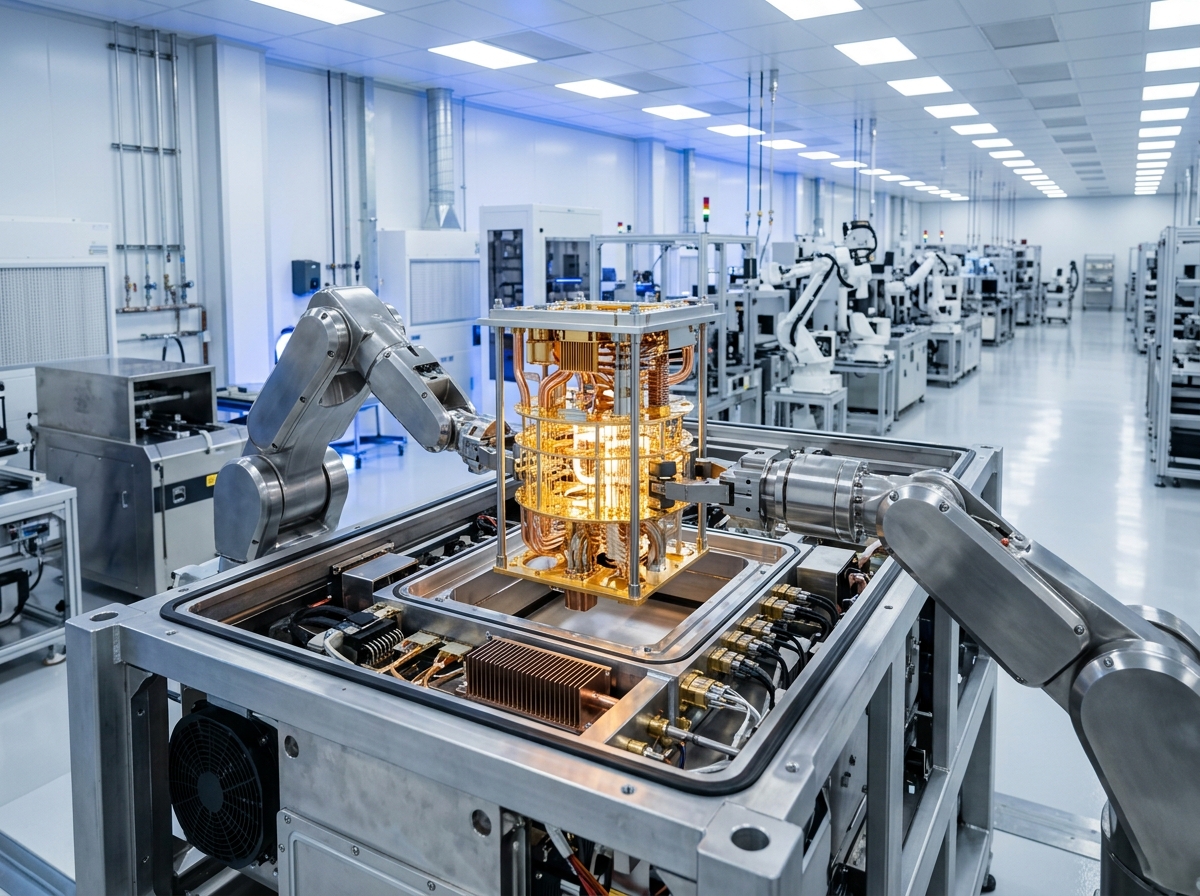
Joint engineering work is already underway. The companies plan to co-develop critical hardware infrastructure for future generations of these quantum systems, with an emphasis on making the hardware more modular, manufacturable, and scalable. Financial terms, production targets, and delivery schedules were not disclosed.
That distinction matters. Much of the quantum computing industry has concentrated on improving qubit performance, control methods, error correction, and application software. Those remain central technical challenges. But commercially useful quantum computers will also require repeatable manufacturing, dependable component sourcing, maintainable system designs, and infrastructure that can be deployed outside tightly controlled research environments.
The president and CEO of Quantinuum framed the agreement as a transition from laboratory physics to manufacturing. "It is time for quantum computing to transition from breakthroughs in physics achieved in the lab to breakthroughs in system manufacturing that can be deployed and operated at scale," the executive said.
Quanta Computer brings experience in industrializing sophisticated computing platforms at a global scale. That background could help address practical engineering concerns that become more prominent as quantum systems grow, including subsystem integration, standardized interfaces, serviceability, production consistency, and supply-chain coordination.
The partnership does not mean those challenges are solved. It creates a structure for tackling them earlier and alongside the core technology roadmap. If manufacturing considerations arrive only after a quantum architecture has matured, redesigning that hardware for volume production can become expensive and slow. Building manufacturability into successive generations reduces those delays and cost overruns.
Commercial interest is rising in parallel. IDC projects worldwide customer spending on quantum computing hardware, software, cloud access, and services to increase from $1.1 billion in 2022 to $7.6 billion by 2027, representing a 48.1% compound annual growth rate. The forecast suggests enterprise demand is developing even while large-scale, fault-tolerant systems remain on the industry roadmap.
Longer-term estimates are larger, though naturally more uncertain. Boston Consulting Group estimates that quantum computing could create between $450 billion and $850 billion in economic value over the long term, supporting a provider market of $90 billion to $170 billion by 2040. Reaching that level would depend on the industry progressing beyond noisy intermediate-scale quantum devices toward fault-tolerant architectures capable of sustained commercial workloads.
What will enterprises actually need from those systems? Raw quantum performance will count, but so will uptime, integration with classical computing, predictable operations, security controls, and support across the equipment lifecycle. Buyers in manufacturing, logistics, chemicals, and scientific research are unlikely to treat quantum machines as isolated laboratory instruments. They will expect them to operate within established data-center, cloud, and high-performance computing environments.
The competitive context is also widening. IBM is pursuing its own quantum systems roadmap, while Rigetti Computing has promoted an integrated chip-to-cloud model. Different qubit technologies and system architectures may prevail in different workloads, but providers face a common industrial question: how can highly specialized quantum equipment become a repeatable computing product?
Standards will influence that transition. NIST has documented work across quantum information science, while ISO/IEC Joint Technical Committees continue developing terminology and technical frameworks for quantum technologies. Separately, NIST finalized the ML-KEM, ML-DSA, and SLH-DSA post-quantum cryptography standards in 2024. Those cryptographic standards address security rather than quantum computer manufacturing, but they illustrate how institutions are preparing for a broader quantum era before fault-tolerant machines become commonplace.
For enterprise technology leaders, the agreement is therefore less about an immediate quantum procurement cycle and more about the infrastructure behind the next one. The two partners are betting that scalable quantum computing will depend not only on scientific advances, but also on disciplined systems engineering and manufacturing. That is a less glamorous layer of the market. It may prove to be one of the most consequential.