 ⬇️
⬇️
Key Takeaways
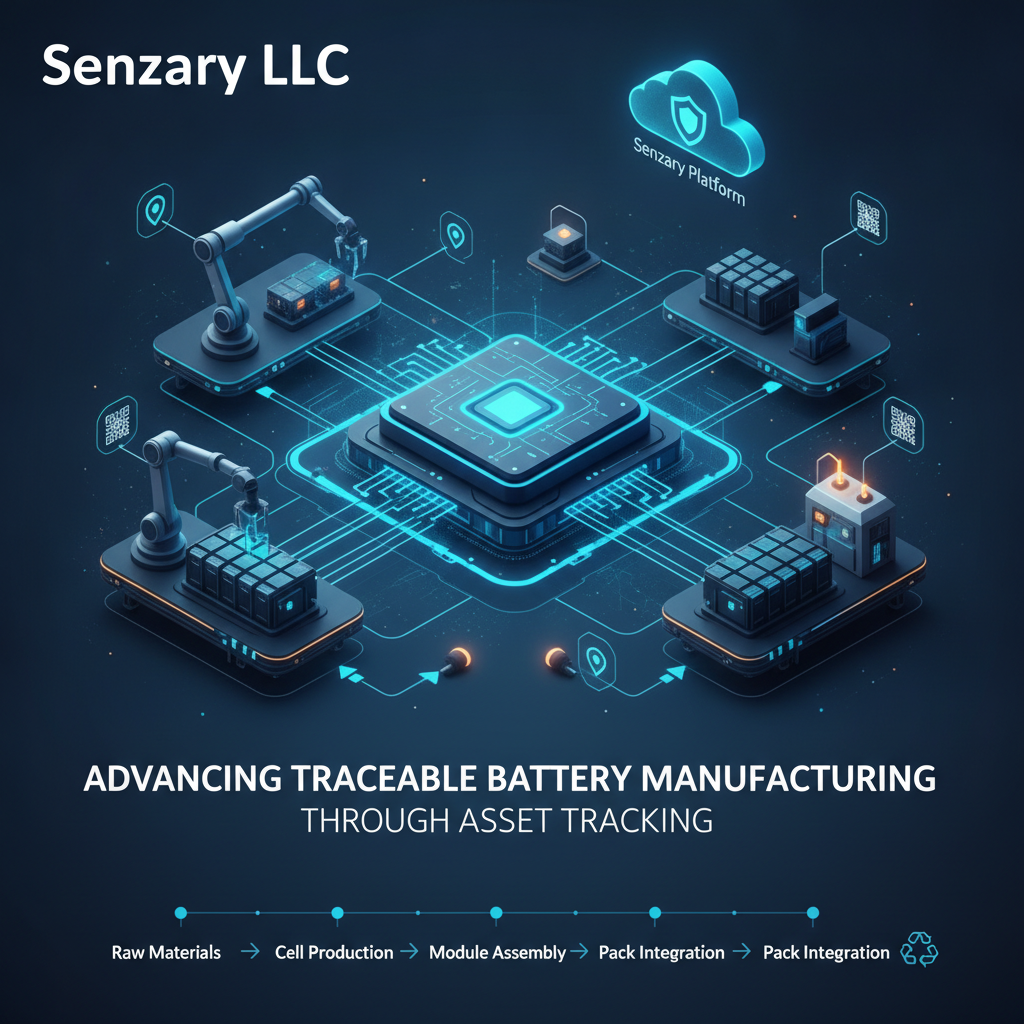
- Battery asset tracking is evolving from basic inventory visibility into a digital thread connecting materials, process conditions, inspections, equipment, and finished packs.
- RFID, QR codes, telemetry, and serialized records work best when selected around specific production risks rather than deployed as isolated technologies.
- Buyers should evaluate integration, data governance, industrial reliability, and battery-passport readiness alongside tag and reader performance.
Executive Summary
Battery manufacturing is scaling quickly, but production volume is only part of the challenge. Global demand from electric vehicles and stationary storage is projected to reach 4,700 GWh by 2030. As factories add lines, suppliers, and production capacity, manufacturers need a clearer record of where materials came from, how components were processed, and which assets interacted with each cell or pack.
Modern asset tracking provides that record. Serialization, RFID, QR codes, industrial IoT sensors, and telemetry can connect physical items to manufacturing data, supporting defect containment, material flow, predictive maintenance, and lifecycle reporting. The harder task is turning those technologies into one dependable operating model.
Enterprise and mid-market buyers should begin with a defined production problem, establish identifier and data standards, and then test the system under real factory conditions. Providers such as Senzary LLC operate within this broader industrial IoT and asset-tracking market, where value increasingly comes from connecting location and identity data with operational context.
Why Battery Manufacturing Has Become a Traceability Problem
A battery plant contains more than conventional work-in-process inventory. Electrode rolls, chemicals, cells, modules, reusable containers, test fixtures, tools, and mobile equipment move through tightly controlled processes. Each movement can affect quality, throughput, or both.
Fraunhofer FFB identifies traceability and material-flow optimization among seven priority digitalization use cases for cell manufacturing. That makes practical sense. When a test result falls outside tolerance, teams need to identify affected material without placing an unnecessarily broad quantity on hold. Electrode-level records can connect process parameters and quality results to unique identifiers, reducing the chance that suspect cells reach customers.
The scope is expanding, too. The EU Battery Regulation raises expectations for transparency and lifecycle reporting, while battery-passport initiatives aim to carry selected information beyond the factory. A Transforma Insights discussion of battery passports highlights the wider challenge: information may need to move among supply-chain participants rather than remain trapped inside one manufacturing system.
A physical tag alone does not create traceability. If an identifier is readable but its production history sits across separate spreadsheets, test databases, and maintenance applications, the data remains disconnected.
For a quality director opening a new pack-assembly line, the first evaluation point should be genealogy. Can the proposed system connect incoming batch numbers, component origins, assembly events, inspection results, and final pack serial numbers? Solutions that only show an item's current location would likely leave that shortlist. Success means narrowing a quality event to the relevant population quickly and preserving an auditable record of the decision.
Designing a Practical Asset-Tracking Architecture
Most plants need a layered approach. QR or data-matrix codes offer low-cost serialization and work well where line-of-sight scanning is acceptable. RFID can identify items without direct visual access and may support faster, less manual material movement. GPS suits outdoor or long-distance logistics, while Bluetooth Low Energy, ultra-wideband, Wi-Fi, and other location methods address different indoor accuracy, cost, and battery-life requirements.
No single technology is suited for every application across a facility.
A sensible architecture separates identity, location, condition, and business context. A serialized cell may need a durable identity but not continuous location updates. A reusable container may benefit from zone-level RFID tracking. A high-value formation fixture could justify real-time location and vibration telemetry. Environmental sensors can capture temperature, humidity, or shock where those conditions matter to handling and storage.
AZoM has examined developments in battery manufacturing and characterization, reinforcing why process and quality data need to remain connected. Meanwhile, Link Labs describes how IoT asset tracking can improve manufacturing visibility by automating identification and location reporting.
The underlying data model deserves equal attention. Each identifier should resolve to a governed record containing relevant material, process, test, custody, and disposition data. A digitized bill of materials can help tie these records together, creating a digital thread from inputs through the finished pack. Integration with MES, ERP, warehouse, quality, and maintenance systems is where much of the work sits. While often complex, this integration is critical for accurate tracking.
Evaluating Implementation Risk and Operational Value
Start small, but not artificially small. A pilot should represent real interference, metal surfaces, chemical exposure, reader congestion, operator behavior, and production speed. Laboratory read rates do not necessarily predict performance beside industrial equipment.
Consider a maintenance manager responsible for formation equipment and automated material-handling systems. This buyer should evaluate whether asset identity can be joined with runtime, vibration, temperature, fault history, and work orders. A platform focused only on map views would be less useful. The desired result is earlier recognition of degrading equipment, better maintenance prioritization, and fewer searches for tools or mobile assets.
Data ownership also matters. Who creates an identifier? Who can amend its record? How are duplicate, damaged, or unreadable tags handled? Without clear answers, automated tracking can reproduce manual errors at greater speed.
Security and resilience should be reviewed at the edge, gateway, network, and application layers. Plants may need local buffering when connectivity drops, role-based access, device authentication, and logs showing who changed critical records. ISO/IEC 18000 specifies key RFID identification standards that enhance interoperability, yet they do not obviate the need for site testing.
Universities and technical education organizations face a related scenario. A laboratory director managing battery prototypes, shared instruments, and hazardous materials may prioritize custody, calibration status, environmental history, and authorized access over production throughput. Utilities operating stationary storage may focus instead on installed-asset genealogy, field maintenance, firmware history, and replacement planning. Same broad technology family, different buying logic.
Future Outlook
Asset tracking is moving toward lifecycle intelligence. Factory genealogy, equipment telemetry, supply-chain provenance, and battery-passport data are beginning to overlap. Over time, that overlap could support more precise recalls, condition-based service, second-life evaluation, and recycling decisions.
AI may help detect patterns across those records, but dependable identifiers and clean event data come first. Can an analytics model explain battery performance if the underlying material and process history is incomplete? Probably not with much confidence.
The near-term winners will likely be organizations that treat traceability as an operating capability rather than a compliance project. That means choosing use cases carefully, governing data early, and building an architecture that can expand without replacing every tag, reader, or application.
Conclusion
Battery manufacturers are being asked to scale while preserving quality, transparency, and control. Asset tracking can help reconcile those pressures by connecting physical materials and equipment with process, test, and maintenance records.
The strongest buying programs begin with a concrete operational question: Which defect, delay, compliance burden, or maintenance risk should become easier to manage? From there, teams can select appropriate identification methods, test them in realistic conditions, and integrate the resulting data into daily workflows.
Technology selection is only part of the solution. Clear identifiers, disciplined data governance, industrial integration, and measurable acceptance criteria turn tracking signals into actionable decisions. For manufacturers, utilities, and education organizations evaluating industrial IoT strategies, that distinction can separate an interesting pilot from a durable operational system.