 ⬇️
⬇️
Key Takeaways
- Electronics assembly is facing rising complexity, shorter product cycles, and ongoing labor volatility, and AI-driven automation is now central to addressing those pressures.
- No‑code programming and vision‑driven robotics reduce deployment friction and unlock flexibility that traditional automation couldn’t deliver.
- Leaders evaluating AI strategies should prioritize adaptability, data foundations, and solutions that scale across production lines—not just isolated tasks.
Definition and overview
Most leaders in electronics assembly know the familiar tension: product variation keeps increasing, yet the automation methods many factories rely on were built for a far more stable era. It is not unusual for production managers to report redesigning workflows almost monthly, whether due to component substitutions, customer revisions, or the sheer pace of consumer hardware refreshes. Traditional robotics can handle predictable work, but when variability enters the picture, operators often revert to manual labor to keep output flowing.
AI‑driven automation attempts to break that cycle. Instead of rigid programming and fixed fixturing, machine learning—especially vision‑based systems—offers a way for robots to interpret parts more like humans do. The shift is not magic; it is incremental, built on better perception, simpler programming interfaces, and feedback loops that allow a robot to adjust to real‑world conditions. Throughout recent cycles of automation technology, this blend of software‑first robotics and manufacturing pragmatism is what differentiates durable solutions from temporary hype.
This is where companies like Telekinesis have been shaping the conversation, primarily by focusing on how AI can integrate into existing production environments without forcing plants to rethink everything from scratch.
Key components or features
Teams evaluating AI strategies often fixate on the robot arms themselves. While understandable, this focus can be misleading. The “AI” in AI‑powered robotics for electronics assembly operates effectively across three main layers.
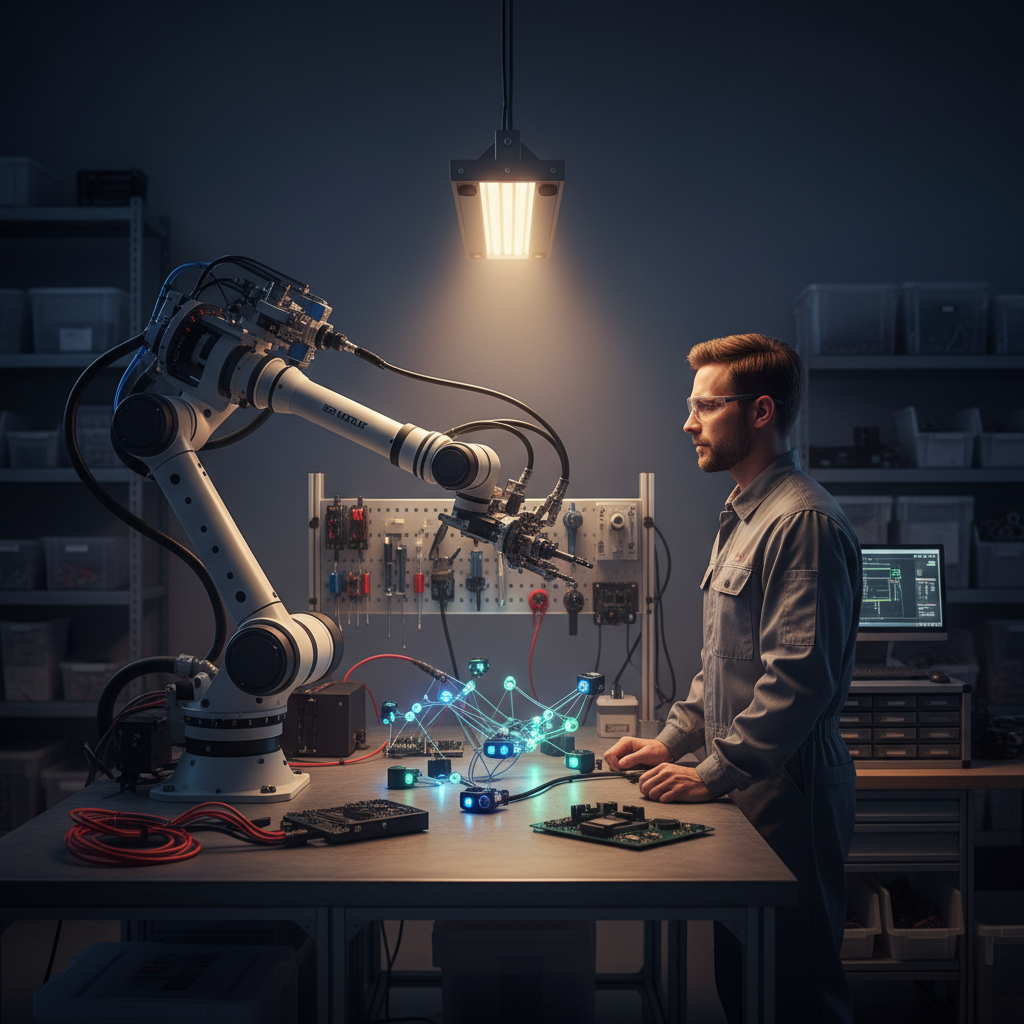
First is the perception layer. Vision AI now routinely handles tasks that once required custom tooling—such as distinguishing between nearly identical components, validating orientation, or compensating for slight variations in part placement. This technology gives the robot a dependable sense of sight, fundamentally changing what it can be trusted to execute.
Next is the programming layer. The bottleneck in robotics deployment has rarely been the hardware itself, but rather the engineering hours needed to set up and adjust processes. No‑code or low‑code interfaces are critical because they shift agency back to line engineers and technicians who understand the workflow best. This is not about oversimplification; it is about making iteration feasible in environments where product specifications change frequently.
Lastly, there is orchestration. AI‑enabled robots do not operate as isolated stations. They tie into MES, quality systems, traceability workflows, and occasionally supplier data. Historically, integrating a single robot into an MES could take longer than the physical deployment itself, but modern software integration has significantly reduced this friction.
These components together create a more adaptable automation stack—one that fits the reality of electronics assembly rather than fighting against it.
Benefits and use cases
Electronics assembly is the kind of environment where the benefits of AI‑driven automation appear less in abstract ROI charts and more in the small, repetitive decisions that collectively determine throughput. For example, pick‑and‑place tasks with moderate variability—different board layouts, component tolerances, or slight shifts in feeder behavior—were historically on the edge of what traditional machine vision could handle. Now, with vision models trained on representative data, robots can manage these tasks with significantly fewer interventions.
Another use case gaining momentum is inspection. This refers not to fully automated optical inspection (AOI), which has existed for years, but to the gray‑area inspection steps where AOI proved too rigid and manual inspection became too costly. AI‑driven cameras can classify defects or validate assembly states in ways that match the nuance of human judgment. While not perfect, the goal of these systems is high-level consistency.
Rework tasks are also becoming more approachable. Robots can now handle delicate cabling, connectors, or fragile components after being guided by AI models that interpret visual cues in real time. While not every facility is ready to adopt these advanced capabilities immediately, the trajectory of the industry is unmistakably moving toward flexible robotic manipulation.
Perhaps the most overlooked benefit is the retention of skilled workers. When technicians are relieved of reprogramming point‑to‑point moves or compensating for unpredictable part variations, they are more likely to remain in their roles and contribute to higher-value process improvements.
Selection criteria or considerations
Choosing an AI strategy for electronics assembly is complex and requires more than evaluating a robot specification sheet. Leaders should focus on adaptability and the speed at which new processes can be brought online. In practice, that means assessing how quickly a system can learn from new component geometries, how accessible the programming environment is, and how much iteration the system can tolerate without expert intervention.
Organizations also need to evaluate their data foundations. AI systems are only as useful as the images, annotations, and feedback loops they draw from. It is essential to determine where data will originate, who will handle labeling, and how updates will be managed. Vendors differ widely in their philosophy regarding data ownership and management, making due diligence necessary.
Another consideration is how well the robotics platform integrates into the larger manufacturing ecosystem. MES compatibility, quality routing, and traceability workflows determine whether a pilot cell becomes a valuable production asset or an isolated experiment.
Finally, regarding cost: leaders often assume AI‑powered robotics must be prohibitively expensive. However, when deployment time decreases and process updates no longer require external specialists, the economics shift favorably. This return on investment typically becomes visible within the first few cycles of production change.
Future outlook
Looking forward, electronics assembly will likely see an uptick in hybrid work cells—robots handling repetitive, precision‑dependent tasks while humans focus on judgment‑heavy steps that currently resist automation. AI will continue to shrink the gap between these modes, especially as multimodal models improve. Some plants will adopt these capabilities gradually, others more aggressively, but the direction is steady.
There is also a broader cultural shift underway. Automation was once something factories simply "installed." Increasingly, it is becoming something they tune, refine, and evolve, much like software. In that mindset shift, AI‑driven robotics is starting to function less like a speculative future investment and more like a practical tool for managing the complexity of modern electronics manufacturing.