 ⬇️
⬇️
Key Takeaways
- Emergency response expectations have shifted, and legacy communication systems can no longer keep up
- Cloud PBX, Unified Communications, and modern Contact Center platforms now play a central role in crisis coordination
- Real-world use cases show that integrated communication can significantly improve response speed and decision making
The Challenge
Emergencies rarely unfold neatly. Whether it is a severe weather incident, an active security situation, or a sudden operational outage, organizations today face events that require fast, coordinated communication. Yet many enterprise and mid-market organizations still rely on systems stitched together over the years. Some are aging on-prem PBXs, others are siloed call queues, and a few are patched VoIP deployments that struggle under peak load.
What makes this problem more pressing now is the shift in expectations. Today, people assume that help should be coordinated instantly. They expect real-time updates, location-aware routing, and immediate access to the right responders. Internal teams feel the same pressure. Safety officers need to reach hundreds or thousands of employees quickly. Contact center leaders need clarity on call surges during emergencies. Executives want the confidence that their communication backbone will not buckle when stakes are highest.
Here is the thing. Organizations often realize the gaps only when an incident exposes them. A large regional healthcare provider recently faced this during a major power disruption. Their legacy PBX could not handle the sudden increase in internal calls, and their emergency hotlines overloaded within minutes. No catastrophic harm occurred, but it was too close for comfort.
This is where solutions built around Cloud PBX, Unified Communications, and advanced Contact Center capabilities start to matter. Providers such as 101VOICE are seeing more leaders treat emergency readiness as a strategic priority rather than a technical upgrade.
The Approach
Most organizations do not begin with technology. Oddly enough, they usually begin with a post-incident debrief or a tabletop exercise that reveals bottlenecks. Buyers tend to ask: How fast can we reach our people? How easily can we escalate calls to the right response teams? What if our physical building loses connectivity? These are practical questions that frame the solution strategy.
A typical approach includes several steps.
- Stabilize the telephony backbone with cloud-based reliability
- Connect voice, messaging, and collaboration into a single environment
- Build or enhance a Contact Center with intelligent routing and redundancy
- Add crisis-specific capabilities such as mass notifications or priority queues
Some organizations also bring in automated workflows or integrations with safety systems. Others take a simpler route, focusing on fast failover and improved visibility into call volumes during emergencies. It depends on their maturity and risk profile.
There is also a growing trend toward linking Contact Center data with facilities management and security platforms. Not in a science fiction way, but in practical touches such as triggering alerts when call spikes occur in certain departments. Buyers appreciate when the tools feel useful rather than overly complex.
The Implementation
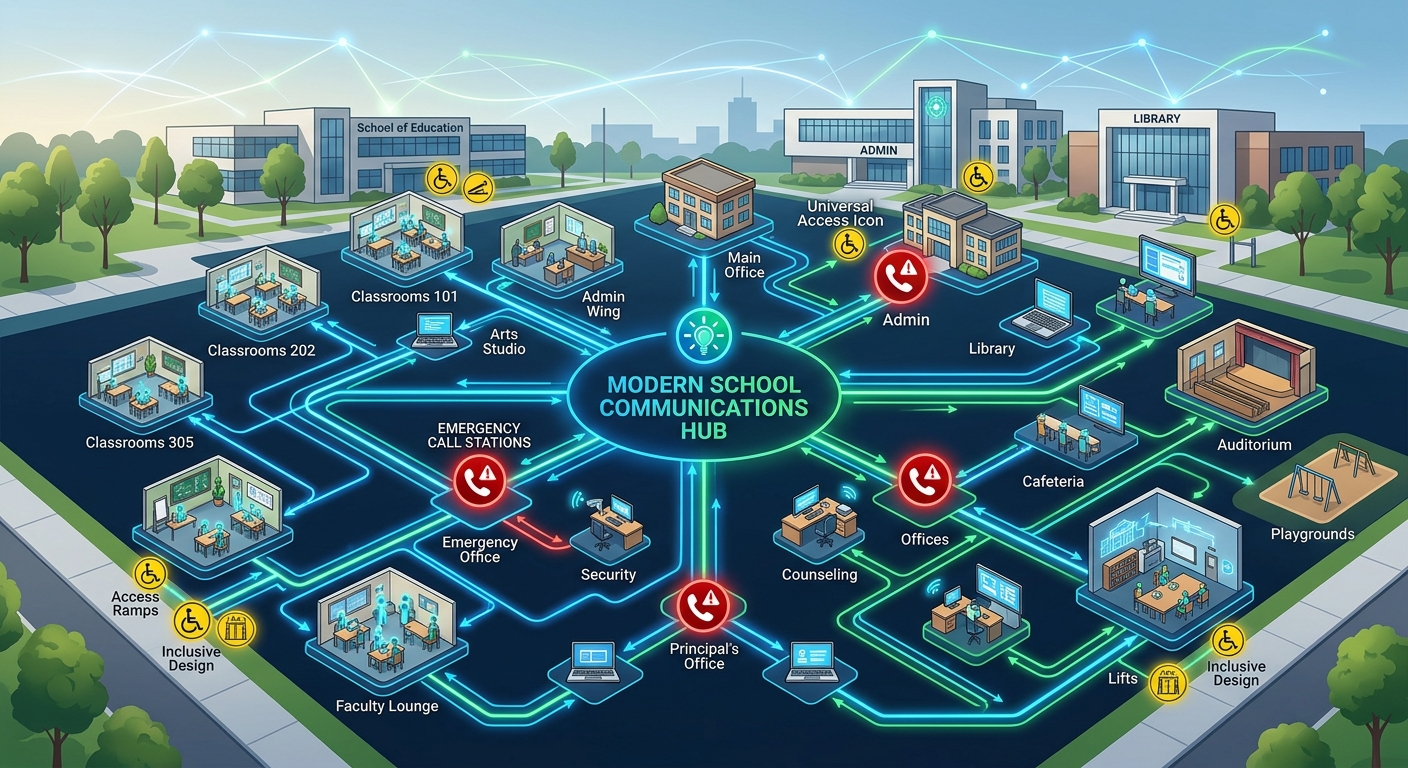
Consider a mid-sized university that decided to modernize its emergency communication posture. They had an older PBX, multiple departmental hotlines, and a small internal contact center that supported campus safety. During a winter storm the previous year, hundreds of callers could not reach support quickly. That moment pushed leadership to move forward.
The implementation happened in phases. First, the telephony infrastructure moved to a cloud-based PBX to ensure continuity even if campus facilities lost power or connectivity. This gave them an immediate boost in reliability. Next, the university unified safety communications across voice, softphones, mobile apps, and internal messaging. Students and staff could now reach help in several ways, not just traditional calls.
Their contact center was then rebuilt with features tuned for emergency response. Intelligent routing prioritized high-severity calls, and automated notifications went to on-call responders instantly. Supervisors gained dashboards showing real-time call spikes during incidents. A small but helpful touch was the ability to route overflow calls to partner campuses during major events.
Implementation took a few months rather than several quarters. And while the project had its share of hiccups, most were related to training and process updates rather than the technology itself. As is often the case, getting people comfortable with new workflows proved more challenging than activating the new features.
The Results
After the transition, the university saw meaningful improvements. Their emergency hotline could now handle sudden call surges without degrading. Response teams received notifications faster and could collaborate across devices even when off campus. Campus safety leaders reported clearer situational awareness during crises because the contact center dashboards showed call patterns in near real time.
They also experienced fewer communication delays between departments. This might sound like a small thing, but in moments of confusion, shaving even minutes off internal coordination can matter. Leadership gained more confidence that the communication backbone would hold up even during disruptive events.
A similar pattern has played out in other industries too, such as finance, manufacturing, and municipal government. The specific tools vary, but the directional outcomes are remarkably consistent. Faster coordination, fewer missed calls, and more reliable communication during peak stress.
Lessons Learned
A few takeaways tend to surface after organizations complete this journey.
- Technology alone does not solve emergency response, but it can remove major barriers
- A unified platform simplifies training and reduces confusion when seconds count
- Cloud-based telephony gives organizations resilience that on-prem systems struggle to match
- Contact center analytics often reveal gaps leaders did not know existed
- Most importantly, testing and drills matter as much as the implementation itself
Emergency readiness is becoming a central business requirement, not a supplemental project. And as the communication landscape continues evolving, organizations evaluating Cloud PBX, Unified Communications, and modern Contact Center solutions are finding that thoughtful modernization can strengthen both routine operations and crisis response. With the right foundation, they can navigate moments of uncertainty with greater speed and confidence.