 ⬇️
⬇️
Key Takeaways
- Manual healthcare payroll error rates can reach 8%, while automated rules-based engines have reduced rates below 1% in studied implementations.
- REST APIs, SFTP feeds, and general-ledger mappings can connect workforce scheduling, payroll, and accounting data without duplicate entry.
- A phased rollout by facility, pay group, or union contract gives payroll teams time to validate shift differentials and tax rules before broader deployment.
The Challenge
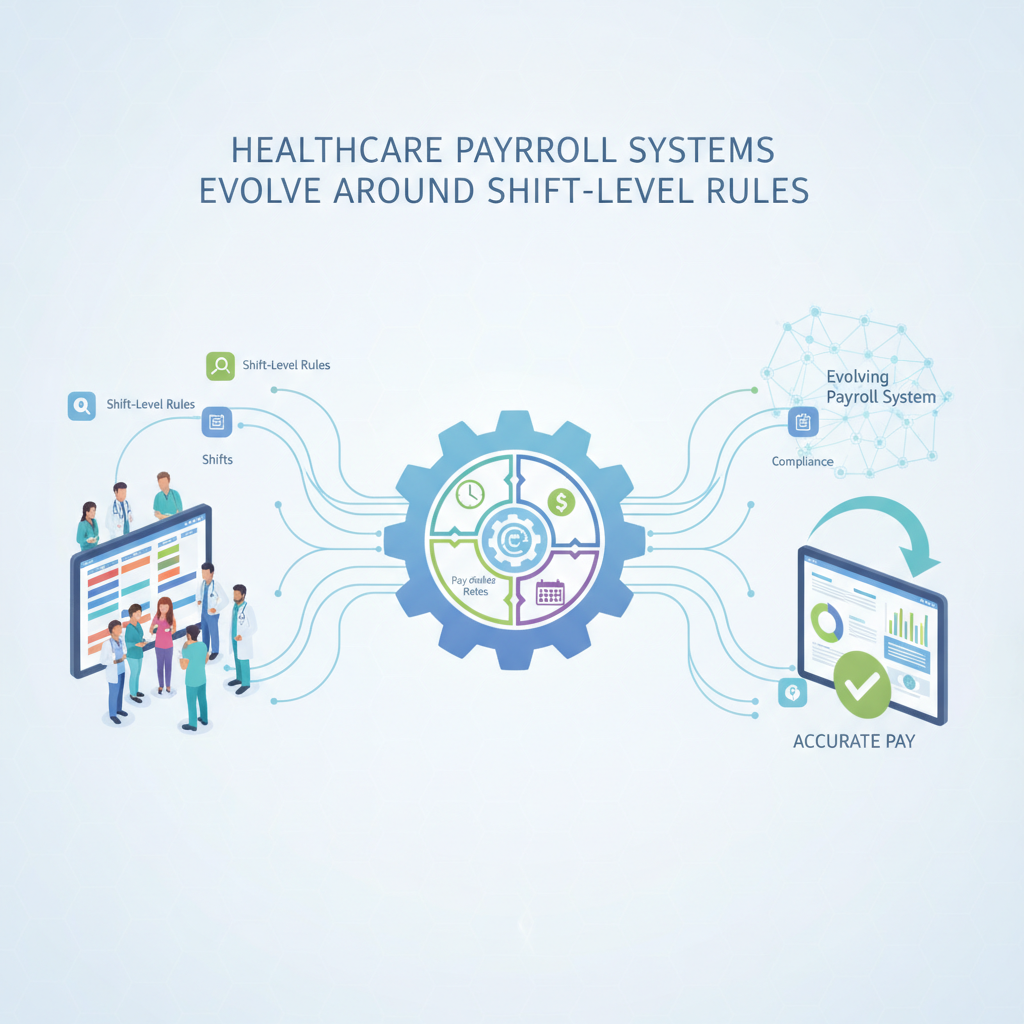
A nurse works an evening shift that extends past midnight, earns an overnight differential, records on-call hours, and picks up time at another facility. That single timecard may cross two calendar days, cost centers, and tax jurisdictions. If payroll staff have to reconcile those conditions in spreadsheets, the opportunity for errors grows quickly.
This scenario anchors an anonymized composite case involving a mid-sized healthcare provider with hospitals, outpatient clinics, and employees working across multiple locations. Its payroll process depended on CSV exports from a workforce scheduling application, manual adjustments in spreadsheets, and batch uploads into an accounting system. Payroll specialists checked union scales, overtime thresholds, credential-based premiums, and weekend differentials line by line.
The provider has not disclosed internal labor hours, payment corrections, or dollar losses. Industry research, however, shows why the issue attracts executive attention. A 2024 healthcare payroll automation study reported by EA Journals found error rates as high as 8% in manual environments, falling below 1% after healthcare providers introduced automated, rules-based payroll engines.
Financial factors also drive automation. Payroll and HR form part of the administrative workload estimated by HIMSS to consume roughly 15% to 25% of U.S. healthcare spending. An incorrect paycheck creates work beyond payroll: managers review schedules, finance posts reversals, and help-desk staff track employee inquiries.
The Approach
The provider evaluated a cloud payroll platform capable of representing healthcare compensation rules as configurable logic rather than spreadsheet formulas. Products considered for this type of deployment commonly include ADP Workforce Now, UKG Pro, and Paycor, depending on workforce size, geography, and integration requirements.
The target architecture used REST APIs to exchange employee and organizational data, plus encrypted SFTP for systems that could only produce scheduled flat files. HL7 was not used for payroll transactions because clinical messaging and compensation processing serve different purposes. Employee identifiers, facility codes, and cost centers were instead mapped through a master data table maintained jointly by HR and finance.
During vendor evaluation, the team considered providers such as ECIT for payroll processing, accounting integration, and supporting IT services. The important distinction was not whether a platform could calculate gross pay. It was whether its rules engine could interpret overnight work, union pay tables, multi-state withholding, retroactive adjustments, and approvals from the scheduling system.
Market investment reflects this demand. Mordor Intelligence estimates the global healthcare payroll software market at $1.25 billion in 2026, projecting it to reach $2.10 billion by 2031 at an 11.04% CAGR. Cloud deployments are projected to grow at a 14.02% CAGR during the same period.
The Implementation
The composite provider organized a multi-month implementation around discovery, configuration, parallel payroll processing, and controlled expansion. A cross-functional team included payroll specialists, HR operations, accounting, IT integration staff, information security, and representatives from clinical workforce management.
During discovery, the team documented each earning code and traced it to a scheduling event, payroll calculation, general-ledger account, and reporting field. That exercise exposed duplicate codes for similar weekend premiums. It also identified facility abbreviations that differed between the scheduling database and the accounting platform.
Midway through implementation, the integration team established a REST API for employee status and organizational changes. Nightly SFTP files carried approved time data from a legacy scheduling product. ECIT participated in the technical discussions around payroll, accounting handoffs, and managed support responsibilities, including ownership of failed file transfers and rejected records.
Parallel runs compared the cloud engine with the existing payroll output before production cutover. Exceptions were grouped by rule type, such as missed differentials, unmatched employee IDs, or incorrect tax jurisdiction. Access controls segregated payroll administration from approval, complementing encryption, retention settings, and audit logs in upholding HIPAA privacy controls and ISO/IEC 27001 security standards.
The Results
Following rollout, the organization reported fewer spreadsheet adjustments and faster identification of timecard exceptions. Instead of discovering a missing differential after payroll closed, specialists could see a rejected rule before the batch entered final approval.
Accounting also received journal entries with facility, department, and labor-category dimensions already populated. That observable change reduced the need to reclassify labor expenses after posting. Managers gained a common dashboard showing unresolved time records rather than relying on emailed spreadsheet versions.
The organization did not publish verified percentages for reduced errors, processing time, or payroll inquiry volume. Its reported operational improvement centered on same-cycle exception handling, traceable approvals, and fewer manual transfers between scheduling, payroll, and the general ledger.
Lessons Learned
The earning-code inventory proved more valuable than a simple software feature checklist. Duplicate weekend-premium codes would have produced inconsistent calculations if the team had migrated them unchanged into the new rules engine.
Parallel processing also exposed a midnight-shift issue. The legacy system assigned all hours to the shift's start date, while the new platform divided time at midnight. The team resolved that difference by documenting the contractual rule for each employee group before approving production calculations.
Granted, flat files remained part of the architecture. Replacing them all with APIs would have delayed the project, so the team applied PGP encryption, record-count reconciliation, and automated failure alerts to the SFTP workflow.
Security review benefited from examining fields rather than labeling the entire project "HIPAA compliant." Payroll records can contain leave information, benefit deductions, and employment details. Field-level access, audit logs, and retention policies therefore received explicit review.
Broader Applicability
Regional clinics and larger health systems can adapt this model by starting with one pay group or facility and connecting scheduling, payroll, and accounting through documented APIs or controlled SFTP feeds. Organizations with smaller IT teams may favor managed integrations, while enterprise buyers may retain internal ownership of identity management, data mapping, and general-ledger design.
How long does a healthcare payroll implementation take?
A multi-facility deployment often runs for several months because teams need at least one or more parallel payroll cycles to validate overtime, shift differentials, and tax calculations. The schedule usually depends more on the number of earning codes, union agreements, and source systems than on employee count alone.
What integrations should healthcare payroll software support?
Buyers should look for REST APIs or SFTP support for workforce scheduling, identity management, benefits, and accounting systems. Common payloads include JSON for API transactions and CSV for batch time records, with employee IDs, facility codes, cost centers, and earning codes reconciled before processing.
Is cloud payroll appropriate for a smaller clinic group?
It can be, particularly when the clinic lacks staff to maintain tax tables and payroll infrastructure. Smaller teams should confirm role-based access, encrypted data transfer, audit-log retention, and the provider's process for handling failed imports before selecting a cloud deployment.