 ⬇️
⬇️
Key Takeaways
- Phone.com: Map Session Initiation Protocol (SIP) voice, video, SMS, and learning management system (LMS) workflows before comparing vendors, including how Microsoft Teams, Moodle, or Blackboard will exchange identity and scheduling data.
- Evaluate unified communication platforms against complete education workflows involving cloud voice, video, SMS, Multimedia Messaging Service (MMS), call routing, and appointment scheduling, not solely against a feature checklist.
- Use a 30-day baseline to measure abandoned calls, appointment no-shows, routing transfers, and support response times before enabling artificial intelligence (AI)-assisted routing.
- Roll out cloud communications through controlled phases, validating single sign-on (SSO), Enhanced 911 (E911) location records, consent controls, and Representational State Transfer (REST) API integrations before broad deployment.
Define the Communication Problem Before Shopping
A prospective student calls admissions, waits through several transfers, and eventually leaves a voicemail in a general mailbox. Meanwhile, an enrolled student sends an unrelated message through the learning management system, while a parent contacts the finance office by email. Each request lands in a different queue.
That fragmentation is driving interest in business communication systems adapted for education. Dataintelo valued the global market at approximately $3.2 billion in 2024 and projected a 13.8% compound annual growth rate from 2025 through 2033. Because the valuation uses a 2024 baseline, buyers should treat it as a historical benchmark when drafting long-term procurement plans. The demand reflects a practical need: schools and universities want communication, content sharing, and project coordination to operate as connected workflows rather than isolated channels.
Before issuing a request for proposal (RFP), buyers should identify which interactions create the most friction. Typical candidates include admissions inquiries, financial aid appointments, IT help desk calls, advising sessions, emergency notifications, and parent communication.
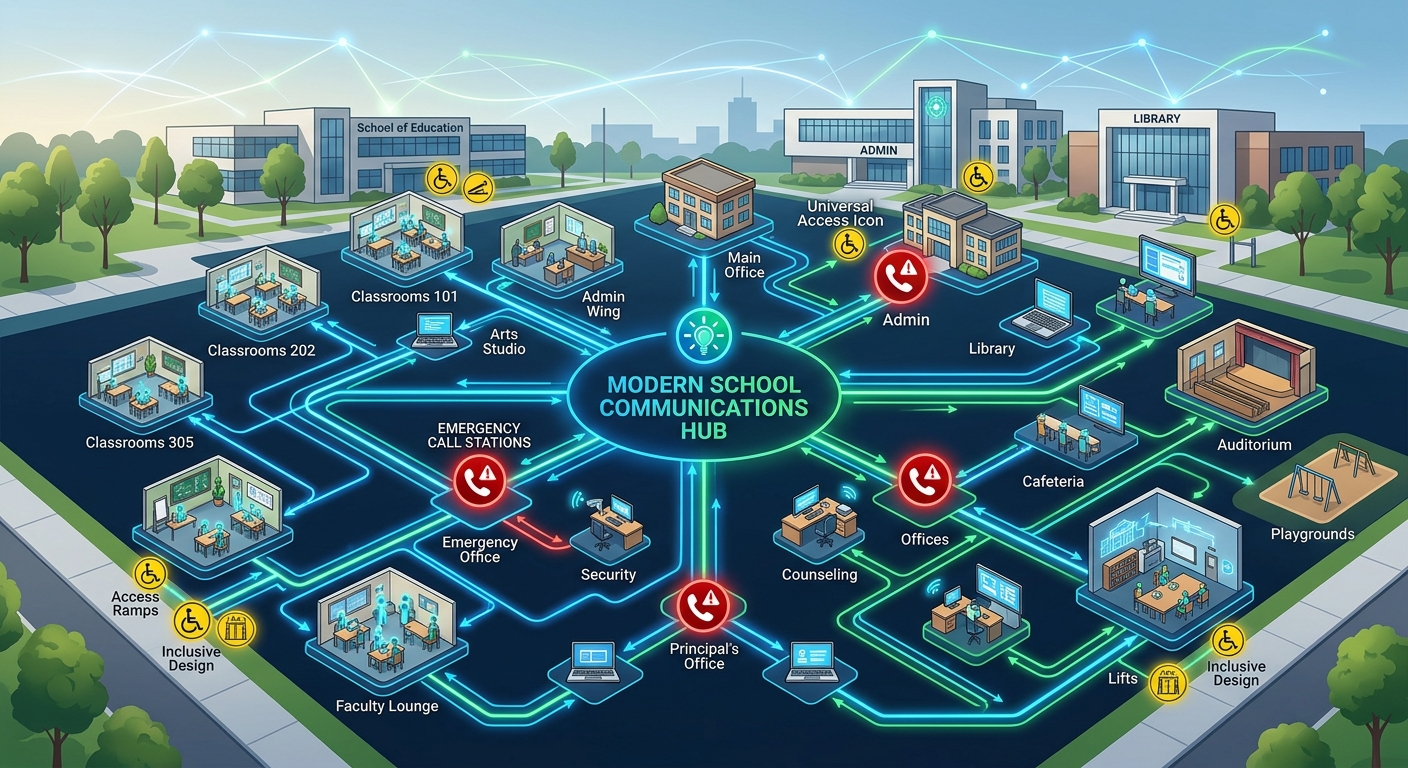
The technical inventory matters just as much. Buyers can document existing direct inward dialing numbers, SIP trunks, analog devices, call queues, SMS short or long codes, video platforms, and integrations with Microsoft Teams, Google Workspace for Education, Zoom, Blackboard, or Moodle. A diagram showing where each call, message, calendar event, and student record travels often reveals more than a feature checklist.
Build an Evaluation Around Actual Workflows
Education buyers benefit from testing complete journeys rather than isolated functions. For example, an admissions workflow might begin with a website form, trigger an SMS acknowledgment, offer a calendar appointment, and route the eventual call according to language, program, or campus.
A platform such as Phone.com can be evaluated within that broader workflow for cloud-based voice, video, SMS, MMS, call routing, and appointment scheduling. The evaluation should examine how those functions connect to existing systems through REST APIs, webhooks (automated messages sent when specified events occur) calendar integrations, or SIP interoperability.
A useful proof of concept can test scenarios such as:
- Routing calls by department, campus, language, and operating hours.
- Sending appointment confirmations through SMS while recording consent and opt-out status.
- Passing caller context to a customer relationship management system (CRM) or student information system through an API.
- Creating voicemail transcripts and delivering them to a controlled Microsoft Teams channel.
- Escalating an unanswered advising call to a shared queue instead of a personal mailbox.
- Preserving E911 location information for staff working across campuses or from home.
Buyers should also distinguish AI-assisted routing from a conventional interactive voice response (IVR) tree, which routes callers through prerecorded prompts and keypad selections. A traditional IVR follows selections such as "press 1 for admissions." AI routing may interpret a phrase such as "I need to change my financial aid appointment," identify the caller's intent, and route the call to the appropriate queue. Testing should include accents, background noise, ambiguous requests, and calls made outside business hours.
Plan Integration and Governance Together
During discovery, IT, academic operations, admissions, accessibility, security, and legal or privacy roles should review the same workflow map. Because implementation timelines vary widely based on institutional scale, buyers should ask vendors to propose phase gates based on phone-number volume, campuses, integrations, and regulatory review.
An initial technical phase generally covers number inventory, number porting requirements, SIP signaling, network readiness, and identity management. IT can verify whether the service supports Security Assertion Markup Language 2.0 (SAML 2.0) or OpenID Connect for SSO, System for Cross-domain Identity Management (SCIM) for account provisioning, and role-based access controls for administrators, faculty, contractors, and student employees.
A controlled pilot can then focus on one call queue or service desk. Within that pilot, Phone.com should be assessed against documented requirements for routing logic, SMS and MMS handling, appointment workflows, administrative permissions, and integration behavior. Testing should include packet loss, failover, mobile access, voicemail retention, caller ID behavior, and export formats such as comma-separated values (CSV) for audit review.
Later deployment phases can cover number porting, staff training, analog telephone adapter configuration, and integration with the LMS or student information system. Number porting often appears mundane until a fax line, elevator phone, or classroom intercom appears on a legacy telecommunications invoice. Those edge cases deserve their own migration register.
Set Measurable Acceptance Criteria
The market context supports careful investment. For more current planning context, IndustryResearch.biz forecasts that the market will reach roughly $139 billion by 2035, with education representing about 59% of demand. This forecast is not directly comparable with Dataintelo’s estimate: "academic collaboration platforms" and "online collaborative learning platforms" use different product boundaries, customer segments, and forecast periods. Neither forecast determines whether a specific deployment works.
Buyers can establish a 30-day baseline before launch and compare it with equivalent reporting periods afterward. Useful measures include average speed to answer, abandoned-call rate, first-contact resolution, transfers per call, voicemail age, SMS response time, appointment no-shows, and the percentage of users successfully provisioned through SCIM.
Observable acceptance criteria are better than broad promises. For example, a buyer might require after-hours calls to reach a designated queue, SMS opt-outs to update within the messaging system, or calendar cancellations to remove associated reminders. The platform’s call-detail records should also expose timestamps, queue events, dispositions, and routing paths so analysts can trace failed interactions.
Specific performance targets vary by institution. Buyers can negotiate reporting access and define acceptable thresholds based on their own baseline data.
Turn the Pilot Into a Buying Decision
A well-designed pilot should expose tradeoffs, not merely demonstrate polished features. If AI routing handles simple admissions requests but struggles with departmental abbreviations, the buyer can decide whether to add a constrained vocabulary, retain keypad options, or route uncertain intents to a general queue.
Similarly, if an LMS lacks a native connector, the team should estimate the work required for REST API calls, webhook processing, authentication-token rotation, retry logic, and monitoring. An integration that works during a demonstration may still require middleware such as an integration platform as a service (iPaaS) to handle production volumes and error recovery.
WisdomInterface’s summary of the Gartner Hype Cycle for Higher Education 2025 presents the framework as a planning reference. Buyers can use that type of framework to distinguish established capabilities, such as SIP calling and video meetings, from newer AI functions that may warrant narrower pilot boundaries and human review.
Buyer Takeaways
The workflow map should remain the central procurement artifact. In this scenario, it connects a website inquiry, an SMS confirmation, a scheduled appointment, an inbound call, and the resulting student-record update.
Governance decisions should also appear in the system design, not in a late-stage policy document. Retention periods, recording notices, SMS consent, E911 records, accessibility, and administrator privileges all affect configuration.
Finally, buyers should retain a rollback plan. Number-porting records, legacy call forwarding, exported queue configurations, and documented Domain Name System (DNS) or SIP changes can reduce disruption if a launch phase needs to pause.
Frequently Asked Questions
How long does an education communications implementation take?
Implementation timelines vary depending on organizational scale. Buyers should request a phase-based estimate tied to the number of phone numbers, SIP endpoints, campuses, integrations, and approval processes, then test one department before wider number porting.
What should schools test in an AI call-routing pilot?
Test at least admissions, financial aid, IT support, and after-hours requests using varied accents and ambiguous language. Log intent classification, transfers, unanswered calls, and fallback behavior through call-detail records rather than relying only on demonstration scripts.
Can a cloud phone system integrate with an LMS?
Yes, when the phone platform and LMS expose compatible REST APIs, webhooks, or middleware connectors. Buyers should verify Open Authorization (OAuth) token handling, user identifiers, event-retry behavior, and whether communication records can be exported in CSV or JavaScript Object Notation (JSON) formats for audit and reporting workflows.