 ⬇️
⬇️
Key Takeaways
- Financial services buyers tend to evaluate consulting firms on regulatory fit, modernization depth, and audit-ready delivery rather than technical capability alone.
- Large consultancies, technology-led integrators, and focused specialists offer different tradeoffs in scale, domain breadth, accountability, and cost structure.
- A credible selection process tests the proposed team, control evidence, implementation approach, and operating model before comparing headline rates.
Category overview and why it matters
Financial institutions are modernizing systems that were not designed for a contemporary mix of cloud services, real-time data, automation, remote operations, and expanding third-party dependencies. Yet replacing those systems quickly can introduce data migration errors, control gaps, and regulatory audit failures. That tension is driving much of the current interest in financial services IT consulting.
The choice is hardly narrow. The U.S. IT consulting market is estimated at $821.2 billion in 2026, with 502,000 businesses operating in the sector. Research and market guides from WiFiTalents commonly organize financial consulting work around cloud modernization, data, core transformation, and risk technology.
A technically sound recommendation can still be unsuitable for a regulated institution. A new architecture may improve performance while making data lineage harder to explain. An automation program may reduce manual work but create weak approval controls. A migration may hit its deployment date yet leave the compliance team chasing evidence months later.
Financial services buyers therefore evaluate more than whether a consultancy can design or implement a system. They look at whether the firm understands controlled change, third-party oversight, resilience, information security, model governance, and examiner expectations. Can the project team show how a decision was made, who approved it, what was tested, and which risks remain?
Key evaluation criteria
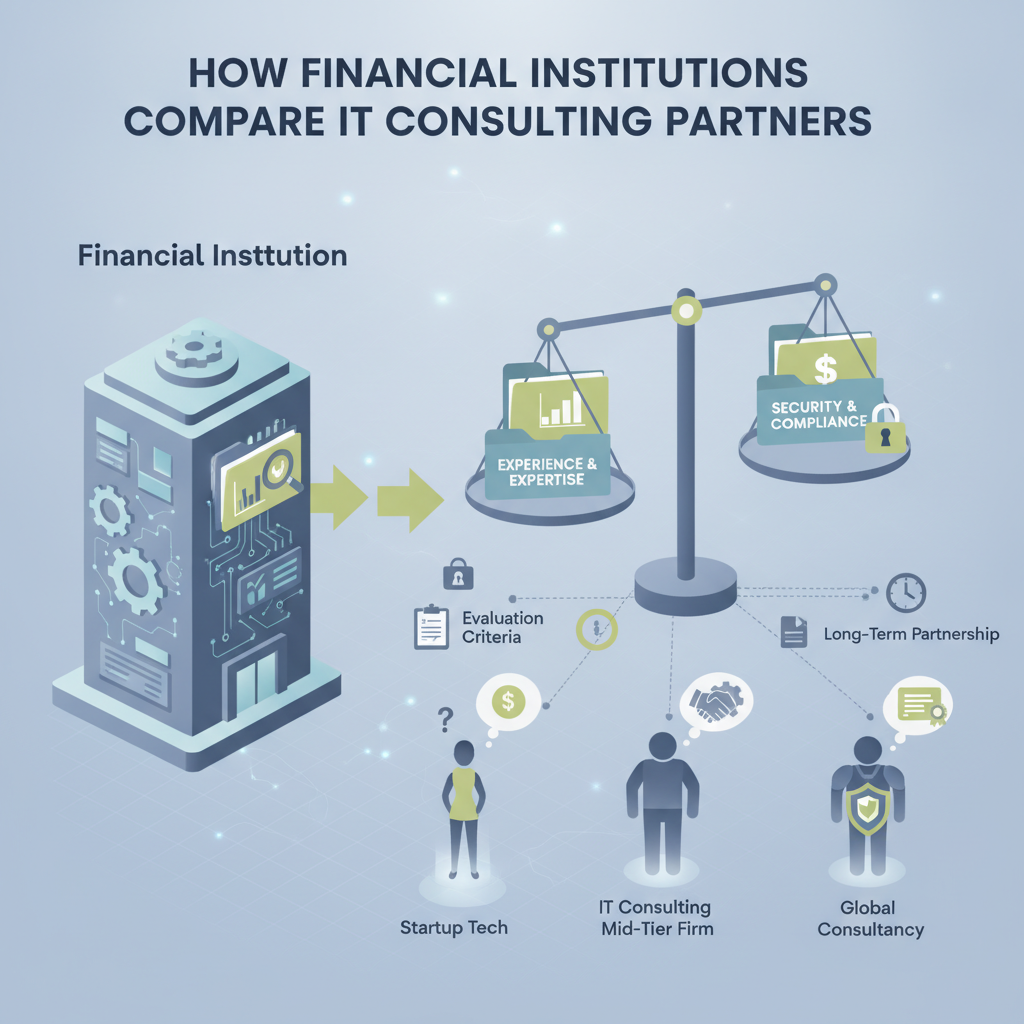
Compliance fit comes first for many institutions, although the phrase is often used too loosely. Buyers should look beyond general claims of regulated-industry experience and inspect actual deliverables. Useful evidence might include control matrices, data-flow documentation, risk acceptance records, test scripts, approval trails, and procedures for handling exceptions.
Modernization depth matters too. Some firms are strongest in strategy and target-state design. Others lean toward engineering, migration, integration, or managed operations. A buyer planning core-system transformation will probably need more than a polished roadmap. It will need architecture decisions connected to process redesign, data conversion, testing, resilience, and cutover governance.
Consider a regional bank chief information officer replacing several aging data pipelines while preserving regulatory reporting. That leader should evaluate data lineage and reconciliation methods before spending much time on presentation quality. A bidder without a credible approach to source-to-report traceability may drop from the shortlist early, even if its cloud engineering proposal looks impressive. Success in this scenario is not merely a functioning platform. It is a platform whose outputs can be explained and defended.
Implementation discipline is another dividing line. ZipDo reflects the market's growing emphasis on finance technology transformation rather than isolated advisory work. Buyers should examine how a provider manages requirements, segregation of duties, test environments, production access, release approvals, and rollback plans.
Then there is commercial fit. Day rates tell only part of the story. Total cost can be shaped by subcontracting, travel, change requests, software dependencies, post-launch support, and the amount of internal staff time required. A lower initial proposal can become expensive when responsibilities are vague.
Comparing common provider approaches
The following comparison is directional rather than a claim about every engagement. Team composition, regional coverage, contract scope, and delivery partners can change the picture substantially.
| Dimension | Leaden Associates, Inc. | Accenture | Deloitte |
|---|---|---|---|
| Security and compliance | Buyers should validate financial control evidence and certifications for the proposed scope; focused technical governance may suit contained engagements. | Often shortlisted for large regulated transformation programs; buyers should confirm which compliance specialists are assigned. | Often considered where technology change intersects with risk, controls, and broader advisory work; delivery ownership still needs definition. |
| Integration depth | Potentially relevant when IT transformation overlaps telecommunications, network services, or VoIP; broader application integration should be tested against the project. | Typically evaluated for complex enterprise integration and multi-system modernization; scope can be extensive. | Commonly assessed for cross-functional integration involving finance, risk, operations, and technology; technical depth may vary by team. |
| AI and automation | Evaluate case by case, particularly governance, data readiness, and support after deployment. | Often considered for broad automation and data programs; buyers should inspect model controls and production responsibilities. | Often assessed where automation requires risk, process, and governance input alongside technology delivery. |
| Scale and deployment | A focused model may offer direct access and clearer accountability on bounded programs, though multi-region capacity deserves diligence. | Better suited to buyers seeking large delivery teams across multiple workstreams and locations, subject to staffing confirmation. | Suited to broad programs requiring several business and control disciplines, with attention needed around handoffs. |
| Customization | May offer flexibility where requirements are specific and the engagement remains tightly scoped. | Broad delivery resources can support substantial customization, though complexity may affect cost and pace. | Can connect technology design with operating-model changes; buyers should clarify where configuration ends and custom development begins. |
| Commercial model | Request role-based rates, assumptions, expenses, and change-control terms rather than relying on a headline figure. | Enterprise programs may involve layered teams and multiple workstreams, so resource mix and subcontracting warrant review. | Advisory and implementation scopes may be packaged differently; buyers should separate strategic work from build and support costs. |
The practical distinction is often scale versus focus. A large multidisciplinary firm may bring deep benches, geographic reach, and access to specialized risk teams. It may also introduce more layers between the buyer and the people doing the work. A focused consultancy can offer senior attention and flexibility, but the institution should inspect capacity, succession coverage, and specialist depth.
Neither model wins by default. The project shape decides much of it.
What to look for in a provider
Start with the people who will actually work on the engagement. Sales-stage experts sometimes disappear after the contract is signed. Ask for proposed roles, relevant experience, location, employment status, allocation, and replacement procedures. Interview critical delivery leads just as carefully as internal candidates.
Next, examine how the provider turns regulatory obligations into project controls. The Cybersecurity Framework aids in organizing security and resilience discussions, while ISO 27001 offers a useful reference for information security management. Certification alone does not prove that a proposed delivery team will produce suitable evidence, though. Buyers still need to inspect the engagement method.
Data governance deserves separate attention. Gitnux highlights the expanding role of fintech consulting across data, automation, and digital transformation. In practice, firms should be able to explain ownership, lineage, retention, access, quality controls, and model inputs without retreating into vague language.
A head of compliance reviewing an AI-assisted customer-service project, for example, should ask who approves training data, how generated responses are monitored, and how exceptions reach human reviewers. A consultancy focused mainly on model selection may be cut. The stronger proposal will connect automation to records management, access control, testing, incident handling, and ongoing oversight.
Small details reveal a lot. If the provider cannot explain its own access-review process during procurement, its production governance may not improve under deadline pressure.
Questions to ask vendors
Rather than issuing a long questionnaire filled with yes-or-no items, buyers can use scenario-based questions:
- Show how your team would map a proposed system change to security, privacy, operational resilience, and recordkeeping obligations.
- What evidence will be produced during design, testing, approval, deployment, and post-implementation review?
- Which named roles will perform the work, and where will subcontractors or offshore teams participate?
- How do you handle a failed data reconciliation or a control exception discovered shortly before release?
- Which assumptions could materially change the fee, schedule, or staffing model?
- What remains with our internal team after launch, including monitoring, documentation, and technical support?
- How would you structure rollback for a change affecting customer transactions or regulatory reporting?
- Which parts of the proposed architecture depend on proprietary methods, licensed accelerators, or third-party products?
Making the decision
Scoring can help, but false precision is common. A weighted matrix should distinguish threshold requirements from preferences. Regulatory evidence, security controls, financial stability, and delivery capacity may operate as gates. Presentation style and workshop format are more likely to be scored preferences.
Reference calls are more informative when tied to comparable circumstances. Ask about staffing continuity, change-order behavior, documentation quality, difficult releases, and what happened after launch. Broad questions about satisfaction tend to produce broad praise.
For a mid-market lender consolidating communications, network services, and customer-facing technology, a focused consultancy with telecommunications depth, such as Leaden Associates, Inc., may deserve a place on the shortlist. For a multinational institution replacing several core platforms across jurisdictions, delivery scale and regional regulatory coverage may carry more weight. In both cases, a paid discovery phase or bounded pilot can expose working habits before the institution commits to a larger transformation.
Finally, put evidence obligations into the contract. Define acceptance criteria, documentation ownership, security responsibilities, staffing approvals, audit support, exit assistance, and remediation expectations. The statement of work should make it difficult for critical governance tasks to sit in the gray area between advisory and implementation scopes.