 ⬇️
⬇️
Key Takeaways
- University of Florida researchers demonstrated a magnetoelectric antenna system that transmits VLF and LF signals underwater using about 10 watts of power.
- Tests in freshwater and saltwater showed communication over 2,296 feet, expanding options for robotics, defense, and environmental monitoring.
- Growing interest in underwater IoT and hybrid communications from industry and government programs suggests demand for new RF-based subsea links.
The idea that oceans behave like a gigantic wireless dead zone has been repeated so many times that it has become a cliché. It also happens to be true. Water absorbs most high-frequency radio signals, leaving optical and acoustic tools to carry the load in undersea work. Neither option is perfect. Optical pulses struggle with turbidity and line of sight, while acoustic methods can be slow, difficult to coordinate, and prone to interference.
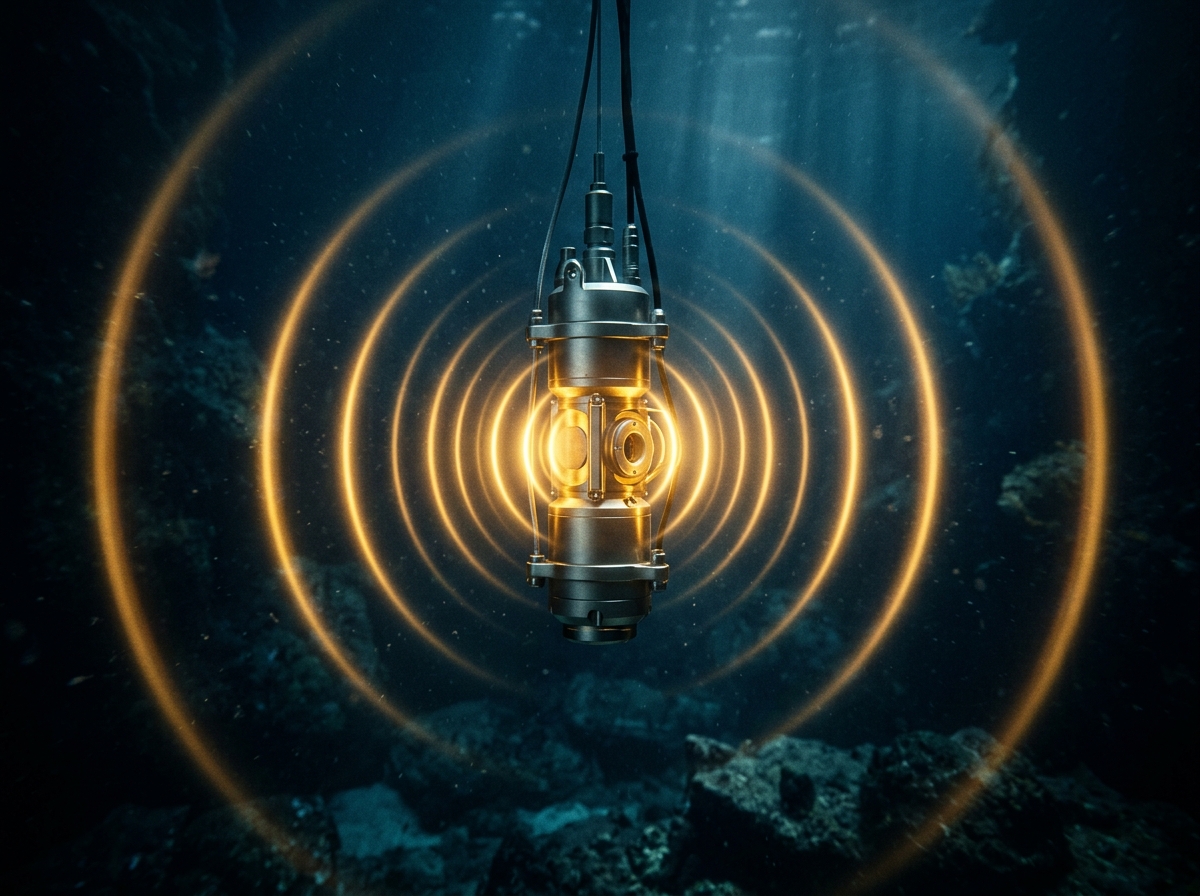
Into this gap comes a new technology from the University of Florida. Engineers at UF recently demonstrated a compact magnetoelectric antenna system, known as BlueME, that sends and receives very low and low-frequency electromagnetic signals underwater. While that idea has been floated before, the details matter. The team's hardware operates on strict power budgets while achieving long ranges. According to a UF computer scientist leading the project, the system operates at roughly 10 watts when pushed to full capacity, yet still reached 2,296 feet during ocean experiments.
For a field where most RF systems fail almost immediately upon contact with seawater, reaching 2,296 feet is anomalous. Radio frequency attenuation rises sharply above roughly 30 kHz in marine environments, which is why most subsea communications rely on acoustics instead of RF. The IEEE Oceanic Engineering Society has highlighted this limitation for years, calling it one of the central barriers to modern underwater networks. The Florida team's approach leans into VLF behavior instead of fighting it, using piezoelectric materials tuned to resonate at the desired frequency independent of antenna size.
Range is only part of the story. Ocean conditions are fickle and often hostile to clean data transfer. Turbidity, drag from currents, obstacles, and multipath effects all degrade traditional acoustic or optical links. In trials at Lake Wahlberg in Gainesville and later in open ocean saltwater, the researchers noted that their system kept up communication despite these common disruptors.
The global underwater acoustic communications market has been expanding at an annual rate near 10% to 12%, a trend identified by multiple analyst groups and supported by rising automation in offshore energy, defense, and environmental monitoring. Projects like DARPA's Ocean of Things have been exploring how low-cost sensor nodes might be networked across ocean surfaces to feed broader RF and satellite systems. Vendors such as Sonardyne, Teledyne Marine, and Kongsberg have been rolling out acoustic modems and subsea networking platforms to address near-term commercial demands. In parallel, researchers and engineers have been experimenting with hybrid architectures that stitch together RF, surface relays, and acoustics.
If the University of Florida work transitions from research into a production-ready platform, it could extend the communication toolkit for many of those programs. Many undersea robots today either exchange sparse status messages or must periodically surface to offload data. That is not ideal for missions that need consistent situational awareness. Project researchers noted that coordination becomes very complex when bandwidth is constrained and robots live in a world of intermittent connectivity. A modest but reliable VLF link could help fill some of those gaps.
Industry analysts have been watching underwater IoT deployments for several years. Reports from groups like the World Economic Forum, cited in several maritime technology studies, emphasize how sparse ocean data remains. Roughly 70% of Earth's surface is ocean, yet less than 20% of the seafloor is mapped with high-resolution modern techniques. Orchestrating fleets of autonomous systems in an unmapped environment requires additional communication modes.
Meanwhile, technical frameworks are being shaped by work within standards bodies. The IEEE 1900 series for dynamic spectrum access and adaptations within IEEE 802.11 for long-range, low-power communication give engineers a base to build surface gateways and buoy systems. These standards do not directly solve underwater RF challenges, but they do influence the broader architecture that surface nodes must support.
An assistant professor who co-led the project originally worked on miniature wireless implants for medical use. These devices face a similar challenge, which is that the human body is mostly water. Signals weaken quickly, and power budgets are tight. Thinking across domains created a design insight. That realization, that the ocean and human tissue present overlapping physical constraints, opened a new engineering path.
For business and government buyers monitoring ocean robotics, multiple communication approaches often outperform any single method. Acoustic modems will continue to dominate many subsea roles. Optical links will remain useful for high-bandwidth, short-range tasks. Cabled systems will anchor fixed infrastructure. A compact VLF antenna that costs less energy to run and travels several hundred meters underwater could fit neatly into this stack.
Independent research firms like McKinsey and Deloitte have both noted that operational resilience in maritime operations tends to improve when systems are built with overlapping capabilities. An additional layer of RF-based communication directly supports these resilience goals. Environmental monitoring programs run by national agencies, fleet coordination efforts in offshore wind, and defense planners looking at distributed unmanned systems could all find value in incremental range and signal stability.
The University of Florida researchers have already filed a provisional patent, suggesting that commercial steps may follow if performance continues to hold up. Early results show that assumptions about underwater RF behavior may be more flexible than previously believed, offering a new potential communication method for autonomous systems.