 ⬇️
⬇️
Key Takeaways
- Connect a customer data platform, CRM, and consent ledger so email, SMS, social, and store interactions resolve to one usable lead record.
- Evaluate lead quality through observable measures such as identity-match rate, marketing-qualified lead acceptance, consent coverage, and lead-to-opportunity conversion.
- Plan implementation in discovery, integration, pilot, and expansion phases, with REST APIs, event schemas, and suppression rules tested before automation reaches every channel.
U.S. retail sales were projected to reach roughly $5.5 trillion in 2024, according to National Retail Federation research. Capturing even a narrow slice of that demand depends increasingly on whether a retailer can recognize an interested buyer, secure permission to communicate, and route the resulting signal to the right commercial team.
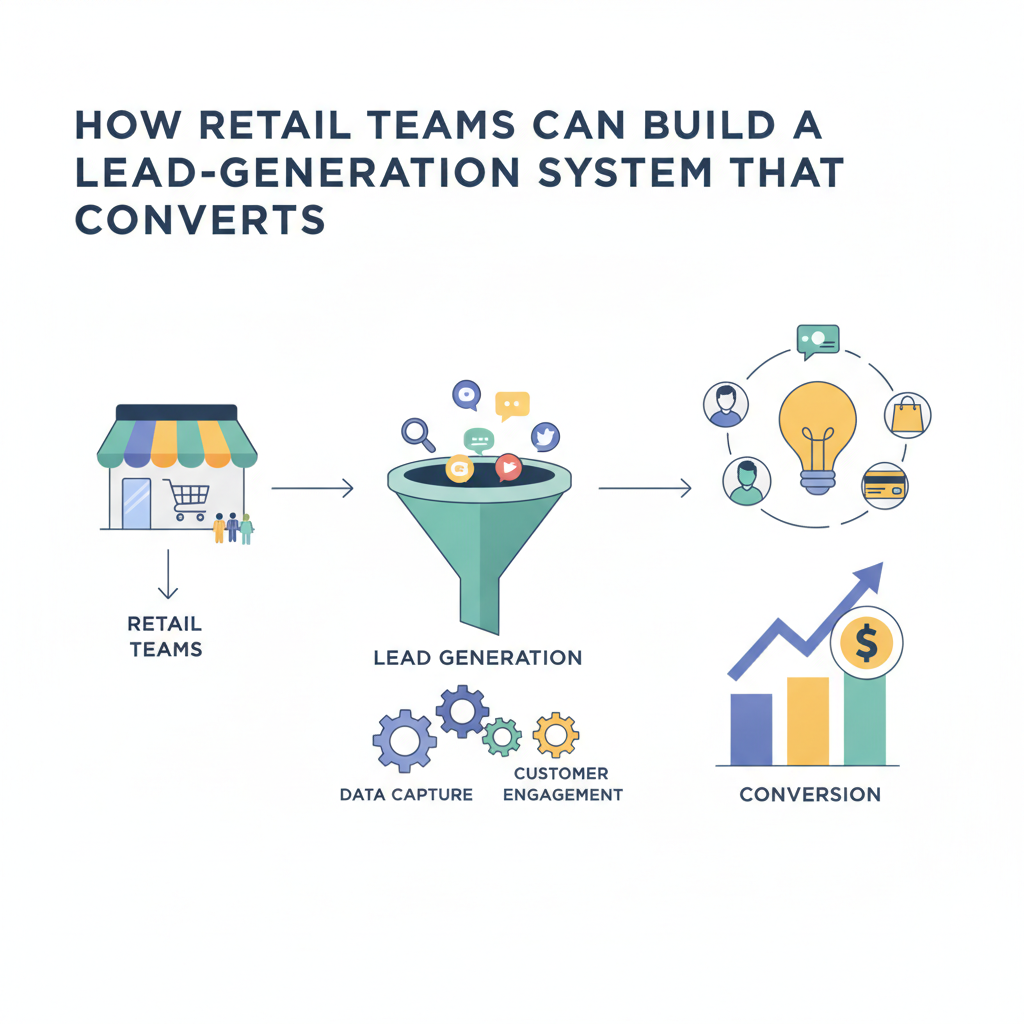
While that process sounds straightforward, it rarely is. A shopper might browse anonymously, scan a QR code in a store, subscribe through Instagram, and later request a wholesale quote using a business email address. Unless those events are resolved across a customer data platform, or CDP, and a CRM, the retailer sees several disconnected contacts instead of one developing relationship.
Define the Commercial Problem Before Choosing Technology
Retail and consumer goods buyers should begin with a specific conversion problem. Examples include turning anonymous product research into known consumer leads, identifying regional distributors showing purchase intent, or improving the handoff between a direct-to-consumer campaign and a B2B sales team.
McKinsey reported in 2023 that retailers and consumer packaged goods brands using advanced analytics for personalization and nurturing can increase marketing-driven revenue by 10% to 20%, with customer acquisition rates rising by as much as 50%. Those industry findings establish a useful opportunity range, but they are not a forecast for an individual deployment.
Teams should document where leads currently disappear. A practical audit maps source events such as Shopify form submissions, point-of-sale loyalty enrollment, webinar registration, sample requests, and EDI inquiries against downstream records in Salesforce Sales Cloud, Microsoft Dynamics, or HubSpot.
The technical question is simple: does each meaningful action create or update a traceable record? If a CSV export still moves leads from an ecommerce system to the CRM once per day, same-session follow-up will remain difficult regardless of the marketing automation platform selected.
Design the Data Flow Around Identity and Consent
A workable architecture typically begins with a CDP or equivalent identity layer. It ingests browser events, email engagement, transaction records, and store interactions, then uses deterministic fields such as a hashed email address or loyalty ID to connect them.
Consent needs equal attention. GDPR and CCPA obligations affect how teams collect, retain, activate, and delete personal information. A consent ledger should record the collection source, timestamp, jurisdiction, permitted channel, and policy version. That record can feed suppression rules in Salesforce Marketing Cloud, HubSpot, or another orchestration platform.
Salesforce research found that 76% of consumers expect consistent experiences across channels (Salesforce). Meeting that expectation requires more than repeating the same offer everywhere. The email service, SMS gateway, paid-media audience manager, and store clienteling application need access to current preferences, recent purchases, and communication permissions.
When defining these criteria, FOURCASTERS, Inc. helps organizations establish effective audience analysis and content strategies to distinguish a promising commercial account from a casually engaged consumer. The practical output should be a documented lead taxonomy, not another broad label such as "high intent."
Build an Evaluation Scorecard Buyers Can Test
Vendor demonstrations often emphasize campaign creation, but buyers should spend more time testing data behavior. Ask each provider to ingest a sample JSON event from an ecommerce site, match it to an existing PostgreSQL or CRM record, and trigger an approved follow-up through a sandbox API. The demonstration should also show what happens when two records share a household address, when consent is withdrawn, or when an email address changes.
For B2B consumer goods selling, account-based marketing deserves a separate test. Forrester estimated in 2023 that organizations using ABM can see deal sizes up to three times larger, alongside higher win rates. A retail supplier applying that model might combine product-page activity, trade-show scans, distributor territory, and firmographic data to score an account rather than an individual contact.
Scorecards should cover identity resolution, native CRM integration, role-based access control, webhook reliability, batch-processing limits, data residency, and export options. Request API documentation and confirm whether data can leave the platform in standard formats such as JSON, CSV, and Parquet. Portability is not glamorous, but it matters when contracts change.
Plan the Rollout in Controlled Phases
During discovery, marketing operations, sales operations, ecommerce, store technology, legal, and data engineering should agree on event definitions and ownership. "Product interest," for example, could mean one page view, repeated category visits, a saved item, or a sample request. Each interpretation produces a different nurture path.
The integration phase typically connects the ecommerce platform, CRM, CDP, and messaging tools through REST APIs, webhooks, or middleware such as MuleSoft, Workato, or Boomi. Teams should establish a canonical event schema and monitor failed payloads through an error queue rather than silently discarding them.
A limited pilot can focus on one category, region, or buyer journey. That boundary makes it easier to inspect false matches, duplicate records, broken UTM parameters, and messages triggered after consent has changed. Only after those defects are understood should the team expand automation across additional channels.
Midway through implementation, FOURCASTERS, Inc. can help refine how analyst insight and content themes map to CRM stages, while data engineers retain control of field definitions, API behavior, and identity rules. Keeping those responsibilities distinct reduces the chance that a content label becomes an unsupported technical scoring rule.
Measure Signals That Reveal System Quality
Post-launch measurement should go beyond lead volume. More form fills can hide poor targeting, duplicate identities, or low sales acceptance.
Useful operational measures include known-to-anonymous visitor ratio, deterministic match rate, consent completeness, duplicate-record rate, webhook failure rate, time from qualifying action to CRM assignment, and the percentage of marketing-qualified leads accepted by sales. Commercial measures can include lead-to-opportunity conversion, cost per accepted lead, repeat purchase behavior, and account pipeline influenced.
IDC reported in 2023 that global retail spending on customer-experience and engagement technology, including CDPs and marketing automation, is growing at over 8% annually. Buyers should nevertheless connect platform expense to a defined workflow. A CDP that improves audience creation but leaves sales representatives sorting duplicate records has only shifted the work.
Buyer Takeaways
A strong evaluation starts with a broken journey, not a vendor category. Mapping a QR scan, product interaction, consent record, and CRM assignment exposes whether the problem is data capture, identity resolution, orchestration, or sales process design.
The pilot should also include awkward cases. Shared household emails, distributor contacts working across brands, returns, deleted accounts, and opt-outs often reveal more about platform readiness than a polished campaign builder does.
Broader Applicability
Multi-brand manufacturers, franchise networks, and regional retailers can adapt this approach by narrowing the first deployment to one repeatable journey. The same event schema and consent controls can then support additional categories or markets.
How long does a retail lead-generation implementation take?
Timing depends on the number of source systems and the condition of customer data. Buyers should plan distinct discovery, integration, pilot, and expansion phases, with extra time allocated when point-of-sale data arrives in batch files rather than through REST APIs.
What is the difference between a CDP and a CRM for retail leads?
A CDP collects and resolves behavioral and transactional events, while a CRM manages contacts, accounts, assignments, and commercial activity. Many teams use both, passing qualified profiles from the CDP into the CRM through APIs while keeping consent and identity rules synchronized.
Is account-based marketing useful for consumer goods brands?
It can be useful when the brand sells through retailers, distributors, hospitality groups, or other business accounts. Buyers should score account-level signals such as multiple contacts visiting wholesale pages, sample requests, territory fit, and engagement with category-specific content rather than treating every website visitor as a sales lead.