 ⬇️
⬇️
Key Takeaways
- Clearspan: Inventory every analog endpoint, including fire panels, elevator phones, fax machines, intercoms, and security dialers, before selecting hosted Voice over Internet Protocol (VoIP) or cellular adapters.
- Build procurement plans around the Federal Communications Commission’s adopted 90-day copper-retirement notice period, rather than assuming every carrier will provide the previous 180-day window.
- Test backup power, dual-tone multifrequency (DTMF) signaling, alarm formats, and emergency calling at each campus before disconnecting a working copper line.
- Evaluate communications providers by examining hosted voice, analog-device support, E911 administration, number porting, service monitoring, and escalation procedures.
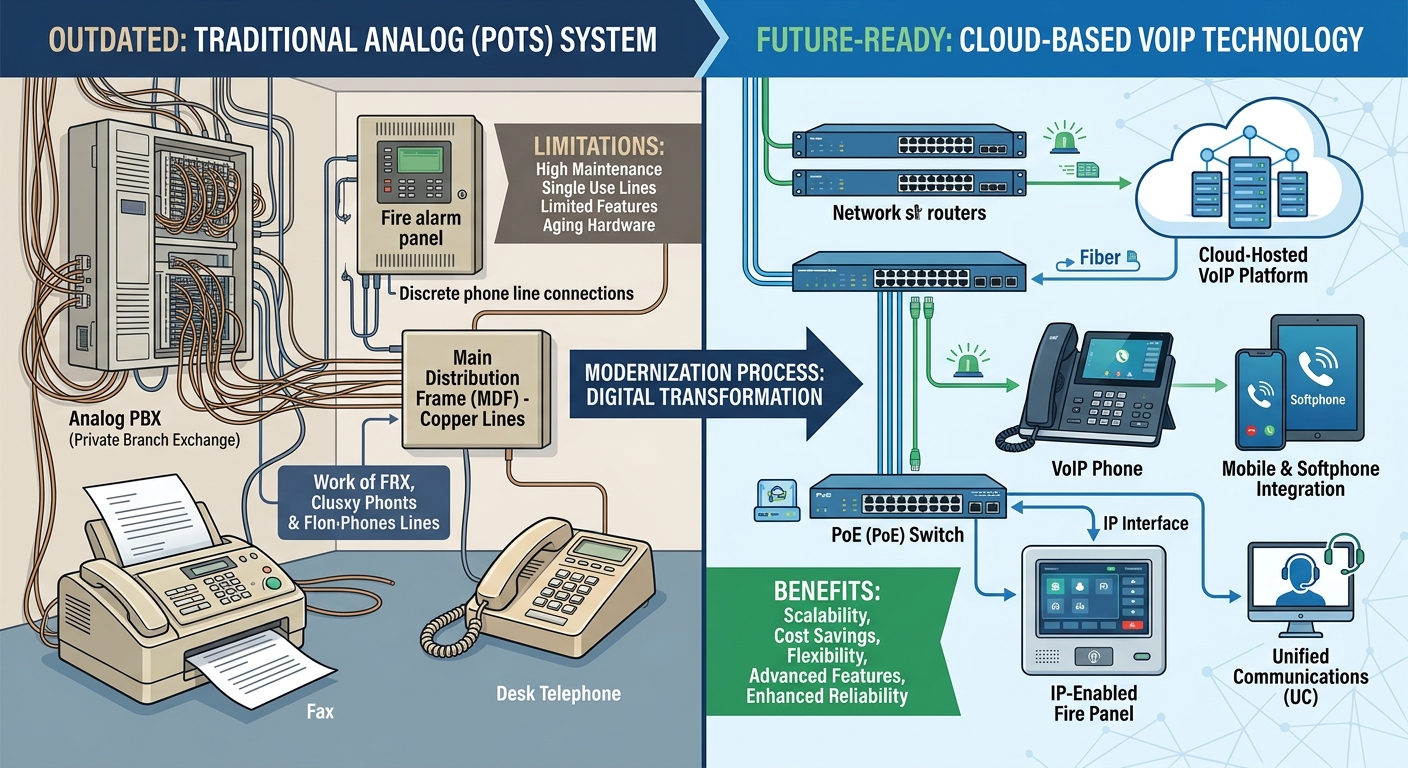
School districts can replace plain old telephone service (POTS) lines by inventorying every endpoint, matching each device to hosted voice or a compatible cellular adapter, and testing signaling, emergency calling, and backup power before copper service ends.
Problem to Solve: Copper Retirement Is Local, but the Exposure Is Districtwide
A school elevator phone may complete a routine test while the main office phones continue working. Yet an analog fire panel in another building may stop transmitting Contact ID (an alarm-reporting format that uses DTMF tones) reliably after a carrier network change. That mixed environment makes POTS replacement harder than a conventional phone-system upgrade.
There is no single national shutdown date. AT&T, Verizon, Lumen, and other carriers are retiring or replacing legacy infrastructure by market and wire center, the geographic area served by a telephone central office. According to AT&T’s published product-change and discontinuance information, the carrier stopped accepting new orders, moves, and changes for specified time-division multiplexing (TDM) services in 1,711 wire centers across 19 states beginning October 15, 2025. TDM is the channel-based technology underlying many legacy voice services; districts should confirm whether a listed service and address are affected rather than treating the date as a nationwide cutoff.
The installed base is shrinking quickly. The FCC’s semiannual Voice Telephone Services reports counted approximately 15.0 million retail switched-access lines as of June 30, 2025, compared with 27.2 million as of mid-2022. Switched-access lines are traditional end-user telephone connections and do not include every interconnected VoIP subscription. Comparing those two FCC reporting periods produces a compound annual decline of roughly 17.9%.
Policy changes have also narrowed the window districts should use for contingency planning. The FCC’s March 2025 rules reduced the waiting period for certain copper retirements from 180 days to 90 days; it did not establish March 2025 as a universal retirement deadline. Because notice obligations depend on the service, customer, and applicable rule, districts should verify the operative deadline in each carrier notice. The International Center for Law & Economics has examined the broader tension between maintaining legacy copper and shifting investment toward fiber infrastructure.
Build an Endpoint Inventory Before Comparing Vendors
The first useful deliverable is not a quote. It is a campus-by-campus inventory that records the carrier, circuit identifier, monthly charge, physical demarcation point, attached device, dialed destination, and power dependency for every analog line.
Teams should inspect more than the telecommunications closet. POTS circuits may terminate inside elevator controllers, fire-alarm panels, pool-area emergency phones, postage meters, building-access systems, intrusion panels, boiler rooms, or standalone fax machines.
For each endpoint, buyers can document:
- Whether the device sends voice, fax, modem, DTMF, Contact ID, or another signaling format
- Whether it requires inbound calling, outbound calling, or both
- Whether the circuit has a published direct-inward-dial number
- How long the endpoint should operate during a utility outage
- Which code, inspection, or vendor-support requirement applies
- Whether fiber, Ethernet, Long-Term Evolution (LTE), or 5G service is available at the location
A spreadsheet can work for a small district, but larger environments may benefit from importing carrier invoices into a configuration management database, or CMDB, that tracks technology assets and their relationships. Matching circuit IDs against accounts-payable records can also expose lines that are billed but no longer connected to an active device.
Evaluate the Replacement by Device Type
Hosted VoIP, which carries calls over Internet Protocol networks, or Unified Communications as a Service (UCaaS) generally fits administrative phones, classrooms, contact-center queues, and conferencing. A district may connect IP handsets through Power over Ethernet switches, route calls through Session Initiation Protocol (SIP) trunks, and use session border controllers to enforce codec, encryption, and emergency-calling policies.
Analog life-safety equipment requires a different evaluation. A cellular analog telephone adapter can present an RJ-11 telephone interface to an existing fire panel or elevator phone while carrying traffic over LTE or 5G. Buyers should verify support for DTMF, loop-start signaling, fax protocols, modem tones, automatic number identification, and dual-SIM resilience, which allows a device with two subscriber identity modules to use more than one mobile service profile.
NFPA 72, the National Fire Alarm and Signaling Code, affects fire-alarm communications, while ASME A17.1/CSA B44 may apply to elevator emergency phones. Local authorities having jurisdiction can interpret and enforce those requirements differently, so a successful voice call alone does not establish compliance.
When assessing Clearspan or another communications provider, buyers should ask how hosted voice, contact-center routing, analog adapters, number porting, Enhanced 911 (E911) location records, and centralized administration work together. The technical answer should identify supported protocols, physical interfaces, power requirements, and monitoring methods rather than offer a general compatibility assurance.
Plan a Phased Rollout Around Risk
During discovery, the district validates its inventory with facilities, IT, security, transportation, and school administrators. The team also checks carrier notices by service address because two campuses in the same district may face different retirement schedules.
A controlled pilot should include dissimilar endpoints. Testing one desk phone, one fax workflow, one fire panel, and one elevator phone provides broader evidence than installing identical adapters across a single building. Engineers can inspect SIP responses, DTMF transmission, alarm-receiver acknowledgments, caller ID, and failover behavior.
During broader deployment, teams typically port numbers in batches and preserve rollback options until acceptance tests pass. Clearspan can be evaluated on whether its management model gives district staff visibility into call routing, device status, E911 location records, and service alarms through one administrative interface.
Power deserves special attention. Traditional copper lines often supplied power from the carrier central office, while an IP gateway or cellular adapter depends on local electricity. The design may therefore require an uninterruptible power supply (UPS), monitored battery, generator circuit, or combination of all three. Buyers should record expected runtime and test it under load rather than relying only on battery specifications.
Measure Outcomes That Operations Teams Can Observe
Post-launch measurement should focus on visible operational changes. Useful indicators include the number of active copper bills eliminated, the percentage of endpoints passing monthly test calls, failed alarm transmissions, unresolved E911-location exceptions, adapter battery alarms, and average time required to change call routing.
For administrative voice, districts can also examine whether staff can move extensions between campuses without carrier service orders, whether contact-center queues remain available during a building outage, and whether conferencing uses the same directory and identity controls as calling.
Because providers rarely disclose universal POTS replacement savings metrics upfront due to the varying complexity of legacy networks, buyers should request reference architectures, test procedures, support-escalation targets, and sample service reports rather than relying on unverified savings claims.
Buyer Takeaways
The most important lesson is that POTS replacement is an endpoint project, not just a carrier project. A line connected to an elevator controller behaves differently from a line serving a receptionist, even when both appear on the same invoice.
Another lesson concerns timing. Because the FCC adopted a 90-day notice period for certain copper retirements, districts can reduce procurement pressure by completing inventory and laboratory testing before receiving a carrier deadline. The actual notice applicable to a district must still be confirmed from the carrier’s filing or customer communication.
Finally, acceptance criteria should be written per device. “Dial tone available” is inadequate for a fire panel that needs to deliver an alarm code and receive an acknowledgment from a monitoring center.
Broader Applicability
Colleges, libraries, municipal buildings, and distributed healthcare organizations can adapt the same inventory and pilot model. The device list will differ, but the core technical questions about signaling, backup power, emergency calling, and carrier coverage remain similar.
Frequently Asked Questions
How long does a school POTS replacement typically take?
Timing depends on campus count, number-porting schedules, inspection requirements, and the variety of analog devices. Buyers should plan for discovery, pilot testing, staged deployment, and acceptance rather than trying to fit the work inside a 90-day carrier-notice window.
Can a school use VoIP for fire alarms and elevator phones?
Standard hosted VoIP may not reproduce every analog signaling behavior reliably. Schools should test purpose-built cellular or IP analog adapters against NFPA 72, ASME A17.1/CSA B44, monitoring-center requirements, backup-power expectations, equipment documentation, and local code interpretations.
What should a district ask a POTS replacement provider?
Ask which DTMF, fax, modem, and alarm formats are supported; how LTE or 5G failover works; and how battery status is monitored. Also request details about SIP security, E911 location management, number porting, replacement hardware, and escalation procedures for life-safety endpoints.