 ⬇️
⬇️
Key Takeaways
- Bluecore Energy raised $10 million to build small modular nuclear reactors on floating barges.
- The company aims to supply ports, coastal infrastructure, and AI data centers with mobile clean power.
- The funding arrives as interest in maritime nuclear solutions grows across multiple sectors.
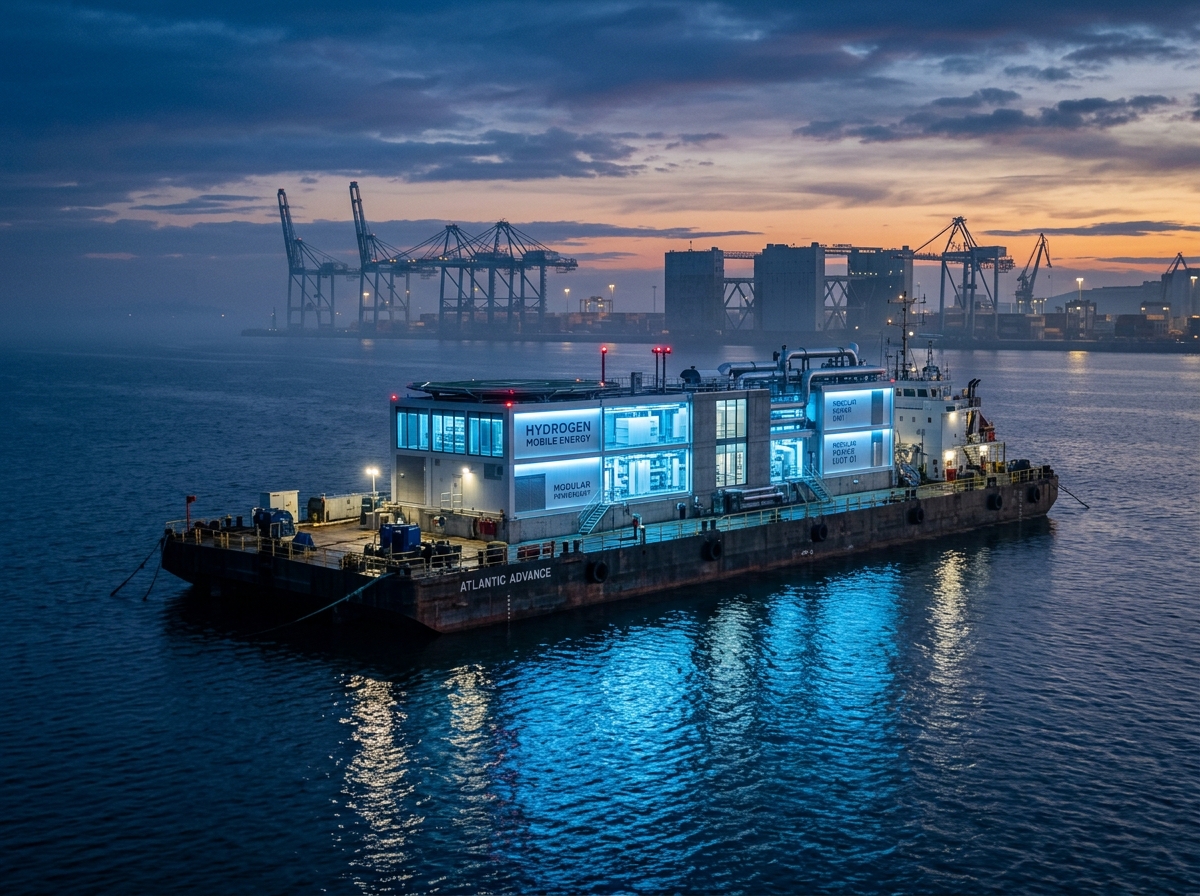
Bluecore Energy announced a $10 million pre-seed round led by Slauson & Co. Founded seven months ago by an executive previously with Uber Freight, the startup is pursuing an unconventional path toward nuclear deployment. Instead of building reactors on land, Bluecore Energy plans to place small modular nuclear reactors (SMRs) on barges to provide power to ports and nearby infrastructure. The system is designed to meet the power needs of approximately 15,000 homes or scale to support major port operations.
The International Energy Agency projects that nuclear generation in advanced economies must grow by roughly 40% between 2022 and 2030 to align with net-zero goals, according to an IEA report. This projection underscores why alternative approaches like factory-built SMRs are actively being explored. Because many utilities struggle to deliver large-scale nuclear plants within conventional timelines, the shift toward smaller and more modular designs offers an alternative pathway to scaling capacity.
Maritime settings present distinct operational advantages. Bluecore Energy designed its closed-loop, water-cooled SMRs as portable power stations that can be towed by ship to new locations, reducing transport emissions to zero. The startup's founder noted that the company utilizes water-cooled nuclear technology that has operated for over 70 years. This reliance on familiar core technology is intended to help regulatory agencies validate the design more efficiently during early-stage deployment.
The OECD Nuclear Energy Agency reports that factory-built SMRs can potentially bring construction times down to 3 to 5 years, significantly shorter than traditional nuclear plants that often require 7 to 10 years. A faster build cycle appeals to ports and operators facing surging power demand driven by electrification trends in shipping and logistics.
Blue Energy, another startup in the space, recently raised $380 million to fabricate reactors in shipyards and deliver them by barge. Their stated goal is to cut capital costs from roughly $10,000 per kilowatt to around $2,000 per kilowatt. The emergence of multiple organizations pursuing shipyard-based fabrication helps validate the maritime nuclear concept as a strategy for cost reduction in nuclear manufacturing.
To support initial deployment, Bluecore Energy has secured a port terminal, a barge, and a test reactor pressure vessel. The test vessel allows the team to simulate water flow and evaluate the cooling characteristics central to the system. The startup combines hardware testing with software-driven validation to verify its foundational design before finalizing the commercial model.
To address safety and regulatory requirements, the startup is building multiple layers of redundancy into the system. The uranium fuel will be clad and placed inside a thick steel pressure vessel, then surrounded by concrete shielding and steel lining. This layered approach aligns with international safety standards for protecting nuclear systems placed outside traditional land-based footprints.
The International Maritime Organization reports that global shipping is responsible for nearly 3% of global CO2 emissions. Analysts at the IMO have discussed the potential of nuclear-assisted vessels for more than a decade to help decarbonize the sector. Floating nuclear barges could directly contribute to cleaner port operations and support adjacent industries without pulling water or electricity from surrounding municipal grids.
AI data center operators are increasingly exploring off-grid power solutions to bypass constrained local utilities. The company's founder stated that data center executives have expressed interest in receiving independent power at sea, which also provides direct access to water for facility cooling. Placing high-density compute clusters near abundant marine cooling resources, powered by barge-mounted SMRs, offers a potential model for supporting energy-intensive AI infrastructure.
The $10 million pre-seed round includes backing from Harlem Capital, Precursor Ventures, Ripple co-founder Chris Larsen, and Hartbeat Ventures, alongside several angel investors. This diverse mix of traditional and nontraditional backers highlights growing venture interest in next-generation nuclear technology, particularly as data centers face acute power bottlenecks and ports face strict regulatory pressure to reduce emissions.
Analysts at the World Nuclear Association track more than 80 SMR designs currently in development worldwide. Researchers at the MIT Energy Initiative observe that shipyard-produced nuclear modules could eventually allow nuclear supply chains to operate similarly to modern manufacturing networks, though scaling such systems will require substantial international policy coordination.
Regulatory approvals for floating nuclear facilities are expected to be complex, and local jurisdictions may resist placing nuclear assets near their shorelines. Early-stage projects will likely target locations where port officials are actively seeking alternatives to diesel-based power. Bluecore Energy is targeting these industrial maritime markets first, reconsidering traditional nuclear infrastructure models to address strict climate targets, data center capacity limits, and maritime power constraints.
The company's capital raise reflects a broader convergence of energy policy, SMR technology, and demand-side pressure from power-hungry tech and logistics sectors. The next phase of development will determine whether barge-based reactors can secure regulatory approval, validate safety frameworks, and physically meet the operational demands of maritime ports and offshore data centers.