 ⬇️
⬇️
Key Takeaways
- Researchers at the Bomhofsplas Solar Farm documented over 400 fish and nearly 2,000 invertebrates using underwater Biohuts between 2020 and 2023.
- Findings support broader modeling and field research indicating that floating PV can coexist with aquatic ecosystems when designs are tailored to local conditions.
- Global interest in floating PV continues to rise, and environmental management frameworks like ISO 14001 are shaping how developers approach biodiversity impacts.
The Bomhofsplas Solar Farm in the Netherlands has become an intriguing case study for energy developers, environmental managers, and policymakers evaluating the fast growth of floating photovoltaic systems. What began as a straightforward renewable energy installation has evolved into a real-world demonstration of how engineered habitat structures can shape ecological outcomes beneath floating arrays.
Floating solar is rarely discussed in the context of habitat creation. More often, the focus lands on land-use efficiency, cooling effects on panels, or grid integration. Yet the Biohut experiment at Bomhofsplas, carried out by Dutch researchers between 2020 and 2023, pushes the conversation in a different direction.
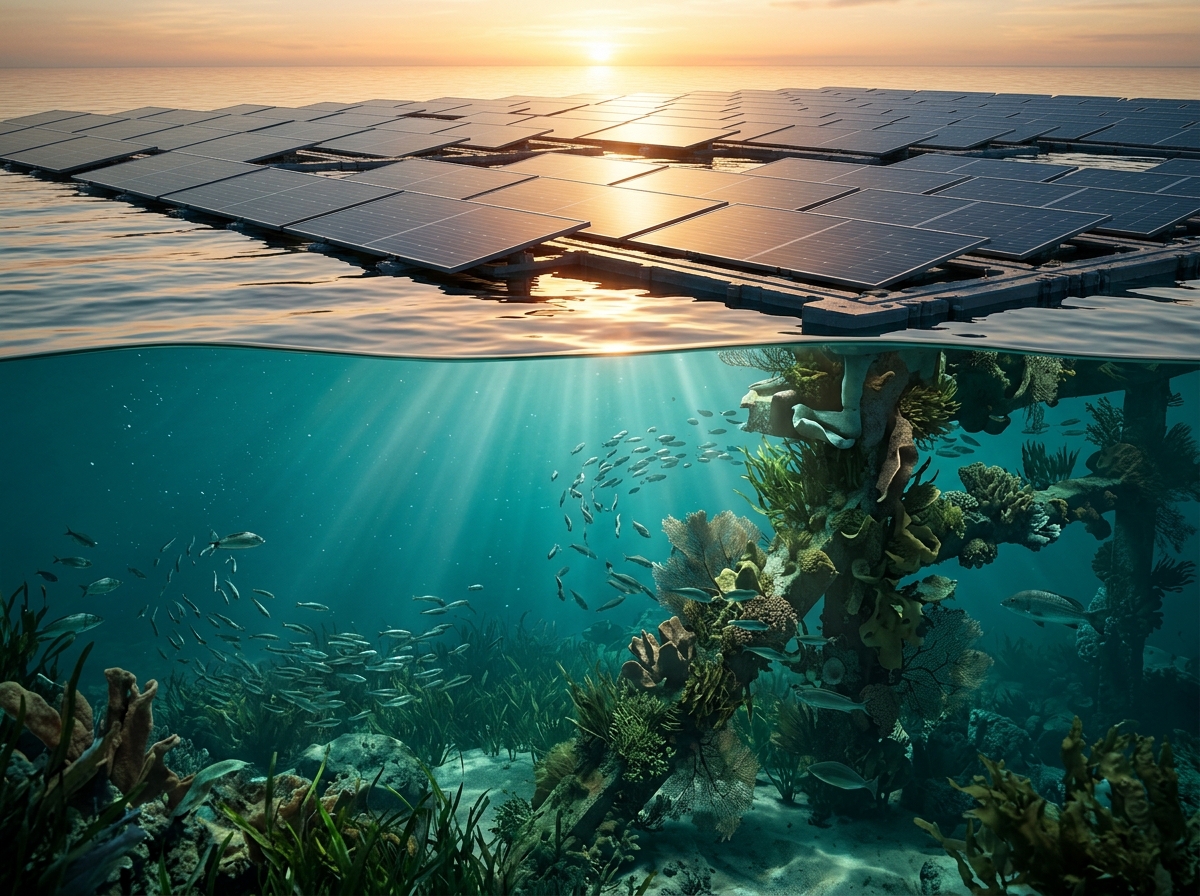
By installing 20 Biohuts, which resemble cage-like reef modules, the team observed a steady rise in aquatic life. Over 400 fish and nearly 2,000 invertebrates, including mussels and sponges, were documented by the end of the study period. These numbers align with broader evidence that carefully designed floating PV can form artificial reef-like zones. The project also echoes insights from the review published in Renewable and Sustainable Energy Reviews, which notes both risks and opportunities for aquatic ecosystems as floating solar scales globally.
One question that emerges is how shading affects the broader water column. Modeling work from Deltares suggests that large-scale coverage can change heat and momentum transfer at the surface, which may influence stratification. It is a nuanced challenge; floating PV can reduce evaporation, which is valuable in warming climates, but reduced light could alter photosynthesis patterns. Both effects matter for lake managers balancing ecological integrity with renewable energy deployment, an area Deltares analysts continue to evaluate.
The Bomhofsplas project becomes even more interesting when you consider the unexpected observations. Scientists reported hearing bird sounds beneath the panels in 2021, hinting at possible nesting sites. That detail is a small aside, but it adds texture to the discussion of how birds interact with solar infrastructure. While many utility-scale solar projects have been associated with bird mortality or behavioral confusion, installations on water may create different interactions. It is too early to generalize, but the combination of shading, structure, and relative isolation is worth studying further.
In the larger global landscape, floating solar continues to gain traction. The World Bank previously estimated that existing hydropower reservoirs alone offer technical potential above 400 gigawatts. Meanwhile, projections from the International Energy Agency anticipate tens of gigawatts of floating PV by 2030, making environmental design an increasingly important consideration. Oceans of Energy, which operates an offshore pilot in the North Sea, has reported no significant disruptions to primary production even under scenarios with larger arrays. This reinforces the idea that context and design matter, a principle Oceans of Energy emphasizes for offshore installations.
Some readers might wonder how this research squares with broader engineering guidance. Standards bodies such as the IEC are developing technical specifications for floating PV systems, aiming to provide clarity around design, mooring, durability, and environmental assessment. ISO 14001 remains a common reference point for operators who integrate environmental management processes into their deployments.
The wider academic community is paying attention too. Environmental engineers at institutions like MIT and ecological modeling groups that publish through platforms such as IEEE have emphasized the value of site-specific evaluation when introducing new structures into aquatic environments. Their work tends to highlight variability. A lake with limited mixing behaves differently from a windy reservoir, and both differ substantially from offshore zones. At the same time, analysts from BloombergNEF have pointed to floating PV as a strategic option for regions with limited available land or high land costs, arguing that environmental performance will increasingly influence project approval timelines.
It is worth noting how small design details, such as the placement and material of underwater structures, can alter ecosystem outcomes. The Biohuts used at Bomhofsplas are relatively lightweight, modular, and designed to mimic natural refuge patterns. In other regions, floating solar arrays may be paired with different substrate types, vegetation enhancements, or no added habitat elements at all. Developers are now examining which interventions have the greatest benefit relative to cost and regulatory complexity.
Local wildlife considerations also continue to shape deployment strategies. The reference to California’s San Joaquin kit fox shows how terrestrial solar farms are adjusting fencing and access patterns to support endangered species. It serves as a reminder that renewable energy installations sit within diverse ecological contexts. Floating projects like Bomhofsplas are simply expanding the range of scenarios in which developers must evaluate habitat impact.
For B2B audiences in energy, engineering, or environmental governance, the underlying message is fairly pragmatic. Floating solar is maturing quickly, and the environmental dimension is no longer a side conversation. The Bomhofsplas findings give operators a tangible example of what proactive biodiversity planning can look like, even if outcomes will differ across lake types and climates.
Ultimately, the Biohut study shows that floating PV does not need to be treated as an ecological risk by default. With thoughtful design, interdisciplinary modeling, and adherence to established environmental frameworks, it can contribute to both energy production and ecological value. The next few years will likely see more experiments, some successful, some not, but the Bomhofsplas project has already added a practical data point to a rapidly evolving field.