 ⬇️
⬇️
Key Takeaways
- A GE Healthcare study cited in the supplied research estimates that nurses spend an average of 21 minutes per shift searching for lost equipment.
- Buyers should test RFID, BLE, and Wi-Fi RTLS against the same use cases, including room-level location, zone-exit alerts, and movement history.
- A useful pilot connects location events to at least one operational system through HL7 v2, FHIR, REST, or MQTT rather than operating as an isolated map.
Start With the Search Problem, Not the Tag
A nurse needs an infusion pump, but the equipment room is empty. The hospital’s inventory system says 38 pumps are available, yet it cannot show whether they are in patient rooms, awaiting cleaning, sitting in maintenance, or parked on another floor.
That distinction matters. A GE Healthcare study cited in the supplied research reports that nurses spend an average of 21 minutes per shift searching for lost equipment, while misplaced equipment costs U.S. hospitals $14 billion in lost productivity annually. For buyers, the practical issue is not whether the hospital owns enough assets. It is whether staff can find, clean, maintain, and redeploy those assets when clinical demand changes.
The underlying records are often fragmented across a computerized maintenance management system, an EHR, spreadsheets, and departmental databases. Asset IDs may also differ. One system might store a biomedical identifier, while another uses the manufacturer’s serial number or an EPC encoded on an RFID tag.
Before comparing vendors, buyers should define a narrow operational question: “Can a nurse find a clean, available pump on the same floor?” is more useful than “Can we track equipment?”
Build the Evaluation Around Clinical Workflows
RFID, Bluetooth Low Energy, and Wi-Fi are not interchangeable labels. Each creates a different balance among location precision, infrastructure, tag cost, battery maintenance, and data latency.
Passive RFID can work well for doorway detection, supply cabinets, and controlled handoff points. Because passive tags do not contain batteries, they can support lower-maintenance identification at scale. The tradeoff is that detection depends on fixed readers, antennas, and carefully designed read zones.
BLE tags transmit signals to gateways or compatible Wi-Fi access points. They can support room-level or zone-level visibility, movement history, and geofence alerts, although walls, elevators, medical equipment, and human bodies can affect signal propagation. Wi-Fi-based tags may reuse existing network infrastructure but can consume more power and introduce additional network-management considerations.
PubMed Central includes peer-reviewed healthcare RTLS literature describing the use of BLE and Wi-Fi tracking to support nursing work, cost control, and operational efficiency. That evidence gives buyers a reason to evaluate workflow outcomes, not merely tag specifications.
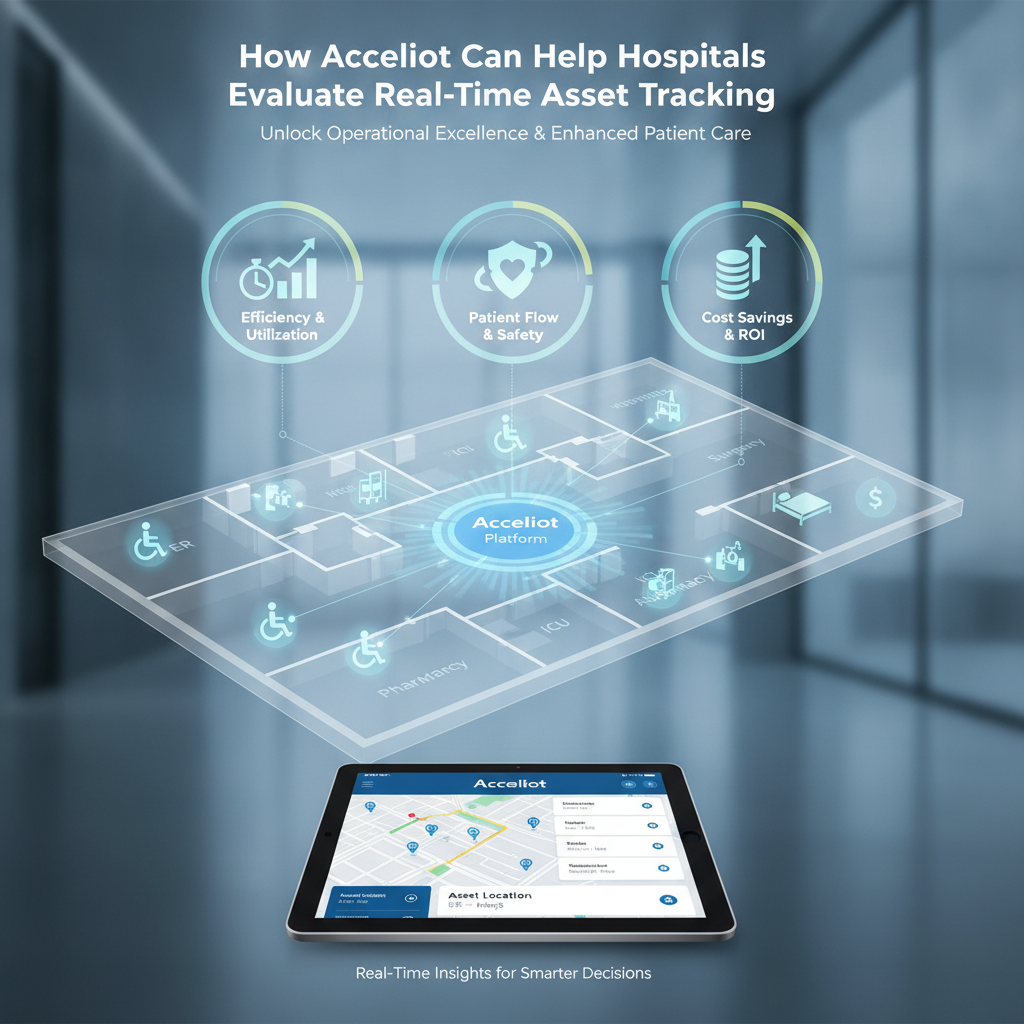
An enterprise evaluating Acceliot can compare its RFID, RTLS, and asset-tracking approach against a scripted test involving infusion pumps, wheelchairs, portable monitors, and maintenance equipment. The script should verify room identification, zone-exit alerts, stale-location handling, battery status, and search behavior on a mobile device.
Design a Pilot That Exposes Technical Limits
During discovery, the clinical engineering lead, nursing operations representative, network engineer, security team, and integration architect should agree on asset states. “Available,” for example, might mean located in an approved equipment room, marked clean, free of an open maintenance order, and not assigned to a patient.
The initial pilot can cover one care area and a limited group of high-value or frequently searched assets. Site surveying comes first. Teams typically examine gateway placement, 2.4 GHz interference, elevator transitions, concrete walls, and rooms containing signal-dense equipment. A floor plan that looks simple in a facilities database can behave quite differently once BLE signals encounter a crowded ward.
Integration should follow the pilot’s workflow. A REST API might send location events to a clinical asset-management platform, while HL7 v2 or FHIR can associate asset status with an admission, discharge, or transfer event. MQTT may be appropriate for high-volume gateway messages. Zebra Technologies and Kontakt.io are among the vendors buyers may encounter when assessing this architecture, while GE Healthcare provides broader clinical-equipment context.
Midway through implementation, teams should test identifier reconciliation. Acceliot’s proposed RFID or RTLS design should show how EPC values, tag UUIDs, serial numbers, and internal asset IDs map to a master record. Otherwise, a technically accurate location event may still attach to the wrong device in the maintenance system.
Measure Availability, Not Dashboard Activity
A colorful floor map is easy to demonstrate. It is less useful than an observable workflow change.
Buyers should establish a baseline for median search time, unsuccessful searches, equipment transfers between floors, cleaning turnaround, preventive-maintenance retrieval, and rentals triggered by apparent shortages. Projections should be validated through the pilot rather than treated as established results.
Current adoption discussions cataloged by World Health Expo emphasize equipment utilization, patient flow, staff safety, and reduced search time as common RTLS value drivers. Each requires a measurable definition. Utilization could mean hours in clinical use divided by available hours, while retrieval performance could be measured from maintenance request to device arrival at the biomedical workshop.
Look for same-shift changes. Staff should be able to search by device type and status, identify the correct floor or room, and distinguish a clean device from one awaiting service. Operations teams should also be able to review movement history when equipment repeatedly accumulates in a particular ward.
Buyer Takeaways From the Evaluation
A useful evaluation separates location precision from workflow correctness. A tag might locate a pump within a room, yet the system may still describe it as available when infection-control staff have not released it. During testing, combine RTLS events with cleaning and maintenance status rather than relying on coordinates alone.
The scripted pilot should also include failure conditions. Disconnect a gateway, remove a tag battery, move an asset through an elevator, and take a device beyond its permitted zone. Buyers can then inspect alert latency, offline buffering, duplicate events, and the audit log.
More precision is not inherently better. Bed-level accuracy may add infrastructure and calibration work when floor-level or room-level visibility already solves the search problem. The appropriate design follows the clinical decision being made.
Applicability Beyond Acute Care
Outpatient centers, rehabilitation facilities, and diagnostic networks can adapt the same model for wheelchairs, mobile imaging accessories, specimens, or loaned devices. The tag technology may change, but the evaluation should still connect a physical event to a defined operational action.
How long does a hospital RTLS implementation take?
A limited pilot generally includes workflow mapping, a radio-frequency site survey, tag installation, integration, and user testing across several implementation phases. Buyers should ask vendors to separate infrastructure deployment from HL7, FHIR, REST, or MQTT integration because interface validation can take longer than attaching tags.
Is BLE or RFID better for tracking hospital equipment?
BLE generally suits recurring room-level or zone-level visibility, while passive RFID often fits doorway, cabinet, or checkpoint detection. A hospital may use both, such as BLE for locating infusion pumps and passive RFID for recording movement into a clean-equipment room.
What should a healthcare asset-tracking pilot measure?
Track median search time, location accuracy by room, stale events, battery alerts, cleaning turnaround, and maintenance retrieval time. The pilot should also test at least one zone-exit alert and one integration that updates an operational record rather than measuring only dashboard logins.