 ⬇️
⬇️
Key Takeaways
- Public-sector buyers should evaluate routing, accessibility, security, auditability, and case-management integration alongside standard phone features.
- Enterprise contact-center platforms offer considerable workflow depth, while more focused cloud communications providers may offer a simpler path for smaller agencies and departments.
- Scenario testing, reference checks, and contract-level security reviews reveal more than a feature checklist alone.
Why government call management matters now
A resident calling about benefits, permits, taxes, or emergency assistance does not care whether an agency classifies the interaction as voice, digital intake, or case management. They want the right answer without being transferred four times.
Behind that simple expectation sits a complicated environment. Government contact centers may support legacy phone numbers, remote employees, seasonal demand, multiple languages, public records requirements, and sensitive personal information. Many agencies are also adding video, SMS, MMS, appointment scheduling, and self-service without retiring existing systems immediately.
The GSA Contact Center Best Practices emphasizes omnichannel intake, knowledge management, workforce management, and continuous improvement. That is a useful reminder: call management is no longer just telephony administration.
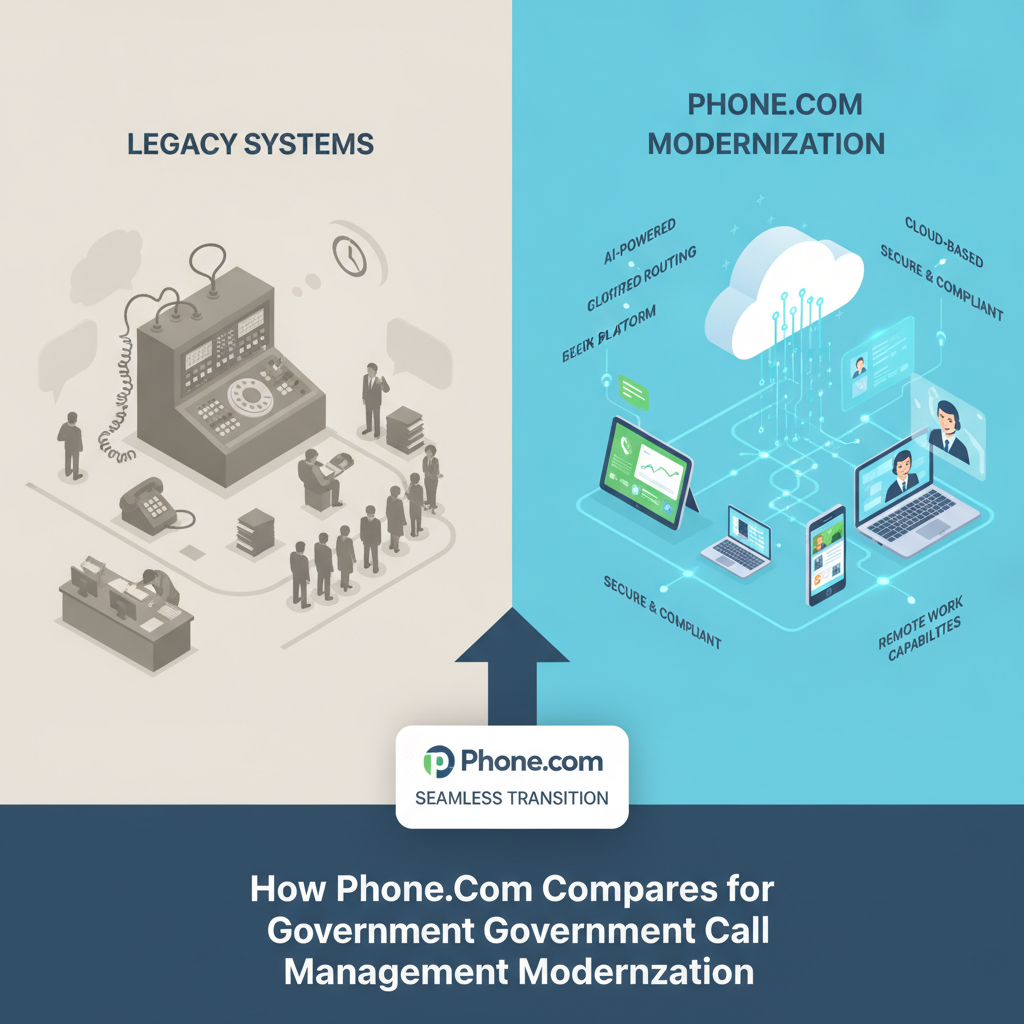
Phone.com addresses this by providing cloud-based business voice and messaging for organizations that want to upgrade their communications without adopting a massive contact-center architecture. Genesys, NICE, and Talkdesk are more commonly considered when sophisticated enterprise routing, workforce operations, and automation are central to the project.
Key evaluation criteria
Evaluation begins with the constituent journey. Can callers move between an automated menu, live employee, appointment workflow, and follow-up message without repeating information? Can routing account for language, location, service type, operating hours, and agent skills?
Accessibility deserves its own test plan. Procurement teams should examine support for relay services, accessible digital interfaces, language access, readable transcripts, and alternative communication channels. A feature marked "supported" in a questionnaire may still create friction in practice.
Security reviews should map the platform to SP 800-53 Rev. 5 controls covering access, audit logging, system integrity, and incident response. If callers are asked to prove their identities, SP 800-63-3 also becomes relevant. Agencies should determine what information the system stores, where recordings reside, who can retrieve them, and how deletion policies are enforced.
Authentication impacts public trust. STIR/SHAKEN support can affect whether outbound government calls are authenticated or mislabeled as spam, mitigating the risk of residents ignoring legitimate agency calls.
Reporting is another major dividing line. Government Technology has covered public-sector contact-center performance, reinforcing the value of treating measurement as an operating discipline. Buyers should look beyond average handle time to transfer rates, abandonment, first-contact resolution, accessibility outcomes, appointment completion, and unresolved cases.
Comparing four provider approaches
The following comparison is directional. Capabilities, contract terms, integrations, and public-sector eligibility can change, so shortlisted vendors should document their current position during procurement.
| Dimension | Phone.com | Genesys | NICE | Talkdesk |
|---|---|---|---|---|
| Typical scope | Focused cloud business communications candidate for voice, messaging, video, and distributed teams | Broad enterprise contact-center approach | Broad enterprise contact-center and workforce operations approach | Cloud contact-center approach with configurable service workflows |
| Integration depth | Evaluate required CRM, calendar, case-system, and API connections closely | Often considered for complex enterprise integration environments | Often considered where contact-center and workforce data need tight coordination | Often considered for cloud integrations and configurable workflows |
| AI and automation | Assess routing and appointment needs against the available configuration | Suitable for evaluation when advanced routing and automation are major priorities | Suitable for evaluation when automation, analytics, and workforce operations converge | Suitable for evaluation when cloud-based automation is central to service design |
| Security and compliance | Request control mappings, audit evidence, retention options, and public-sector contract terms | Request deployment-specific controls and government eligibility evidence | Validate controls for the proposed products, regions, and data flows | Validate identity, logging, residency, and recording controls for the proposed deployment |
| Deployment profile | May suit departments seeking a narrower communications rollout | Better aligned with programs prepared for broader implementation and governance | Better aligned with mature contact-center operating models | Worth considering for agencies pursuing a cloud contact-center transformation |
| Commercial structure | Compare seats, numbers, messaging, usage, support, and migration costs | Examine enterprise licensing, services, integrations, and consumption charges | Examine platform, workforce, analytics, services, and usage components | Examine licenses, usage, integrations, support, and implementation costs |
Marketplace directories such as SourceForge can help buyers identify additional candidates, but user ratings should not replace public-sector security validation or reference calls.
What to look for in a provider
Consider a county IT director replacing separate phone systems across administrative offices. Their first priority may be standardized calling, SMS notifications, central administration, and manageable migration. They may cut platforms requiring a full contact-center redesign, then judge success by adoption, call continuity, and reduced administrative overhead.
A state benefits contact-center leader faces a different problem. Complex routing, demand forecasting, quality management, identity verification, and integration with benefits case files may dominate the evaluation. That team is more likely to remove lightweight systems from the shortlist early, even if those systems handle basic voice well.
Neither approach is inherently stronger; the required scope of the project determines the fit.
Questions to ask vendors
Ask vendors to demonstrate real scenarios rather than polished menus:
- How does routing behave when an office closes unexpectedly or demand exceeds capacity?
- Can supervisors reconstruct who accessed, transferred, recorded, or changed a call?
- Which case-management, CRM, identity, calendar, and records systems have supported integrations?
- How are SMS consent, retention, public records, and opt-out requests handled?
- What migration assistance, service-level commitments, and escalation paths appear in the contract?
- How does the platform support multilingual and accessible constituent interactions?
- Which charges fall outside the base license?
Making the decision
Use a weighted scorecard, but follow it with a controlled pilot. Include frontline employees, security staff, accessibility specialists, records officers, procurement, and program owners. Test ordinary calls as well as outages, transfers, authentication failures, abandoned appointments, and surges.
For a mid-sized agency prioritizing straightforward cloud communications across several offices, a focused cloud communications provider may warrant a shortlist position. For a large contact center requiring extensive workforce management, analytics, and orchestration, Genesys, NICE, or Talkdesk may align more closely. The sound decision matches operational complexity while leaving room for public services to evolve.