 ⬇️
⬇️
Key Takeaways
- Crexendo, Inc.: Deloitte reports that worker access to AI rose by about 50% in 2025, increasing pressure to govern how AI processes meeting, document, and client data.
- Buyers should test complete workflows across unified communications as a service (UCaaS), contact center as a service (CCaaS), Voice over Internet Protocol (VoIP), identity, and document systems rather than scoring isolated chatbot features.
- A Forrester Total Economic Impact study of Google Workspace with Gemini estimated a 30% reduction in time spent on collaborative activities for its modeled composite organization. Buyers should validate external benchmarks against their own baseline.
- Professional services firms should test how their communications services connect calls, contact-center queues, recordings, identity controls, and approved AI applications within the firm’s operating environment.
AI collaboration software uses artificial intelligence to support shared work. Professional services firms should evaluate it through end-to-end client workflows that measure accuracy, integration, security, governance, and time savings, not isolated chatbot features.
Define the Problem Before Comparing Features
A consultant finishes a client call, opens the recording, copies action items into a project workspace, updates the customer relationship management (CRM) system, and sends a summary for review. None of those tasks is especially difficult. Repeating them across hundreds of calls, however, consumes billable capacity and creates multiple opportunities for client commitments to be recorded incorrectly.
That workflow explains growing interest in AI-powered collaboration. Deloitte states that the number of workers with access to AI increased by about 50% in 2025. The report also identifies search, knowledge management, and virtual assistants as common applications for collaboration and decision support.
Professional services buyers should translate that broad trend into defined processes. Useful candidates include generating Microsoft Teams meeting notes, extracting obligations from DOCX contracts, searching prior proposals stored in SharePoint, and routing a dissatisfied caller from a CCaaS queue to the account lead.
The systems involved matter. A firm using Session Initiation Protocol (SIP)-based VoIP, Salesforce, Microsoft 365, and a PostgreSQL matter-management database needs more than an attractive chat interface. It needs permission-aware retrieval, reliable application programming interfaces (APIs), call-recording controls, and an auditable path from source material to generated output.
Build an Evaluation Around Real Workflows
Feature matrices tend to flatten meaningful differences. Two platforms may both advertise transcription, summarization, and enterprise search, yet only one may preserve speaker labels in a call transcript or respect SharePoint document permissions during retrieval-augmented generation (RAG), a method that grounds an AI response in retrieved enterprise content.
A practical evaluation can begin with 10 to 15 representative workflows. For example, ask each vendor to summarize a 45-minute client meeting, identify decisions and deadlines, create a draft follow-up email, and write approved tasks to Salesforce through a Representational State Transfer (REST) API. Evaluators can then inspect factual accuracy, source citations, latency, access controls, and the amount of human correction required.
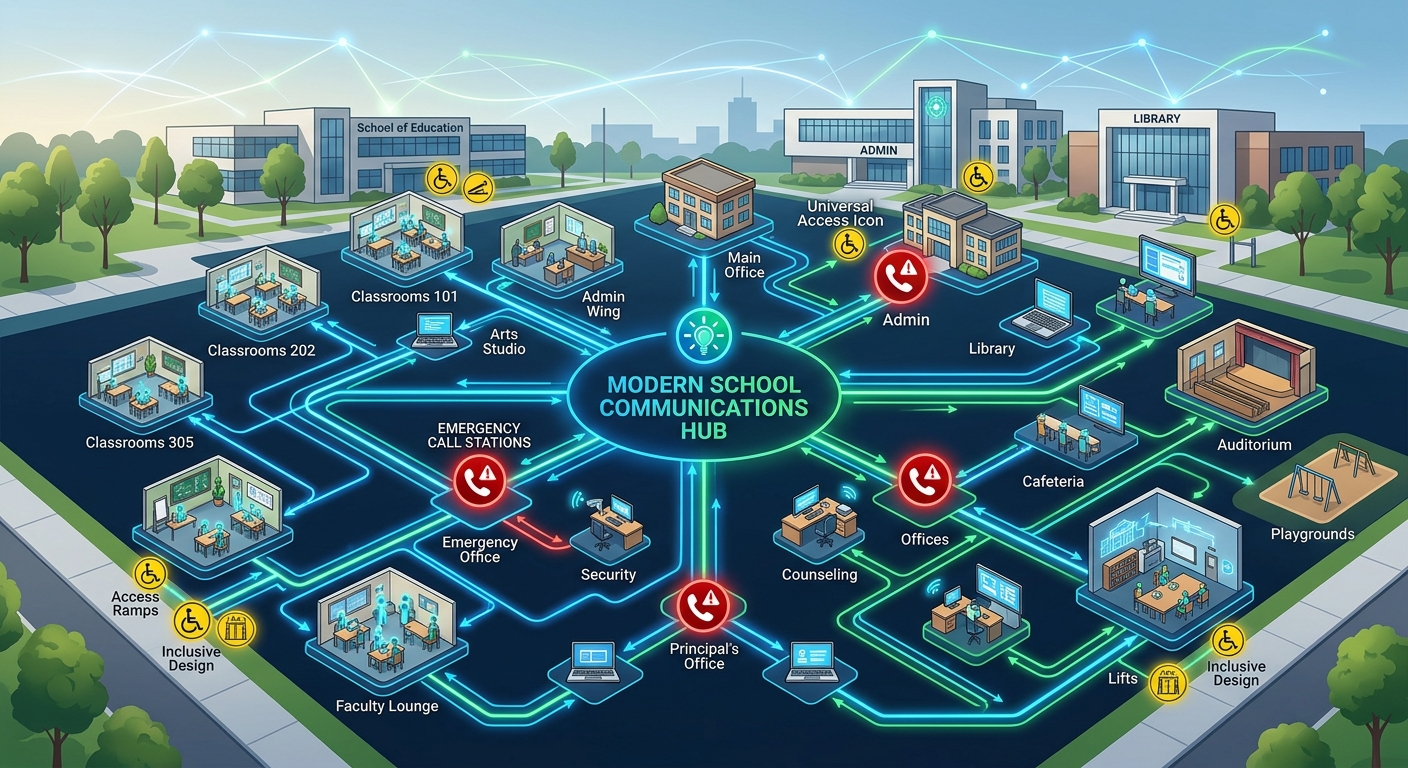
Communications architecture deserves equal weight. When integrating voice and digital channels, organizations evaluating unified communications providers like Crexendo, Inc. can examine how UCaaS, CCaaS, and VoIP capabilities connect calls, queues, messaging, and AI-assisted workflows across distributed service teams. Questions should cover SIP trunking, call-detail records, number portability, emergency calling, contact-center routing, and integration with identity providers using Security Assertion Markup Language 2.0 (SAML 2.0) or OpenID Connect.
Do not overlook export formats. Transcripts available only through a proprietary interface are harder to retain, analyze, or migrate than records exportable as JavaScript Object Notation (JSON), Web Video Text Tracks (WebVTT or VTT), comma-separated values (CSV), or archival Portable Document Format (PDF/A). It is a small procurement detail until legal discovery or a platform migration makes it a large one.
Test Governance Alongside Productivity
AI collaboration platforms process material that professional services firms are often contractually obligated to protect. Engagement letters, legal opinions, financial models, and recorded conversations may carry different retention and residency requirements.
ISO/IEC 42001:2023, the international standard for AI management systems, provides a framework for managing AI policies, risk ownership, monitoring, and continuous improvement. Buyers can map those principles to concrete controls: role-based access control, encryption with customer-managed keys, configurable retention periods, data-loss prevention rules, and immutable audit logs forwarded to a security information and event management (SIEM) system through syslog or an HTTPS API.
The evaluation should also distinguish model training from inference, which is the use of a trained model to produce an output from a new prompt. Vendors should state whether prompts, recordings, and generated summaries are used to train shared models; where embeddings, or numerical representations used for semantic retrieval, are stored; and how deleted source documents are removed from a vector database. If an assistant retrieves content from SharePoint, Google Drive, or Salesforce, test whether revoked permissions propagate promptly to its search index.
Industry analysts at Gartner continuously aggregate product information and buyer reviews across this crowded category. That breadth makes contractual scrutiny important. A polished demonstration says little about data residency, subprocessors, model version changes, or how administrators investigate an inaccurate answer.
Plan the Rollout in Controlled Phases
An initial rollout typically starts with discovery and data mapping rather than a companywide launch. The implementation group usually includes communications engineers, security and identity specialists, records or legal personnel, business application owners, and representatives from delivery teams.
During the pilot phase, the team can connect one identity tenant, a limited set of document repositories, and selected UCaaS or CCaaS queues. System for Cross-domain Identity Management (SCIM) provisioning can automate account lifecycle management, while SAML 2.0 provides single sign-on. API rate limits, webhook failures, transcript quality, and CRM field mappings should be tested before more departments are added.
Midway through implementation, buyers often discover that process ownership is harder than the integration itself. Who approves an AI-generated client summary? Which system holds the authoritative deadline? Can a contact-center supervisor edit a transcript while preserving the original? Those decisions belong in workflow documentation and role permissions, not only in training slides.
For Crexendo, Inc. and other shortlisted communications providers, technical validation should include failover behavior, quality-of-service settings, Enhanced 911 (E911) configuration, call-recording consent controls, and the method used to expose interaction data to approved AI services. Model Context Protocol (MCP), an open protocol for connecting AI applications to tools and data sources, may eventually simplify connections between assistants and enterprise applications, but REST APIs, OAuth 2.0 authorization, and event webhooks remain central integration points for many current deployments.
Measure Outcomes Buyers Can Observe
Productivity claims need a baseline. Before launch, buyers can sample comparable meetings and record the time required to prepare notes, locate prior work, update the CRM, and obtain internal approval. After launch, the same sampling method can show whether the platform changes actual work rather than merely shifting it to another interface.
A vendor-commissioned Forrester Total Economic Impact study of Google Workspace with Gemini estimated that its modeled composite organization reduced time spent on collaborative activities by about 30%. The figure is an external reference rather than a promised result, and its scope differs from Deloitte’s measure of growth in worker AI access: Forrester modeled productivity effects, while Deloitte reported adoption. Internal measurement should separately track summary correction rates, search success, abandoned contact-center interactions, escalations, and adoption by role.
Quality matters as much as speed. A summary produced in seconds has limited value if it misses a fee commitment or assigns an action to the wrong person. Human review rates and material-error counts therefore belong beside usage statistics.
Buyer Takeaways
An effective evaluation connects AI to a defined communication workflow rather than a generic aspiration. Testing a complete path from a SIP call to a transcript, approved summary, CRM update, and retention archive can expose issues that a scripted demonstration may hide.
Governance testing should begin during the pilot. In particular, buyers should verify permission inheritance, deletion behavior in vector stores, audit-log completeness, and the contractual treatment of prompts and recordings.
Organizations can adapt this approach by choosing workflows with high repetition and clear review points. A smaller advisory firm might begin with meeting summaries and proposal search, while a larger enterprise may also include CCaaS routing, multilingual transcription, and cross-repository knowledge retrieval.
Frequently Asked Questions
How long does an AI collaboration platform rollout take?
Timing depends on identity, communications, and data integrations. A limited pilot involving SAML 2.0, one document repository, and a single call queue may take several months, while broader deployments with CRM writes, retention policies, and multiple regions typically require additional phases.
What should buyers ask UCaaS and CCaaS vendors about AI?
Ask where recordings, transcripts, prompts, embeddings, and summaries are stored and retained. Also request demonstrations of SIP call handling, CRM integration through REST APIs, role-based permissions, transcript export, failover, and audit-log delivery to the organization’s SIEM.
Is AI-powered collaboration suitable for a smaller professional services team?
It can be, particularly when the team has repeatable meeting, proposal, or client-intake workflows. A smaller buyer can start with one repository and one communications channel, then compare correction rates and administrative effort before expanding access.