 ⬇️
⬇️
Key Takeaways
- Start with an assessment that identifies 3 to 5 priority improvements, maps dependencies, and assigns each item a budget range.
- Separate consulting from managed IT services: consultants define the target architecture, while managed services operate patching, backups, endpoint protection, and service desks.
- Measure observable changes through tools such as Microsoft Intune, Microsoft Sentinel, REST APIs, and recovery tests rather than relying on broad “digital transformation” goals.
Define the Problem Before Shopping for Providers
An accounting application that stalls during month-end close is not necessarily a cloud problem. The constraint could be an undersized SQL Server instance, an unreliable site-to-site VPN, excessive endpoint latency, or an integration that submits transactions in large overnight batches.
Buyers should therefore begin with concrete failure modes. Useful examples include unsupported Windows Server installations, inconsistent Microsoft 365 access policies, backups that have not passed a restoration test, or employees manually re-entering CSV data between an ERP and a customer relationship management platform.
Research summarized by TMCnet identifies cloud migration, cybersecurity, systems integration, and IT planning as common SMB consulting use cases. That breadth can create scope problems. Trying to address all four areas under one loosely defined project makes it difficult to assign ownership or determine whether the engagement has worked.
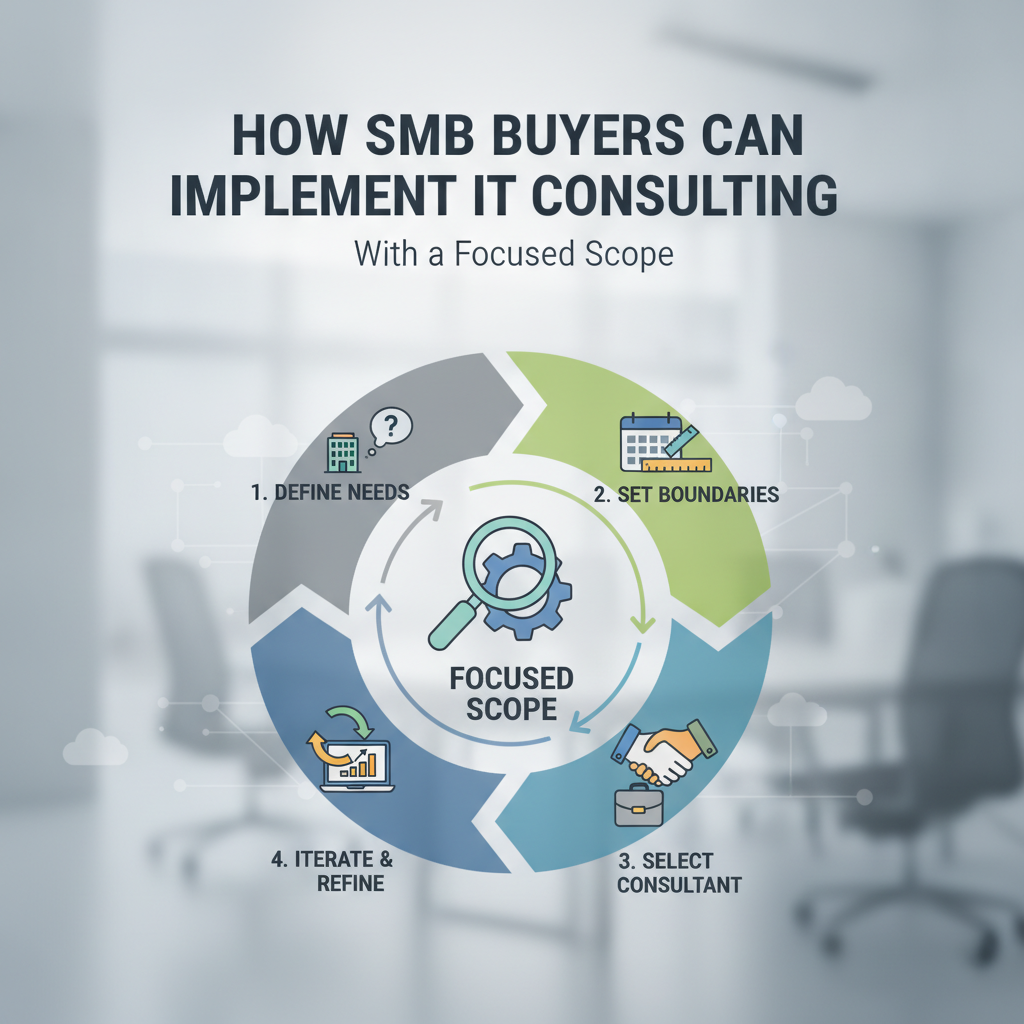
A short assessment offers a more controlled entry point. The deliverable should identify 3 to 5 priorities, the affected systems, estimated cost bands, technical dependencies, and the operational consequence of deferring each item. Buyers should reject assessments that produce only maturity scores and generic diagrams.
Build an Evaluation Checklist Around Deliverables
Provider comparisons often focus too heavily on hourly rates. A more useful evaluation examines what the buyer will own when the engagement ends.
For a cloud migration, expected artifacts might include an application dependency map, Azure or AWS landing-zone design, identity architecture, rollback procedure, and monthly consumption model. For cybersecurity work, buyers can request a Microsoft Entra ID access review, endpoint inventory, firewall rule analysis, phishing-resistant multifactor authentication plan, and controls mapped to NIST Cybersecurity Framework 2.0 or ISO/IEC 27001.
Apex Technology Services can be evaluated using the same artifact-based standard as any provider: buyers should ask who produces the architecture, which tools gather evidence, how recommendations are prioritized, and what documentation remains available after handoff.
Commercial boundaries matter too. The North Solution describes an assessment-led model that narrows attention to a small set of high-impact improvements. That structure can help buyers distinguish a defined consulting project from an open-ended advisory retainer. Industry cost guidance places some SMB assessments in the low five figures, while migrations and integration programs can cost substantially more, so change-control terms deserve close review.
Plan Delivery as Connected Phases
Implementation typically progresses through discovery, remediation, controlled deployment, and operational handoff. These are not rigid calendar blocks. A straightforward Microsoft 365 configuration review may move quickly, while an ERP integration involving SAP Business One, REST APIs, and a PostgreSQL reporting database may require several months of testing and data reconciliation.
During discovery, internal application owners should validate the consultant’s asset inventory. Automated scans can miss a scheduled PowerShell script, an Access database used by finance, or an SFTP exchange that runs outside the documented architecture. Old systems have a habit of becoming visible only when someone turns them off.
Remediation should address prerequisites before migration. That could mean removing shared administrator accounts, replacing unsupported firewall firmware, standardizing device enrollment through Microsoft Intune, or confirming that immutable backups can be restored into an isolated environment.
Controlled deployment limits blast radius. Buyers can start with a representative user group, verify single sign-on through SAML 2.0 or OpenID Connect, test conditional-access policies, and compare application response times before expanding deployment. The final phase transfers runbooks, configuration baselines, escalation paths, and administrative credentials to the operating team.
Decide Where Consulting Ends and Managed IT Begins
Consulting and managed services solve different problems. Consulting defines what should change and why; managed IT handles recurring work such as patch deployment, endpoint alerts, backup monitoring, account provisioning, and service-desk tickets.
Managed IT Canada presents the two models as complementary, particularly for organizations with limited internal IT depth. A buyer might use consulting to design a Microsoft Azure landing zone and then place monitoring, cost reviews, and incident response under a managed-service agreement.
The boundary should be visible in a RACI matrix. For example, the provider may investigate Microsoft Sentinel alerts, while the buyer’s security lead approves account suspension. A provider like Apex Technology Services should also document which incidents are covered by the recurring fee, what triggers project billing, and how configuration changes move from recommendation to approval.
Measure Outcomes Buyers Can Observe
Post-launch measurement should connect each technical change to an operational signal. For identity work, track the number of dormant privileged accounts, conditional-access exceptions, and help-desk requests involving password resets. For backup improvements, record whether quarterly recovery exercises restore the required virtual machines, SQL databases, and file shares within the organization’s recovery objectives.
Integration projects need similar discipline. Buyers can compare manual CSV uploads, rejected API transactions, duplicate customer records, and the time required to reconcile failed batches. Cloud projects should monitor monthly consumption by workload, reserved-instance coverage, storage growth, and application latency rather than treating migration completion as the result.
Because specific performance metrics are often not disclosed publicly, buyers should be cautious when any vendor presents improvement claims without explaining the starting point, measurement window, or monitoring system.
Apply the Practical Buyer Takeaways
A practical step is to connect every recommendation to a system owner and test. If the assessment identifies unreliable recovery, the acceptance criterion should be a successful restoration of named workloads, not the purchase of another backup product.
Scope control also begins with dependencies. An ERP-to-CRM integration cannot be considered complete if customer identifiers differ across both databases. Data mapping, retry logic, API rate limits, and exception ownership belong in the original statement of work.
Finally, insist on operational documentation. Architecture diagrams are useful, but service-desk staff also need concise procedures for failed backups, locked accounts, expired certificates, and unavailable VPN tunnels.
Mid-market organizations can use the same model across cloud, cybersecurity, integration, and compliance projects. The scope will vary, but the pattern remains assessment-led: identify a few priorities, specify technical deliverables, deploy under controlled conditions, and assign ongoing operations explicitly.
How long does an SMB IT consulting implementation take?
Duration depends on system count, integration depth, and testing requirements. A Microsoft 365 security assessment is generally shorter than an ERP migration involving SQL Server, REST APIs, identity federation, and multiple business units; buyers should ask for phase-based milestones rather than a single completion date.
What is the difference between IT consulting and managed IT services?
IT consulting usually produces time-bound deliverables such as a target architecture, migration plan, security assessment, or integration design. Managed IT services handle recurring operations, including patching, endpoint detection, backup monitoring, user support, and incident triage under defined service levels.
Is an IT consulting assessment worth it for a small team?
It can be useful when the assessment produces 3 to 5 funded priorities instead of a broad list of deficiencies. A small team should request an asset inventory, risk-ranked backlog, architecture diagram, budget range, and a 90-day action plan that identifies which work stays internal and which work requires outside support.