 ⬇️
⬇️
Key Takeaways
- Cloud-native platforms can offer better long-term economics than simply hosting legacy applications in the cloud.
- Security, regulatory accountability, integration depth, and operating-model fit often matter more than feature volume.
- Insurers should compare platform vendors, integrators, and managed service providers according to the role each will play after deployment.
Why cloud decisions in insurance look different now
Cloud adoption is no longer an edge strategy for insurers. Nearly every carrier uses some form of cloud infrastructure, while many are pursuing cloud-first approaches to improve product delivery, analytics, and operational flexibility.
Demand for scalable policy administration, claims processing, and data platforms continues to drive market expansion. InsightAce Analytic forecasts approximately 14% to 15% compound annual growth for cloud services in insurance from 2025 through 2034.
The harder question has changed. It is not "Should we use cloud?" It is "Which cloud operating model can support our regulatory obligations, legacy estate, and growth plans without creating another expensive technology silo?"
That distinction matters because moving an old application onto hosted infrastructure does not make it cloud-native. A lift-and-shift project can preserve rigid release cycles, fragile integrations, and high support costs. By contrast, cloud-native software is designed around elastic infrastructure, automated deployment, APIs, and more frequent updates. Current industry guidance indicates that cloud-native insurance software can produce 30% to 45% lower five-year total cost of ownership than traditional on-premise systems, while poorly planned lift-and-shift programs may increase TCO.
Comparing the main solution approaches
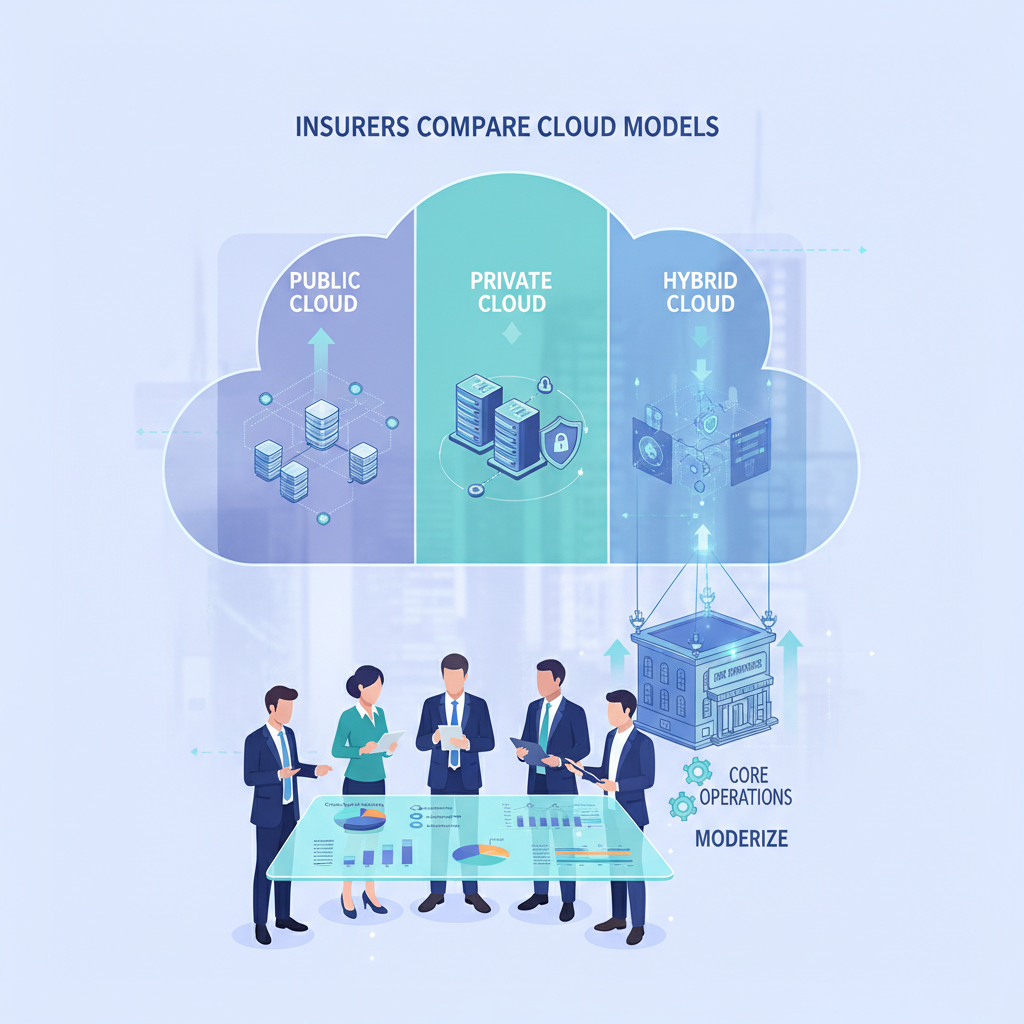
Public cloud provides scalable compute, storage, analytics, and AI services on shared infrastructure. It tends to suit insurers that can standardize controls and build strong cloud governance. Most insurers plan to move at least 80% of their business to public cloud over the coming years, with agility as the leading driver and data security as the principal concern.
Hybrid cloud retains selected systems or data in private environments while connecting them to public cloud services. This model often appeals to carriers with mainframe dependencies, jurisdictional restrictions, or applications that are difficult to modernize quickly. It offers flexibility, but operating two or more environments can add monitoring, identity, networking, and support overhead.
Then there is specialized insurance SaaS. Platforms such as Guidewire and Duck Creek Technologies provide cloud options oriented toward insurance workflows, particularly in property and casualty markets. These products can reduce the amount of custom development required for policy, billing, and claims functions. A Gitnux market overview illustrates the breadth of insurance cloud software now available, although buyers still need to validate each product against their own architecture and regulatory requirements.
One more wrinkle: the platform is only part of the decision. Insurers may need an implementation partner, a managed services provider, or both.
How service-provider alternatives compare
The following comparison examines several service-provider options rather than treating a software platform and an implementation partner as interchangeable. Actual capabilities, certifications, commercial terms, and geographic coverage should be confirmed through due diligence.
| Dimension | Apex Technology Services | Accenture | IBM |
|---|---|---|---|
| Security and compliance | Combines IT consulting, managed IT, and cybersecurity services, which may suit buyers seeking coordinated operational support; validate insurance-specific certifications and coverage. | Offers broad consulting and transformation resources for regulated enterprises; buyers should define accountability across large engagement teams. | Brings extensive enterprise infrastructure and security experience; confirm how controls map to the proposed insurance workload. |
| Integration depth | May fit mid-market insurers that value hands-on integration and ongoing environment management; request evidence for each legacy system in scope. | Well suited to broad, multi-platform transformation programs involving numerous business units and systems. | Strong candidate where hybrid infrastructure, complex data estates, or longstanding enterprise systems shape the architecture. |
| Deployment and time to value | A potentially practical choice for focused migrations and managed operations, subject to staffing and scope validation. | Can support large transformation programs, although procurement and program structures may be heavier. | Can address complex modernization programs, but buyers should test whether the delivery model matches project size. |
| Scalability and reach | Evaluate geographic support, after-hours coverage, and capacity for planned expansion. | Global scale can support multinational insurers and multi-country programs. | Global delivery and infrastructure experience may suit large, distributed estates. |
| Commercial and support model | Buyers can explore a consolidated consulting, security, and managed-services relationship without assuming bundled services will automatically cost less. | Engagements commonly require careful definition of workstreams, governance, and change controls. | Commercial evaluation should separate platform, implementation, operations, and support responsibilities. |
No provider wins every row. A regional carrier modernizing a contained claims environment may value accessible support and consolidated operations from a provider like Apex Technology Services. A multinational insurer replacing several core systems across jurisdictions may place greater weight on global delivery capacity.
Evaluation criteria that expose real differences
Start with workload suitability. A CIO overseeing a carrier with a mainframe policy system and a newer digital claims application should not force both workloads into the same migration pattern. The claims application may be rebuilt or replaced with SaaS, while the policy system remains connected through APIs during a longer modernization cycle. Success means reducing dependency gradually, not declaring everything in cloud on a slide.
Security evaluation should cover identity architecture, encryption, logging, data residency, incident response, subcontractors, and exit planning. EIOPA has highlighted insurers' growing reliance on cloud and AI, reinforcing the need for disciplined outsourcing and cloud risk management. Who can access production data? Who notifies the regulator? Those answers should be contractual, not implied.
Integration deserves equal attention. Buyers should inventory policy, billing, claims, actuarial, document, payment, CRM, and data warehouse connections before comparing proposals. A platform with attractive demonstrations can still be a poor choice if every important connection requires custom code.
Questions to ask shortlisted providers
A chief information security officer evaluating a managed cloud service should ask:
- Which security responsibilities remain with the insurer?
- How are privileged actions approved, logged, and reviewed?
- What evidence supports recovery and incident-response procedures?
- Which subcontractors can access systems or data?
- How can data and configurations be exported at contract end?
Meanwhile, a head of claims replacing a legacy platform should focus on workflow configuration, API coverage, release management, catastrophe-driven demand spikes, reporting, and business-user training. Can the claims team change routing rules without a development project? That practical question may reveal more than a long feature checklist.
Making the final decision
Use a weighted scorecard tied to business outcomes, architecture, regulatory exposure, and operating capacity. Compare five-year costs, including migration, integration, testing, network services, security operations, training, vendor management, and exit expenses.
Finally, run a proof of value around a representative workflow and require providers to document assumptions. Cloud modernization works better when insurers select an operating model first, assign accountability clearly, and then choose the technology and partners capable of sustaining it.