 ⬇️
⬇️
A retail branch loses power overnight. Its IP phones go dark, the alarm panel cannot reach its monitoring center and the elevator emergency phone no longer has a dial tone. The new communications service worked perfectly during installation. The problem was that nobody tested the building as a complete system.
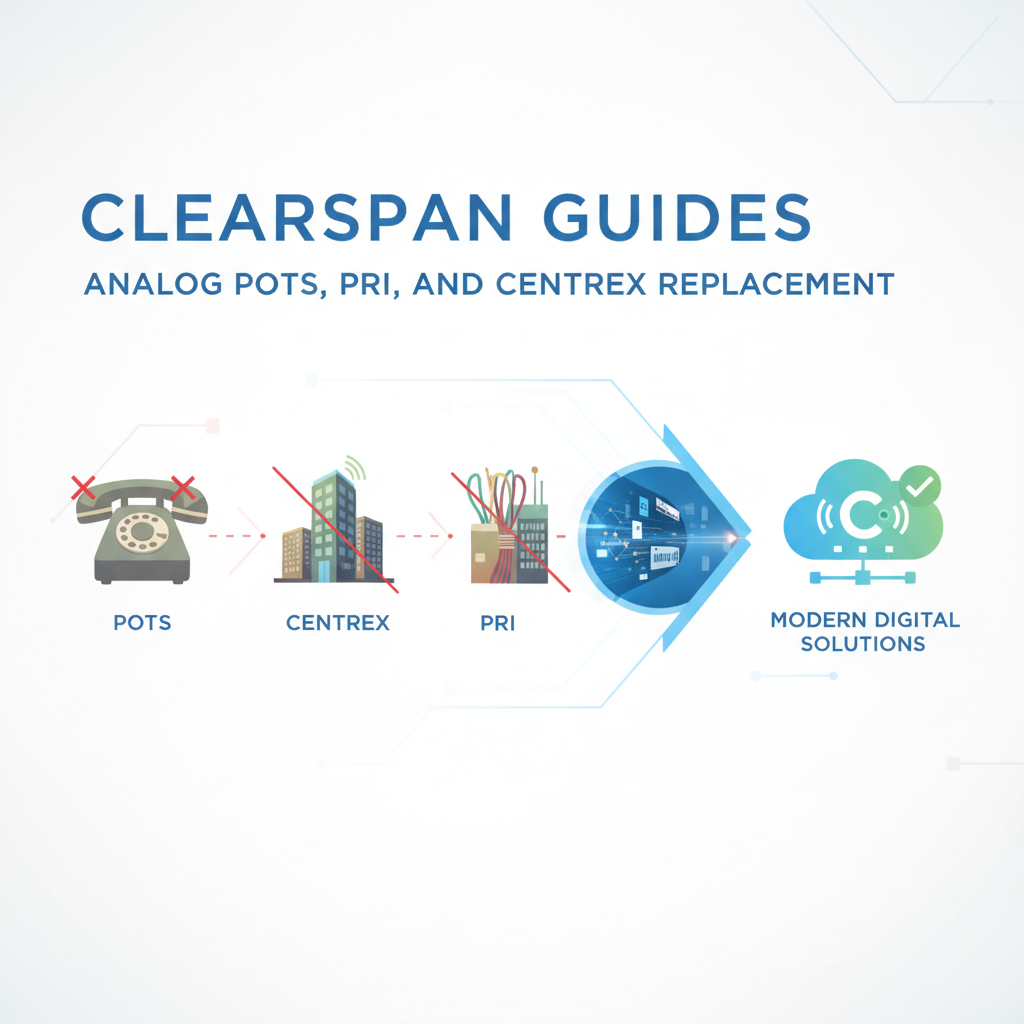
That scenario captures the central challenge of replacing analog POTS, PRI and Centrex services. This is not simply a voice upgrade. It is an effort to identify old circuits, understand what depends on them and move each workload to an appropriate IP, cellular or cloud-based alternative.
The timing matters. U.S. PSTN lines fell from approximately an industry-cited figure in 2005 to 175.2 million in 2024, a significant share decline (docs.fcc.gov). Meanwhile, the FCC has taken additional steps in 2025 and 2026 to reduce copper-retirement notice and filing requirements, giving carriers more flexibility to grandfather or discontinue legacy services.
Waiting for a carrier disconnect notice is a risky planning strategy.
What POTS, PRI and Centrex replacement involves
Plain old telephone service, or POTS, generally refers to an individual analog line delivered over copper. Enterprises still use these lines for voice, fax, fire and burglar alarms, elevator phones, gate intercoms, point-of-sale devices and other specialized equipment.
PRI is different. It connects a PBX to the public telephone network through a channelized digital circuit. Replacing PRI usually means moving to SIP trunks, a cloud unified communications service or a combination of both.
Centrex is a carrier-hosted business telephone service in which calling features reside in the service provider's network. Its modern successor is typically hosted or cloud communications, with centralized administration, soft clients, collaboration and contact center capabilities.
Here's the thing: an enterprise may have all three technologies in the same building. The reception desk could use Centrex, the PBX could connect through PRI and the elevator could rely on POTS. Treating the location as a single line item can hide those dependencies.
Platforms such as Clearspan can help enterprises bring cloud communications, collaboration, contact center functions, call recording, phones and soft clients under a more consistent operating model. Clearspan PRS helps modernize analog endpoints that still require gateways, adapters and/or managed replacement services.
Build the migration around workloads, not circuit names
A useful first step is to create a circuit and endpoint inventory for every site. Carrier invoices are a starting point, but they rarely tell the full story. Teams should physically trace lines where practical and interview facilities, security, life-safety and local operations personnel.
Each record should capture:
- Site address and building area
- Carrier, circuit identifier and monthly cost
- Assigned telephone number
- Connected device and business owner
- Inbound, outbound or bidirectional calling requirements
- Power, battery and failover behavior
- Fax, modem, DTMF, caller ID or line-seizure requirements
- E911 location and emergency-routing implications
- Contract expiration and number-porting constraints
That last mile of discovery often produces surprises. A "fax line" may actually support a postage meter, while a forgotten number may terminate at a loading-dock intercom.
After discovery, classify each workload into a migration path. PRI-connected PBXs can move to SIP trunks as an interim step, preserving existing telephony investments while retiring TDM access. Centrex users can transition to hosted UC accounts with a centralized dial plan. Conventional office POTS lines can often become cloud extensions or IP phones.
Specialty analog devices require more scrutiny. An analog telephone adapter or FXS gateway may work for basic voice, but alarms, elevators, fax machines and modems can behave differently over packet networks. Cellular POTS-replacement devices are another option, particularly where wired broadband diversity is limited. Device compatibility, local codes and monitoring-provider approval should be confirmed before deployment.
Design for outages and emergency calling
Copper lines historically carried their own electrical power. IP replacements usually depend on local power, Ethernet, broadband equipment and upstream services. That changes the failure model.
For each site, buyers should examine battery runtime, backup generation, dual broadband access, cellular failover and local calling survivability. A large campus may justify redundant session border controllers and diverse access circuits. A small branch might use broadband with cellular backup. An unmanned equipment room could need a managed analog replacement appliance with battery monitoring.
Emergency calling deserves its own workstream. Enterprises should map users, numbers and devices to accurate dispatchable locations, then evaluate E911 processes in light of Kari's Law and the RAY BAUM'S Act. Nomadic soft clients complicate the picture because users can move between offices or work remotely.
Testing should include more than placing a normal outbound call. What happens when commercial power fails? When the primary access circuit is disconnected? When the cloud service is unreachable? Can an elevator passenger still reach the intended operator, and does that operator receive usable location information?
Those questions are uncomfortable. They are also far cheaper to answer in a controlled pilot.
Evaluate providers on operational depth
Feature comparisons matter, but multi-site buyers should give equal weight to migration execution. Relevant selection criteria include SIP interoperability, E.164 number management, 802.3 Ethernet support, encryption, number-porting coordination and integration with existing PBXs.
Look closely at centralized dial-plan administration, contact center integration, call recording policies, analog device support and site-level survivability. Reporting should expose failed registrations, gateway status and service degradation before local employees open a trouble ticket.
Commercial flexibility counts too. Enterprises often benefit from phased licensing because a national migration may span several budget cycles. Ask whether the provider can support temporary coexistence among PRI, SIP and cloud users without creating conflicting dial plans.
The outlook is IP-based, but rarely IP-only
The global SIP trunking services market is projected by market analysts to reach roughly a notable sum by 2033. SIP will likely remain important even as enterprises adopt cloud voice because it can connect PBXs, contact centers, cloud platforms and carrier networks during phased migrations.
Analog equipment will not disappear on the same schedule as copper access. Elevators and alarm panels tend to outlive office phones. The practical goal, then, is not to force every endpoint into one architecture. It is to replace fragile legacy access while preserving the functions each site still depends on.
For multi-site enterprises, disciplined discovery is the dividing line between a telecom upgrade and an operational incident. Start with the endpoints, test the failure modes and migrate in manageable waves. The dial tone may sound the same afterward, but nearly everything behind it will have changed.
COMPANY: Clearspan (https://clearspancloud.com/)