 ⬇️
⬇️
Key Takeaways
- Government VoIP decisions should account for E911, network resilience, security, accessibility, and procurement requirements, not simply monthly seat costs.
- Hosted VoIP, UCaaS, hybrid architectures, and integrated CCaaS each address different operational needs.
- Buyers should compare providers through documented evidence, contract terms, migration support, and real-world testing rather than feature checklists alone.
Why public-sector phone modernization matters now
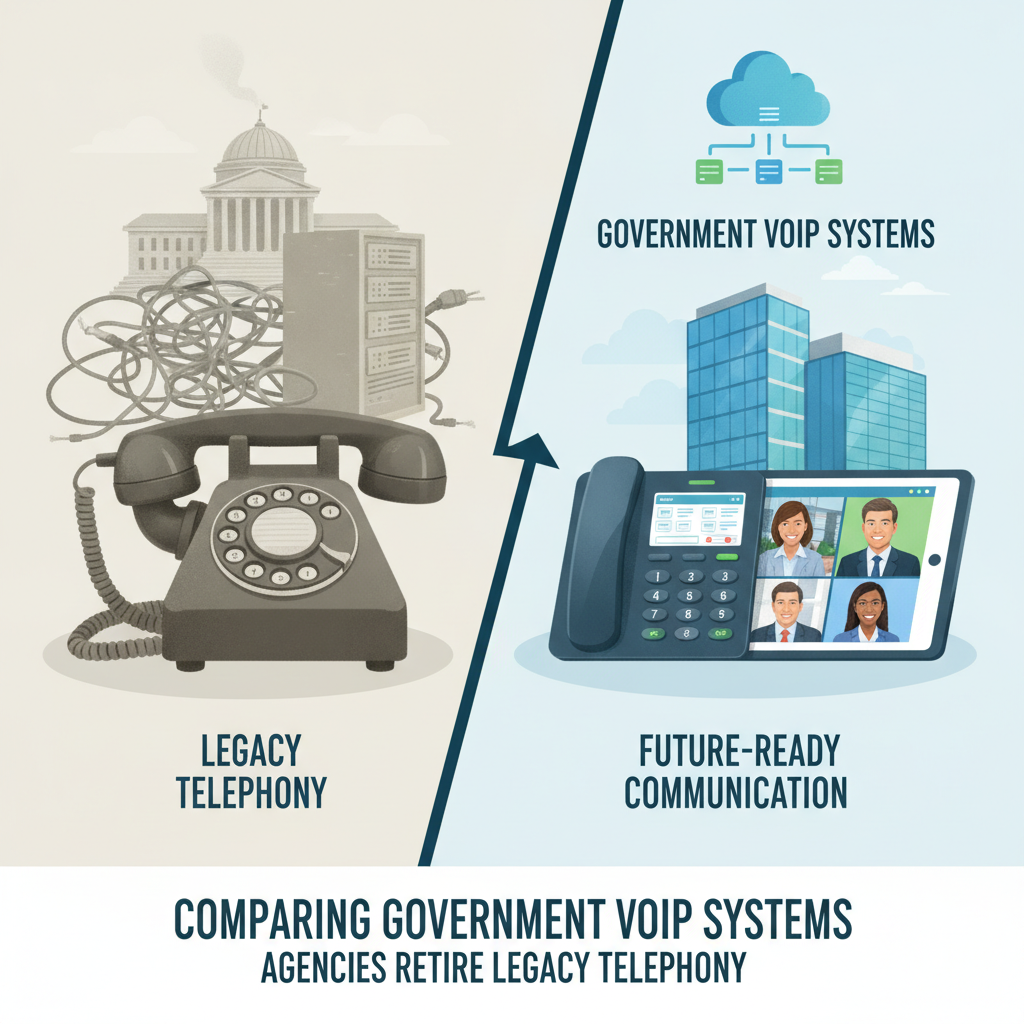
Aging Centrex and PBX systems are becoming harder to support, particularly across agencies with many offices, inconsistent carrier contracts, and limited telecom staff. Hosted Voice over Internet Protocol, or VoIP, offers a path toward centralized administration, lower setup costs, and more flexible service delivery.
The financial case can be compelling. A 2024 public-sector comparison placed traditional landline systems at roughly $100 to $250 per month for small deployments, while cloud VoIP generally involved lower setup costs and call charges. Those figures are directional, not a substitute for a complete total-cost model. Handsets, broadband upgrades, session border controllers, support, taxes, and migration services can change the picture.
There is another shift underway. Government employees increasingly work across offices, homes, field locations, and shared facilities. A desk phone alone no longer covers the job. UCaaS can bring calling, messaging, meetings, and presence into one environment, while CCaaS can support constituent service centers with routing, recording, quality management, and reporting.
Replacing dial tone is a baseline requirement; preserving emergency calling, accessibility, continuity, and public trust is the actual project.
Key evaluation criteria
Emergency calling belongs near the top of the scorecard. The FCC advises VoIP users to understand E911 location handling and the effects of power or internet outages. Agencies should test location records for headquarters, branches, remote workers, and shared workspaces. They should also document what happens when broadband, electricity, or the hosted service becomes unavailable.
Network readiness comes next. Voice is sensitive to latency, jitter, and packet loss, so a structured assessment should examine WAN capacity, Wi-Fi coverage, quality-of-service policies, power-over-Ethernet capacity, and failover connections. Session Initiation Protocol, commonly called SIP, provides call signaling for many deployments. Its core operation is defined in IETF RFC 3261, while the ITU maintains related multimedia communications standards.
Security reviews should cover identity controls, encryption, administrative permissions, audit logs, retention, fraud monitoring, and incident response. Ask which controls apply to the exact service tier and hosting model being proposed. Marketing language is not a substitute for documented evidence.
When an IT team consolidates separate phone systems across administrative buildings, courts, libraries, and public works sites, that team must map emergency locations and network dependencies first. A provider lacking credible failover design or multi-site migration support usually leaves the shortlist early, even if its per-seat quote appears attractive.
Common approaches and named-provider comparison
Public agencies generally choose among hosted VoIP, broader UCaaS, hybrid systems, or a combined UCaaS and CCaaS architecture. Hosted VoIP works well when the primary objective is replacing PBX calling. UCaaS adds collaboration. Hybrid designs can retain selected analog, paging, elevator, fax, or dispatch-related systems while moving general office users to the cloud.
Crexendo, Inc. is a reasonable candidate for agencies and public-sector-adjacent organizations that want to evaluate voice, UCaaS, and CCaaS in a connected procurement. RingCentral, Nextiva, and Zoom Phone offer credible alternatives, particularly where existing contracts, integrations, or user familiarity influence the decision.
The following comparison is deliberately procurement-oriented. Capabilities, certifications, packaging, and contract terms can differ by edition and public-sector agreement, so every item calls for vendor documentation.
| Dimension | Crexendo, Inc. | RingCentral | Nextiva | Zoom Phone |
|---|---|---|---|---|
| Service orientation | Evaluate as a VoIP, UCaaS, and CCaaS shortlist option | Evaluate for broad UCaaS requirements and multi-site administration | Evaluate for business communications and constituent-service workflows | Evaluate when calling will sit within an existing Zoom-oriented environment |
| Security and compliance | Request current control reports, encryption details, and public-sector eligibility | Confirm applicable certifications and government contract coverage | Verify controls and retention options for the proposed edition | Confirm which public-sector controls apply specifically to Zoom Phone |
| Integration depth | Test required identity, CRM, workflow, and API connections | Review connector breadth and support ownership | Validate agency-specific integrations and data flows | Assess advantages and limitations within the wider Zoom ecosystem |
| AI and automation | Review available features, governance controls, and data handling | Compare automation features by license tier | Test workflow value against agency use cases | Examine administration, transcription, and automation policies |
| Pricing and TCO | Request an itemized quote covering licenses, devices, support, and migration | Model licensing tiers and potentially overlapping collaboration tools | Clarify bundled versus optional functions | Compare incremental cost when other Zoom services are already licensed |
| Deployment and support | Examine migration planning, escalation paths, and hands-on assistance | Assess rollout resources for complex, distributed environments | Review onboarding and ongoing support responsibilities | Evaluate administration effort within the agency's existing collaboration stack |
What to look for in a provider
Procurement teams should ask providers to demonstrate ordinary but consequential workflows: transferring a constituent call, changing an E911 location, activating failover, retrieving an audit log, and onboarding a seasonal employee. Glossy demonstrations often avoid these details, but real operating work lives in them.
State contact-center directors present a different scenario from municipal IT leaders. These buyers prioritize queue behavior, supervisor controls, recording retention, accessibility, analytics, and integration with case-management systems. A voice-focused proposal without sufficient CCaaS depth could be eliminated, while success would mean consistent routing and reporting across departments without forcing every agency into identical workflows.
Support also deserves scrutiny. Who owns an incident when the carrier, access network, handset, and cloud application come from different parties? Ask for escalation procedures, service-level language, maintenance practices, number-porting support, and continuity plans.
Questions to ask vendors
Keep the final interviews practical:
- How is location information maintained and tested for E911?
- What calling functions remain available during local or regional outages?
- Which security attestations apply to the proposed service and contract?
- How are call records, recordings, transcripts, and administrative logs retained?
- What migration help is included for number porting, analog devices, and user training?
- Which fees sit outside the recurring license quote?
- Can the agency pilot representative offices and contact-center workflows before award?
Making the decision
Start with operating risk, then compare economics. Build a weighted scorecard covering emergency calling, resilience, security, integrations, accessibility, administration, support, and total cost. Run a pilot that includes a busy office, a smaller branch, remote users, and at least one outage exercise.
The platform that produces the fewest surprises after procurement is usually the one whose architecture, responsibilities, and contract terms have been tested rather than assumed. For government VoIP, disciplined validation tends to matter more than the longest feature list.