 ⬇️
⬇️
Key Takeaways
- Copper retirement is turning education voice modernization from a discretionary upgrade into a time-sensitive operational issue.
- POTS, PRI and Centrex services require different replacement strategies, particularly for elevators, alarms, emergency phones and other specialty endpoints.
- Successful programs begin with a detailed inventory, then combine resilient connectivity, SIP-based calling, unified communications and disciplined emergency-services planning.
Executive Summary
Schools, colleges and universities have relied on analog lines, PRI circuits and Centrex services for decades. Those services are now disappearing as carriers retire copper facilities and move customers to IP networks.
The decline is measurable. Traditional U.S. switched-access POTS lines fell from 27.2 million in mid-2022 to 15.0 million by June 30, 2025. For education leaders, the issue is larger than replacing desk phones. Legacy lines may support elevators, fire panels, door systems, emergency call stations, fax machines and obscure building-control equipment.
A practical modernization program separates these use cases, evaluates their safety and regulatory implications, and assigns an appropriate replacement path to each. SIP trunking can extend the value of an existing PBX, while cloud communications can consolidate calling, collaboration, conferencing and contact-center functions. The goal is not simply to reproduce an aging telephone environment over IP. It is to create a supportable, resilient communications architecture suited to distributed campuses.
Why Legacy Voice Has Become an Immediate Education Issue
According to the Federal Communications Commission, switched-access POTS lines declined at a roughly 17.9% annual rate. FCC orders adopted in 2017 and 2019 also authorized carriers to retire copper facilities and legacy POTS services, subject to transition and notification requirements.
That shift changes the economics of waiting. Monthly analog-line charges may rise even as repair intervals lengthen and replacement parts become harder to source. PRI and Centrex customers can face similar pressure through end-of-support notices, limited contract options or carrier migration programs.
An institution may know how many telephone extensions it operates yet have no reliable record of every analog circuit. A line installed years ago for a boiler alarm could still be billed under an unfamiliar account. Another might serve an elevator in a building now managed by a different department.
What happens if that circuit stops working after copper retirement? That question brings facilities, campus safety, IT, procurement and legal teams into the same conversation.
Choosing the Right Replacement Architecture
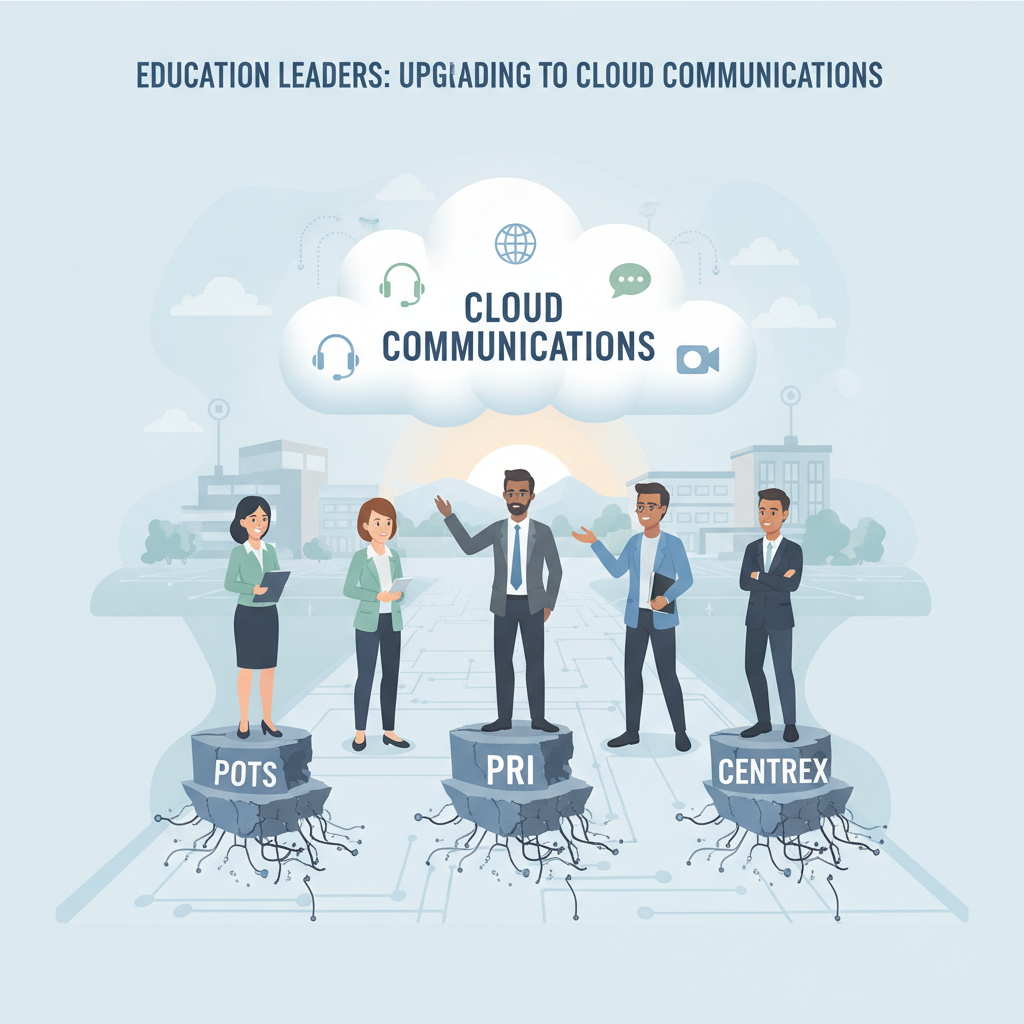
POTS, PRI and Centrex are related legacy technologies, but they are not interchangeable.
POTS replacement focuses heavily on individual analog use cases. Some endpoints can move to analog telephone adapters or managed line-replacement devices using IP or cellular connectivity. Others may need updated alarm panels, elevator interfaces or code-compliant purpose-built services. Buyers should confirm power backup, line supervision, environmental tolerances, carrier diversity and behavior during a WAN outage.
PRI replacement is generally a capacity and call-routing decision. SIP, defined through standards maintained by the IETF, carries signaling over IP and allows organizations to scale sessions without adding fixed blocks of physical voice channels. An institution can connect SIP trunks to an existing PBX, migrate campuses in phases or move calling into a hosted environment.
Centrex replacement usually reaches further. Because Centrex placed call-control functions in the carrier network, its retirement often encourages evaluation of cloud PBX and unified communications. Providers such as Clearspan participate in this market alongside Avaya, Mitel and RingCentral, while carriers including AT&T transition customers toward all-IP services.
Consider a K-12 technology director overseeing dozens of schools with a small central team. The first shortlist cut should be any solution that requires separate administration at every building. The director is likely to prioritize centralized provisioning, survivable calling, delegated school-level controls, emergency notifications and compatibility with classroom paging workflows. Success looks like fewer management consoles and clearer accountability, not merely lower calling rates.
Building an Inventory and Migration Plan
Discovery is often the hardest part. Start with carrier bills, PBX records, telephone closets and number inventories, then physically trace questionable circuits. Interview facilities staff and administrative assistants. They frequently know about lines that never appeared in an IT asset database.
Classify each endpoint by function, location, owner, usage, criticality and replacement constraint. E.164 number mapping should also be documented so direct inward dialing numbers, main numbers and emergency callback information remain consistent.
A higher-education CIO replacing PRI service across several campuses faces a different scenario. Existing PBXs may still have useful life, but the carrier has announced an end-of-support date. That buyer will typically evaluate SIP interoperability first, followed by session border controllers, redundant network paths, fraud controls and failover routing. A vague disaster-recovery design should remove a candidate from consideration. The McLennan Community College PRI-to-SIP migration charter illustrates these familiar drivers, including carrier support deadlines, cost considerations and resiliency.
Pilots should test more than ordinary inbound and outbound calls. Can users reach emergency services during a local internet failure? Are dispatchable-location records accurate for buildings, floors and rooms? Do contact-center queues, auto attendants, fax workflows and accessibility features behave as expected?
Power deserves attention too. Traditional copper lines often supplied endpoint power, while IP phones and adapters depend on local electricity, switches and backup systems. A migration that overlooks power can create a quieter failure mode, and a dangerous one.
Preparing for the All-IP Campus
Education communications are moving toward consolidated cloud calling, collaboration and contact-center environments. Over time, voice is likely to become less of a standalone utility and more closely connected with identity management, messaging, video meetings, safety workflows and service-desk operations.
Still, consolidation should not mean forcing every device onto one technical path. Specialty analog endpoints may remain mixed across IP, cellular and purpose-built services. Network segmentation, redundant access and lifecycle monitoring can help institutions manage that diversity.
The more useful question is not, “Which product replaces our PBX?” It is, “Which communications functions does the institution need during an ordinary day and during a campus emergency?”
Conclusion
Copper retirement gives education organizations a clear reason to revisit legacy communications, but urgency should not lead to a simple one-for-one swap. POTS endpoints, PRI trunks and Centrex users present different operational and safety requirements.
A sound program begins with discovery, assigns ownership to every circuit, evaluates cloud and SIP options against real campus conditions, and tests emergency behavior before cutover. Institutions that take this broader approach can retire fragile services while building a communications environment that is easier to operate, more adaptable and better prepared for the all-IP future.