 ⬇️
⬇️
Key Takeaways
- Google Research advances its orbital compute exploration with updated mass and cost analyses for sun-synchronous data center concepts
- SpaceX and xAI continue pursuing solar-powered orbital data center plans, intensifying industry focus on launch economics and cooling physics
- New academic modeling highlights cooling, communication limits, and maintenance challenges that shape long-term orbital data center viability
AI-driven power demand is reshaping the way technology companies think about infrastructure placement. Instead of looking for cooler regions, cheaper electricity contracts, or better substations, organizations are now asking whether some compute should leave the planet entirely. Google Research's ongoing Project Suncatcher, discussed in November 2025 and now referenced again in updated analyses published on July 11, 2026, pushes this question into the mainstream. The idea is simple on the surface, yet stubbornly complex underneath. Could solar-powered satellites in low Earth orbit provide a long-term platform for machine-learning workloads?
Electricity consumption explains the renewed attention. A single AI-optimized data center can consume as much electricity as 100,000 households. Facilities under construction may require roughly 20 times that load. Pressure on regional grids has triggered new regulatory reviews, more cautious permitting processes, and rising energy prices for high-density industrial customers. It is not surprising that companies such as Google, SpaceX, xAI, Starcloud, and Blue Origin are exploring orbital alternatives.
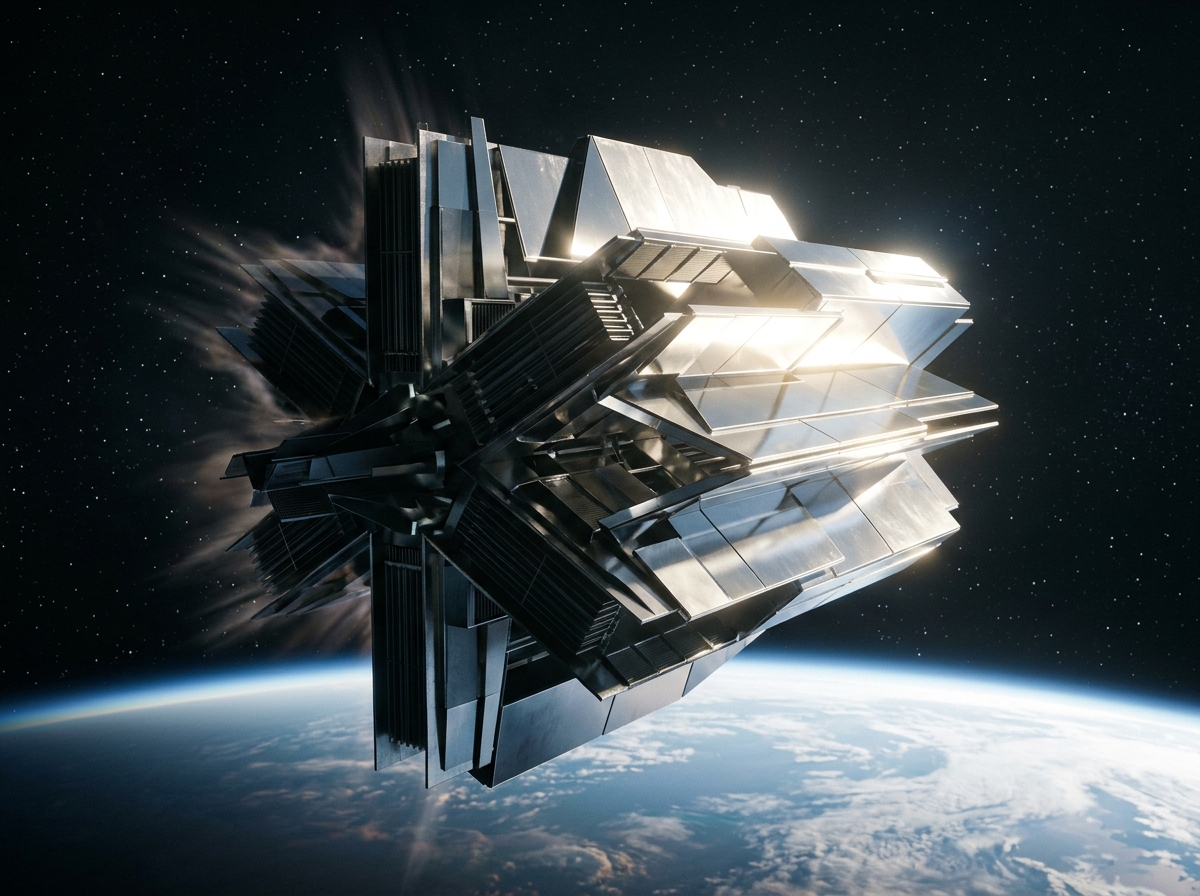
The source of the appeal is the Sun. A spacecraft in a dawn-dusk, sun-synchronous orbit can receive near-continuous sunlight. That sunlight is free, consistent, and unaffected by cloud cover or diurnal cycles. Terrestrial solar farms compete for land and transmission access, but solar panels in orbit avoid much of that. Google Research argues that this geometry allows a constellation to convert solar energy directly into computation, rather than try to beam gigawatts of electricity back to Earth. In theory, this puts the energy source next to the workload.
While sunlight in orbit carries no transmission cost, everything else has a price tag attached. Radiators, solar arrays, shielding, structures, batteries, computers, pumps, control electronics, and optical communication links all add mass. Mass must be launched, and launch pricing remains the hinge on which the entire business case swings. Analysts at the International Energy Agency estimate that global data center electricity use could double to around 945 terawatt-hours by 2030. That forecast creates urgency, but it does not change orbital physics.
Current modeling illustrates how quickly mass accumulates. A 2026 paper by Slava G. Turyshev calculates that a representative one-megawatt orbital system would require about 5,640 square meters of photovoltaic area and roughly 2,500 square meters of radiator surface before adding structural elements. These are not decorative wings. Panels operating in orbit must handle micrometeoroids, thermal cycling, and radiation exposure. They also represent most of a spacecraft's mass. IEEE Spectrum reporting indicates that space-grade solar arrays and radiators typically account for 65% to 70% of satellite mass. That fits with broader estimates placing orbital compute infrastructure at roughly $10,000 to $40,000 per kilowatt.
Launch economics complicate matters further. Reusable rockets like Falcon 9 offer pricing around $2,600 to $3,400 per kilogram. A typical high-performance compute rack plus its thermal hardware can easily exceed 3,500 kilograms. That puts launch costs in the $9 million to $12 million range per deployment. These numbers mirror independent analyses such as the cost breakdown published by Alistair Schofield, and they reflect the limits of current propulsion economics. NASA's space-based solar power studies concluded that launch costs would need to fall to about $100 to $200 per kilogram to make large-scale orbital solar power competitive with terrestrial alternatives. That gap remains significant in mid-2026.
Cooling turns out to be an even sharper constraint. Vacuum provides no mechanism for convective heat transfer. All heat must be radiated away as infrared energy. Even a 120-kilowatt AI rack would require radiator hardware whose launch cost alone could approach $6 million to $36 million. Reddit's TheyDidTheMath community has highlighted this challenge by calculating radiator mass relative to typical Falcon 9 payload performance. For a one-megawatt system, radiator design becomes one of the gating factors on both cost and scalability.
Some early efforts look for alternative architectures. A 2025 tether-based proposal from a University of Pennsylvania-led research group maps out how multi-megawatt orbital AI systems might distribute photovoltaic surfaces, radiative cooling, and integrated shielding along long structural supports. That approach reduces some packaging challenges, but introduces its own dynamic and operational issues. Could such large structures remain stable in low Earth orbit? The idea is impressive, although it also reveals how complex the design tradeoffs become when trying to export a data center into space.
Even if power and cooling problems can be solved, communications remain a bottleneck. Space-to-ground links are nowhere near the internal fabric bandwidth of terrestrial data centers. Research by Minghao Sun, Zehui Chen, Jinbo Hou, Kezhi Wang, and Xiaoli Chu points to the mismatch between AI training and inference data flows and the capacities of optical or radio downlinks. Unless workloads are designed for locality or operate on data already captured in orbit, communication can become the dominant limiter. This is one reason early concepts focus on preprocessing Earth observation data or running delay-tolerant analytics.
Maintenance and reliability raise further questions. On Earth, a technician can replace a defective GPU in minutes. In orbit, radiation and thermal cycling can degrade electronics long before their theoretical lifetime. Google's radiation testing on Trillium TPUs suggests positive early results, although scaling those findings to entire clusters is still uncertain. Any constellation of dozens or hundreds of satellites would need a strategy for servicing, replacing, or deorbiting units safely. Here and there, industry conversations point to future on-orbit servicing spacecraft, but operational reality has not caught up.
Industry observers such as the World Economic Forum, research groups at MIT, and analysts from Deloitte have all noted rising interest in space-based compute as part of broader energy planning studies. Their assessments tend to align on one point: orbital compute may not replace terrestrial data centers, but it could serve as a specialized supplementary layer for specific use cases. The idea fits naturally where the data is already in orbit, such as satellite imaging or climate monitoring. It may also support specialized AI workloads where latency is less critical.
Still, the economic shape of the problem shifts. Instead of paying for electricity and real estate, operators pay for mass. Instead of securing permits for cooling towers, they purchase radiator panels that must survive ten years of orbital cycles. Instead of hiring maintenance teams, they plan for robotic servicing or replacement launches. Some of these tradeoffs will look more favorable if launch prices fall, perhaps through future heavy reuse or fully reusable vehicles. Others may depend on advances in space-qualified photovoltaics from companies like Solestial or Rocket Lab, which continue refining high-efficiency, radiation-tolerant solar cells.
For now, orbital compute remains part aspiration and part engineering discipline. The energy constraint is real, and companies like Google, SpaceX, and xAI are betting that continued improvements in launch pricing and satellite manufacturing will eventually open new architectural options. Whether this happens by the mid-2030s or takes longer is still open. The Sun is available almost continuously in space. The rest of the equation relies on hardware, economics, and an evolving understanding of which AI workloads make sense thousands of kilometers above the ground.