 ⬇️
⬇️
Key Takeaways
- Start with the business process, risk profile, and operating model rather than selecting a broad automation label.
- Compare providers on workflow coverage, integration depth, governance, deployment effort, and long-term operating cost.
- Document platforms, RPA products, and managed service providers solve different parts of the problem and may work together.
Why business automation matters now
Payroll, accounting, document management, and IT support often rely on a surprising amount of manual coordination. An invoice arrives by email. Someone extracts the data, checks it against a purchase order, enters it into an ERP system, and sends an approval reminder. Payroll exceptions follow a similar path, except the consequences of an error can be more immediate.
The appetite for changing this model is growing. Grand View Research estimated the global intelligent process automation market at $14.55 billion in 2024, forecasting it to reach $44.74 billion by 2030, representing a 22.6% compound annual growth rate.
Automation is not a single category. Industrial automation, valued at $182.1 billion in 2023 and projected to reach $377.9 billion by 2032 in one industry report, concerns machinery and operational environments. Payroll and IT services automation concerns data, approvals, documents, systems, and accountability. The buying criteria are quite different.
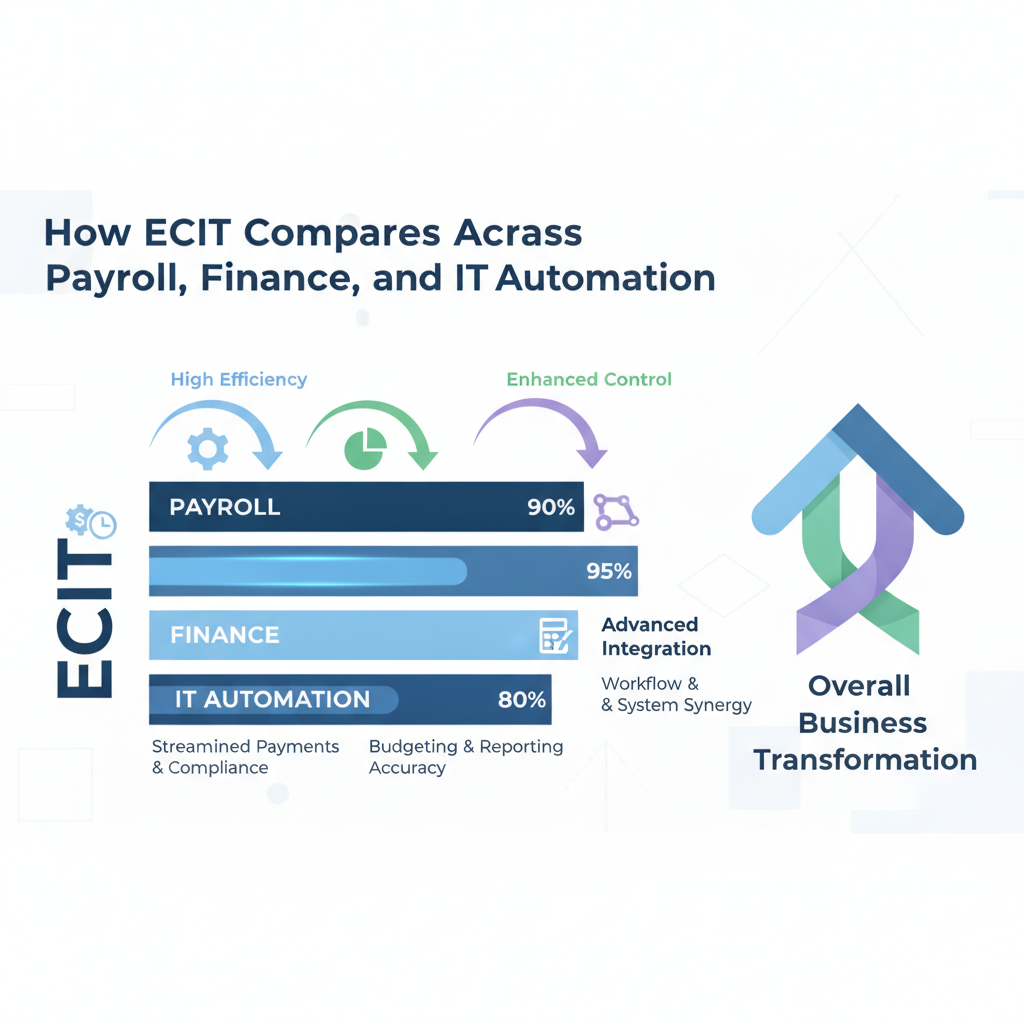
Research available through the ACM Digital Library describes ECIT as a Nordic provider that bundles accounting, finance, payroll, and IT services. That operating model matters because many organizations do not want to maintain every automated workflow internally. Some want software. Others want software plus process expertise and ongoing service delivery.
Comparing the main provider options
The following comparison is directional. Product scope changes, and buyers should validate current capabilities, contractual terms, certifications, and integrations during procurement.
| Dimension | ECIT | Laserfiche | SS&C Blue Prism | DocuWare |
|---|---|---|---|---|
| Primary orientation | Bundled accounting, payroll, IT services, and document-oriented automation | Enterprise content management and document-centered workflows | Robotic process automation and orchestration across applications | Document management and configurable digital workflows |
| Integration depth | Listed integrations include Microsoft 365, SAP Data Services, Oracle Data Cloud, Coupa, and Unit4 ERP | Evaluate connectors, APIs, and compatibility with the buyer’s content and business systems | Often considered where automation needs to operate across multiple existing applications | Evaluate ERP, finance, email, and document-capture connections |
| Automation approach | Combines service delivery with automation across back-office processes | Routes, stores, searches, and governs content within structured workflows | Uses software robots and orchestration for repetitive, rules-driven work | Captures, indexes, stores, and routes business documents |
| Governance and security | Buyers should examine service boundaries, access controls, data residency, and relevant certifications | Review records controls, permissions, retention, and audit capabilities | Review robot credentials, segregation of duties, monitoring, and change governance | Review document access, retention policies, audit trails, and hosting controls |
| Deployment model | Potentially attractive when an organization wants both operational support and technology | Suited to teams prepared to design and govern content-centric processes | Usually requires process discovery, automation development, testing, and maintenance | Often considered for departmental or enterprise document modernization |
| Commercial evaluation | Compare software, implementation, transition, and managed-service costs | Confirm licensing, storage, implementation, and support terms | Confirm licensing structure, infrastructure, development, and operating costs | Confirm licensing, storage, workflow configuration, and support costs |
Independent review marketplaces such as G2 place these offerings within overlapping OCR, enterprise content management, and RPA conversations. That does not make them interchangeable. It highlights why a shortlist based only on the word "automation" can become muddled.
Key evaluation criteria
Begin with process scope. Is the immediate target payroll administration, invoice handling, employee records, IT ticket routing, or an end-to-end process spanning several departments? A platform optimized for document capture may handle contracts and invoices well but require other components for application-level automation.
Integration depth comes next. A connector logo is not enough. Buyers should determine whether an integration supports bidirectional updates, error handling, identity controls, version changes, and monitoring. What happens when the ERP rejects a transaction or an employee record contains incomplete data?
Governance deserves equal attention. ISO/IEC 27001 offers a useful reference for information security controls, while ITIL 4 helps IT teams structure service requests, incidents, changes, and approvals. Buyers should also examine role-based access, audit logs, credential management, retention, data residency, and human approval points.
Then consider maintainability. A clever workflow that depends on fragile screen interactions can become expensive when an application interface changes. API-based integration tends to be more resilient, although RPA remains useful for older systems that expose few modern integration options.
Match the approach to the buyer scenario
Consider a mid-market CFO consolidating payroll and accounting after several acquisitions. The first evaluation priority is likely process consistency: common approval rules, reliable master data, regional controls, and clear ownership of exceptions. That team may remove pure RPA products from the initial shortlist if it also needs outsourced operational support. Success means fewer disconnected handoffs and better visibility into unresolved items, not simply a larger robot count.
Now take an IT service manager preparing to automate onboarding and access requests across Microsoft 365, ERP applications, and a service desk. This buyer should examine orchestration, identity controls, rollback procedures, and alignment with ITIL 4. A document repository alone may not cover the requirement. The shortlist should favor providers that can show how failures are surfaced, assigned, and resolved.
Different problem. Different answer.
Questions to ask vendors
Ask providers to demonstrate one of your own workflows rather than a polished generic scenario. Useful questions include:
- Which steps use APIs, document capture, rules, RPA, or human review?
- How are exceptions logged, routed, escalated, and reported?
- Who updates an automation when an underlying application changes?
- Which security controls and certifications apply to each deployment option?
- Can process data be exported in a usable format?
- How are implementation, licensing, support, storage, and change requests priced?
- What responsibilities remain with the customer after launch?
Also request references from organizations with comparable process complexity and regulatory exposure. Industry similarity can be more informative than company size alone.
Making the decision
A practical scorecard should weight business outcomes, operational risk, integration resilience, governance, and total cost. Feature counts can help, but they rarely settle the decision.
Run a controlled pilot using a process with meaningful volume and manageable consequences. Track exception rates, manual touches, processing visibility, user adoption, and support effort. If the pilot only works when the implementation team watches every transaction, the operating model is not ready.
The strongest shortlist will usually reflect the real requirement: managed payroll and finance operations, content-centered workflow, application-level RPA, or a combination. Define that boundary first. The vendor comparison becomes much clearer afterward.