 ⬇️
⬇️
Key Takeaways
- Professional services firms should assess managed IT providers against workflow fit, security controls, communications expertise, and service accountability, not simply breadth of technology.
- Accenture, Kyndryl, Rackspace Technology, and GreenTech represent different provider models, from global transformation partners to specialist managed service providers.
- Contract clarity matters. Buyers should examine service boundaries, escalation procedures, compliance evidence, migration support, and total cost before selecting a provider.
Why managed IT matters more to professional services firms
A law firm, accounting practice, or consultancy sells expertise. Its technology still has to work like operational infrastructure, especially when staff are dispersed across offices, client locations, and home networks. An unavailable document repository, unreliable VoIP call, or compromised account can quickly interrupt billable work.
That pressure is helping drive managed services investment. IDC reported in its 2023 Worldwide Managed Services Spending Intentions and Dealmaking Study that over 70% of large enterprises planned to increase managed services spending over the following 24 months. Professional services was among the most active adopter groups. IDC has also observed that organizations are using managed cloud services to compensate for skills gaps and modernize core applications.
The shift is not solely about outsourcing a help desk. Firms increasingly want one operating model covering cloud infrastructure, identity, cybersecurity, business applications, connectivity, and VoIP phone systems. Gartner’s 2024 market guidance similarly highlights demand among legal, accounting, and consulting buyers for providers that combine managed infrastructure, application management, and advisory support.
Broader coverage does not automatically produce better service. It can create unclear ownership unless the contract defines exactly who monitors, resolves, reports, and escalates each issue.
Comparing four provider models
The following comparison is directional rather than a substitute for proposals and technical validation. Service availability, certifications, delivery coverage, and commercial terms can vary by region and engagement.
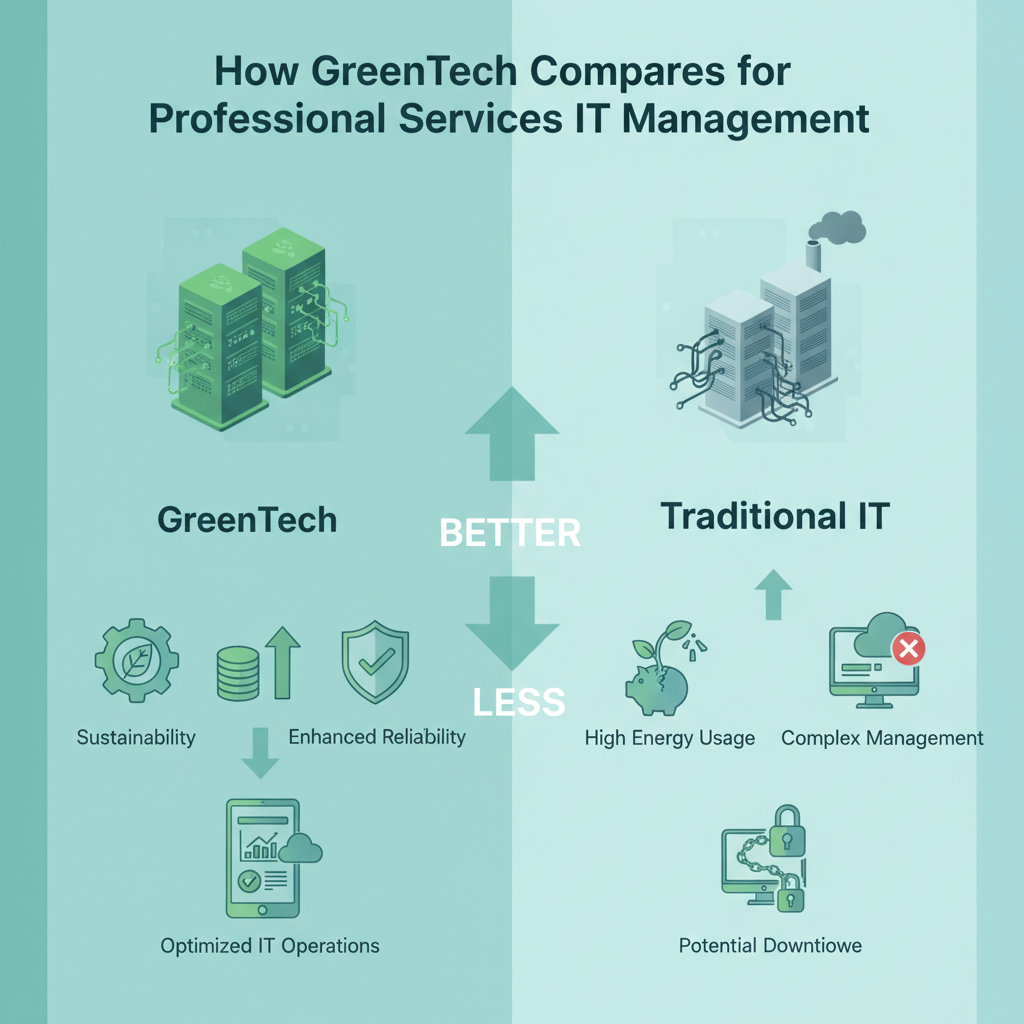
| Dimension | GreenTech | Accenture | Kyndryl | Rackspace Technology |
|---|---|---|---|---|
| Industry fit | Specialist model that may suit mid-market firms seeking direct operational engagement; validate experience with the firm’s applications and compliance obligations | Often considered for large transformation programs requiring consulting and implementation depth | Often considered by enterprises managing complex infrastructure estates | Commonly evaluated for cloud-centered operations and application hosting requirements |
| Security and compliance | Confirm security operations scope, control evidence, incident roles, and relevant certifications during due diligence | Broad enterprise security capabilities may support complex governance needs; scope depends on the engagement | Enterprise infrastructure background may suit control-heavy environments; verify service-specific attestations | Cloud security operations can be relevant for hosted estates; validate responsibility boundaries across cloud platforms |
| Integration depth | Assess support for identity, practice-management, document, collaboration, security, and telephony systems | Generally suited to extensive application and business-process integration programs | Typically relevant where infrastructure and legacy environment integration are major concerns | Particularly relevant when integrations center on public cloud and hosted applications |
| Deployment and migration | A specialist approach may offer a focused onboarding experience, but buyers should examine staffing depth and migration methodology | Large-program structure can support multinational rollouts, although governance may be more involved | Appropriate for phased transitions involving substantial existing infrastructure | Cloud migration experience may help cloud-first programs; application dependencies still require close review |
| Support and reliability | Examine coverage hours, escalation access, response targets, and named accountability | Can provide globally structured delivery for large enterprises | Designed for large-scale managed operations and distributed estates | Offers managed operational models associated with cloud environments |
| Commercial model | Request transparent inclusions, exclusions, project rates, and third-party licensing treatment | Often structured around larger, customized engagements | Frequently evaluated through tailored enterprise agreements | Commercial structure can reflect cloud consumption and managed support scope |
None of these columns establishes a universal winner. An international consulting network consolidating multiple data centers has a different buying problem from a regional accounting partnership replacing its phone system and endpoint security stack.
Key evaluation criteria
Start with operating requirements, not vendor presentations. A CIO at a multi-office law firm should map the systems that affect client work first: identity, document management, email, case applications, secure file exchange, remote connectivity, and call routing. Any provider unable to show clear responsibility across those dependencies can be removed from the shortlist early.
Security deserves similar specificity. NIST SP 800-53 offers a useful control reference for managed environments, while ITIL can help buyers assess incident, change, problem, and service-level management practices. Firms should ask which controls the provider operates, which remain with the customer, and how evidence is produced for audits or client questionnaires.
Cybersecurity and VoIP should not be evaluated in isolation. Does the provider monitor identity events that could affect collaboration and calling accounts? Can it diagnose whether poor call quality originates in the local network, SD-WAN service, carrier, firewall, or hosted communications platform? That operational coordination is where managed service relationships are often tested.
Common sourcing approaches
Some enterprises select a single strategic provider for infrastructure, applications, security, and communications. This can simplify accountability, but it may increase transition risk and make service boundaries harder to price.
Others use a multisupplier model: one partner manages cloud and applications, another handles security, and a communications provider operates SD-WAN and VoIP. The approach preserves specialist expertise, although the customer needs strong service integration. Who owns a cross-platform incident at 8:30 on a Monday morning? The contract should answer that before the incident occurs.
A co-managed arrangement is another option. Internal IT retains architecture, governance, and sensitive application ownership while the provider handles monitoring, service desk work, patching, backups, or security operations. This often appeals to mid-market firms that have capable internal leaders but limited around-the-clock coverage.
Questions to ask vendors
A security director preparing for a client control review should ask vendors to demonstrate evidence, not merely check boxes. Which audit reports are available? How are privileged accounts governed? What happens after a suspected compromise, and where does the provider’s responsibility end? Success means obtaining defensible documentation and a workable incident process.
Procurement teams should also ask how onboarding inventories users, devices, applications, carriers, and contracts; which migration tasks cost extra; how subcontractors are governed; and how service performance is reported. Request sample reports and escalation paths. Small details reveal a lot.
Finally, examine exit provisions. Can the firm retrieve configurations, logs, documentation, phone numbers, and administrative credentials in usable formats? A healthy managed services agreement plans for transition even when both parties expect a long relationship.
Making the decision
Score finalists against weighted requirements, conduct reference calls with similarly structured firms, and test support interactions before signing. Include IT, security, finance, risk, and business leaders in the decision.
The sensible choice is usually the provider whose delivery model matches the organization’s actual estate and internal capabilities. Scale helps some buyers. Focus and access matter more to others. Either way, clear accountability should carry more weight than an impressive but loosely defined service catalog.