 ⬇️
⬇️
Key Takeaways
- Inventory every analog endpoint, PRI circuit, Centrex line, and emergency-service location before comparing SIP trunking or UCaaS proposals.
- Test SIP signaling, session border controllers, E911 routing, fax, alarms, and contact-center call flows during a controlled pilot.
- Track rejected calls, mean opinion score, carrier charges, and same-day incident resolution after migration rather than relying on vague cloud transformation metrics.
Define the Communications Problem Before Selecting a Platform
A copper retirement notice arrives with a 90-day response window. The telecommunications team knows which offices still have PRI circuits, but nobody can immediately confirm how many elevator phones, fire panels, fax machines, gate intercoms, and security alarms depend on analog lines.
That scenario increasingly shapes enterprise voice planning. An Industrial Networking Solutions summary of FCC copper-retirement orders notes that the customer-notification period has been reduced from 180 days to 90 days. Buyers may therefore have only three months to identify affected services and establish a migration path.
The first task is discovery, not procurement. A useful inventory records the circuit ID, carrier, billing account, physical demarcation, telephone number, endpoint type, traffic volume, E911 address, contract expiration, and business owner for each service. Teams can reconcile carrier invoices against PBX configuration exports, call-detail records, wiring diagrams, and on-site inspections.
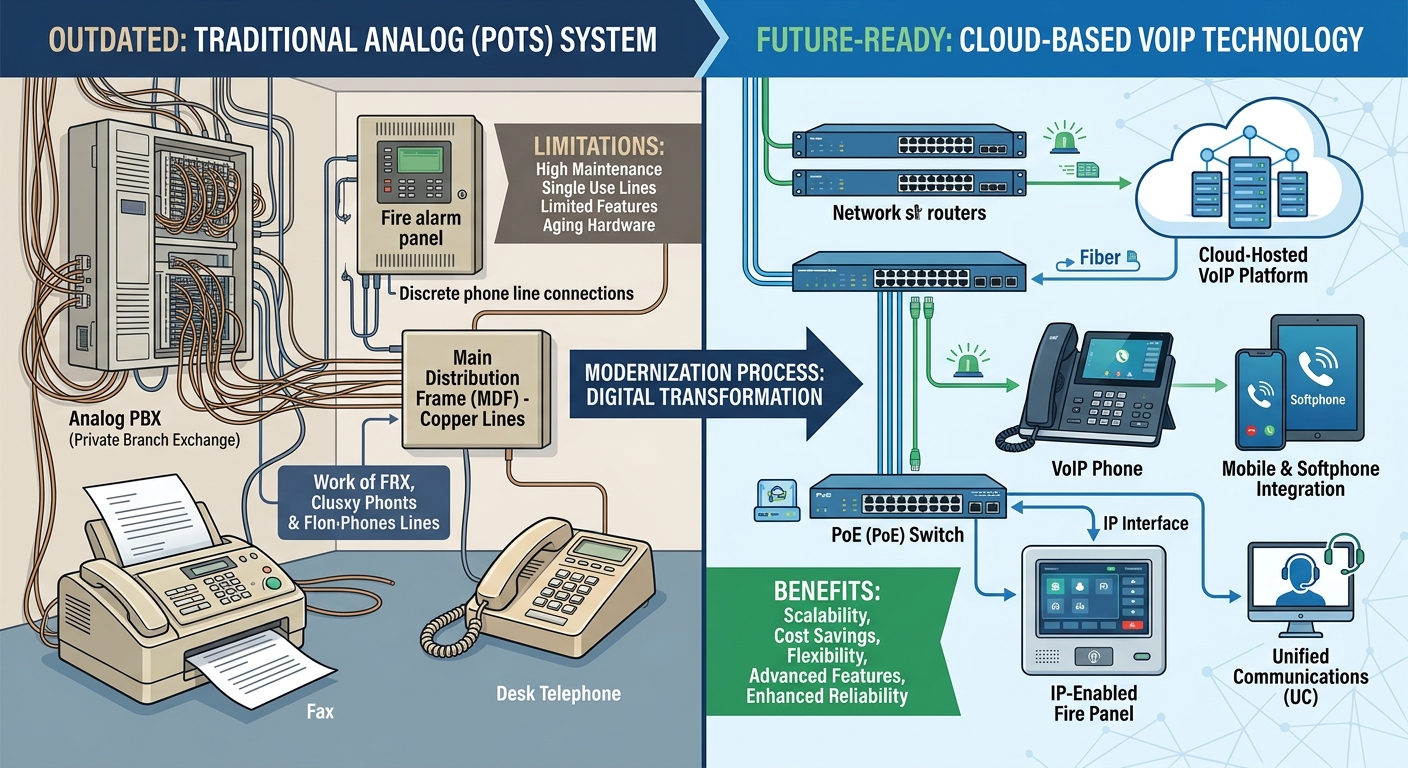
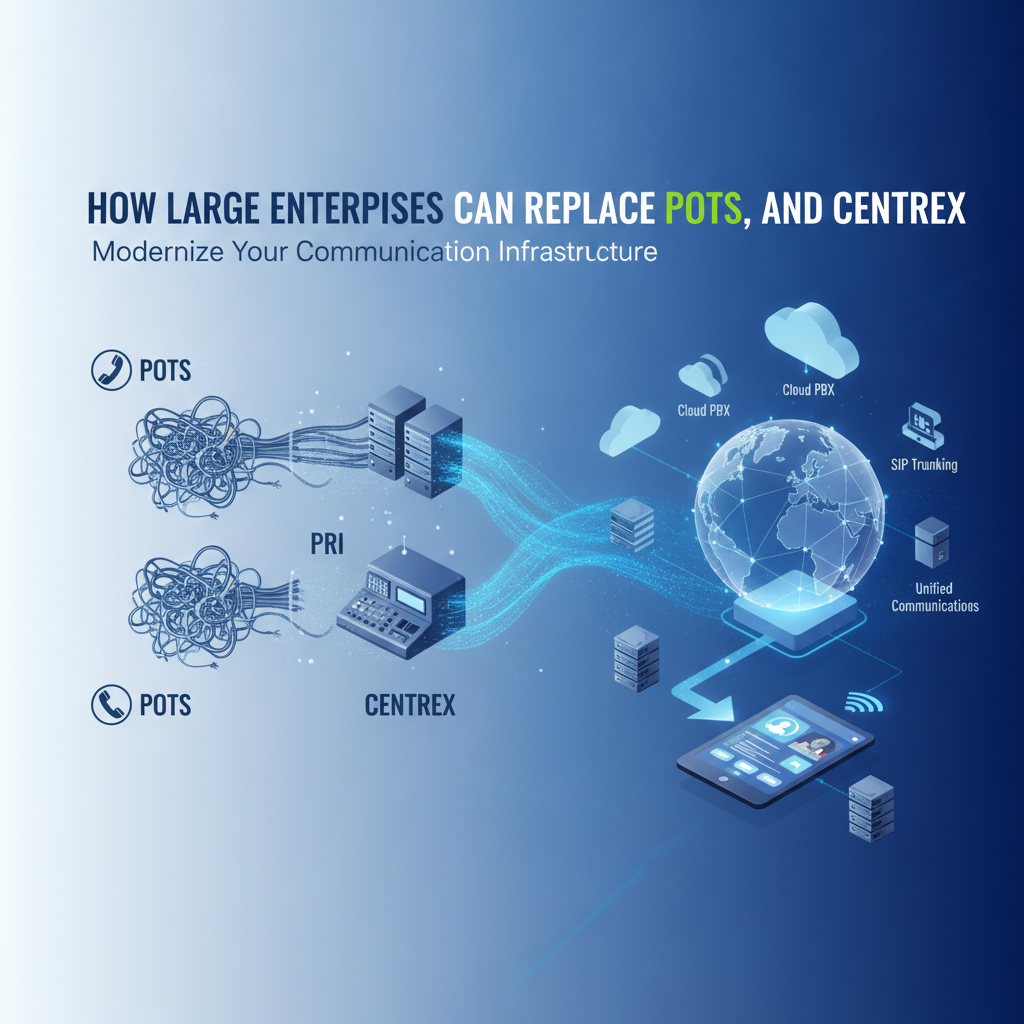
PRI and Centrex services require separate analysis. PRI replacement commonly points toward SIP trunks connected to an existing Avaya, Cisco, Mitel, or other IP-capable PBX. Centrex replacement may favor UCaaS because call control already resides with the carrier. Analog endpoints might require an analog telephone adapter, an LTE-based POTS replacement appliance, or retention until a fire-code or elevator-system upgrade is completed.
Build an Evaluation Model Around Workloads
SIP trunking has become a mainstream enterprise choice rather than a niche carrier service. Omdia reported that large enterprises accounted for roughly three-quarters of global SIP trunking service revenue in 2023. Market Growth Reports also found that more than 15,000 US enterprises with over 500 employees adopted SIP trunking during 2023, while over 64% of large global enterprises had integrated it for centralized communications.
Those figures do not make every workload suitable for the same architecture. Buyers should classify services by function:
- Enterprise calling through SIP trunks and an existing PBX
- User calling and conferencing through UCaaS
- Contact-center traffic requiring IVR, recording, workforce management, and CRM integration
- Analog life-safety or telemetry devices that cannot move directly to native SIP
- Fax traffic requiring T.38 support or a secure cloud-fax alternative
Vendor evaluation should cover SIP interoperability, number portability, geographic coverage, E911 support, encryption, fraud controls, and service-level commitments. Buyers comparing Clearspan with carrier SIP services or UCaaS alternatives should also examine how each option handles hybrid estates where some locations retain PBXs while others move users to hosted call control.
A lab test should inspect SIP INVITE, 180 Ringing, 200 OK, ACK, and BYE messages, along with codec negotiation for G.711 and G.729. It should also verify whether the session border controller rewrites headers correctly when traffic crosses carrier, MPLS, SD-WAN, or internet boundaries.
Plan the Rollout in Operational Phases
During discovery, telecommunications staff, network engineers, security personnel, facilities teams, contact-center administrators, and procurement should validate the inventory together. Facilities involvement matters because an elevator phone may appear on a carrier invoice under an old building name, while its physical location is known only to property operations.
The design phase establishes call routing, dial plans, codec policy, bandwidth reservations, survivability, and failover. Voice VLANs can use IEEE 802.1Q tagging, while switches apply 802.1p priority and routers enforce DSCP EF treatment for RTP packets. A session border controller can terminate carrier SIP sessions, apply topology hiding, normalize headers, and restrict signaling to approved IP addresses.
A controlled pilot should include ordinary desk phones, Microsoft Teams or another collaboration client where applicable, contact-center queues, voicemail, fax, and an emergency-call test coordinated through the appropriate public-safety process. Clearspan can be assessed during this phase for hosted calling, collaboration, contact-center integration, administrative controls, and coexistence with remaining enterprise telephony systems.
Migration then proceeds by site, user group, or number range. Number-port orders require particular care: buyers should confirm the firm order commitment date, temporary routing arrangements, directory listings, caller ID presentation, and rollback procedure. Implementation timelines vary significantly based on legacy debt, so enterprises should derive a month-based schedule from circuit count, porting dependencies, facility access, and testing scope.
One practical tangent deserves attention: telephone closets are often poorly documented. A tone generator, labeled patch panels, and current floor plans can reveal more than a billing spreadsheet when an analog pair disappears into a building riser.
Measure Outcomes That Operations Can Observe
Buyers should define acceptance criteria before disconnecting legacy circuits. Technical measures can include call-setup success rate, post-dial delay, packet loss, jitter, latency, mean opinion score, failed fax sessions, abandoned contact-center calls, and E911 location accuracy.
Financial tracking should compare recurring PRI, Centrex, and POTS charges with SIP channel, UCaaS seat, SBC, internet-access, analog-adapter, and managed-service costs. Overall cost optimization depends heavily on the organization's existing contracts and baseline traffic patterns.
Operationally, teams should look for fewer carrier tickets, centralized number administration, same-day routing changes, and reduced dependence on technicians for PBX programming. For contact centers, observable improvements often include consistent queue routing across locations and consolidated call recordings.
Buyer Takeaways From the Migration Pattern
The inventory determines the architecture. If discovery exposes a large population of alarms and elevator phones, treating the project solely as a UCaaS deployment leaves critical endpoints unresolved.
The pilot should also reproduce failure, not just normal calling. Disconnecting the primary WAN path can show whether branch phones re-register, whether the SBC redirects traffic, and whether emergency calls retain the correct location information.
Finally, disconnect orders need the same governance as activation. Keeping an unused PRI active just in case can preserve duplicate carrier charges for months. Buyers should require written acceptance from the service owner before authorizing a carrier disconnection.
Where This Approach Applies
Multi-site manufacturers, healthcare networks, retailers, financial institutions, universities, and public agencies can adapt this model by changing the endpoint inventory and compliance tests. Organizations with fewer sites may use the same SIP, E911, and number-porting checklist with a smaller pilot group.
How long does a POTS and PRI replacement take?
There is no universal timeline for enterprise-wide migrations. A buyer should plan in months and base the schedule on circuit discovery, contract terms, number-port intervals, analog-device testing, and the number of sites requiring physical access.
What is the difference between SIP trunking and UCaaS?
SIP trunking supplies IP-based carrier connectivity to an enterprise PBX, while UCaaS moves call control and user features into a hosted platform. A hybrid design can retain SIP-connected PBXs at complex sites while assigning cloud calling and conferencing to other users.
Can elevators, alarms, and fax machines use SIP?
Some can, but compatibility depends on the endpoint and transport path. Buyers should test T.38 for fax, confirm battery backup for analog adapters, and obtain approval from the alarm, elevator, or fire-system provider before retiring the original copper line.