 ⬇️
⬇️
Key Takeaways
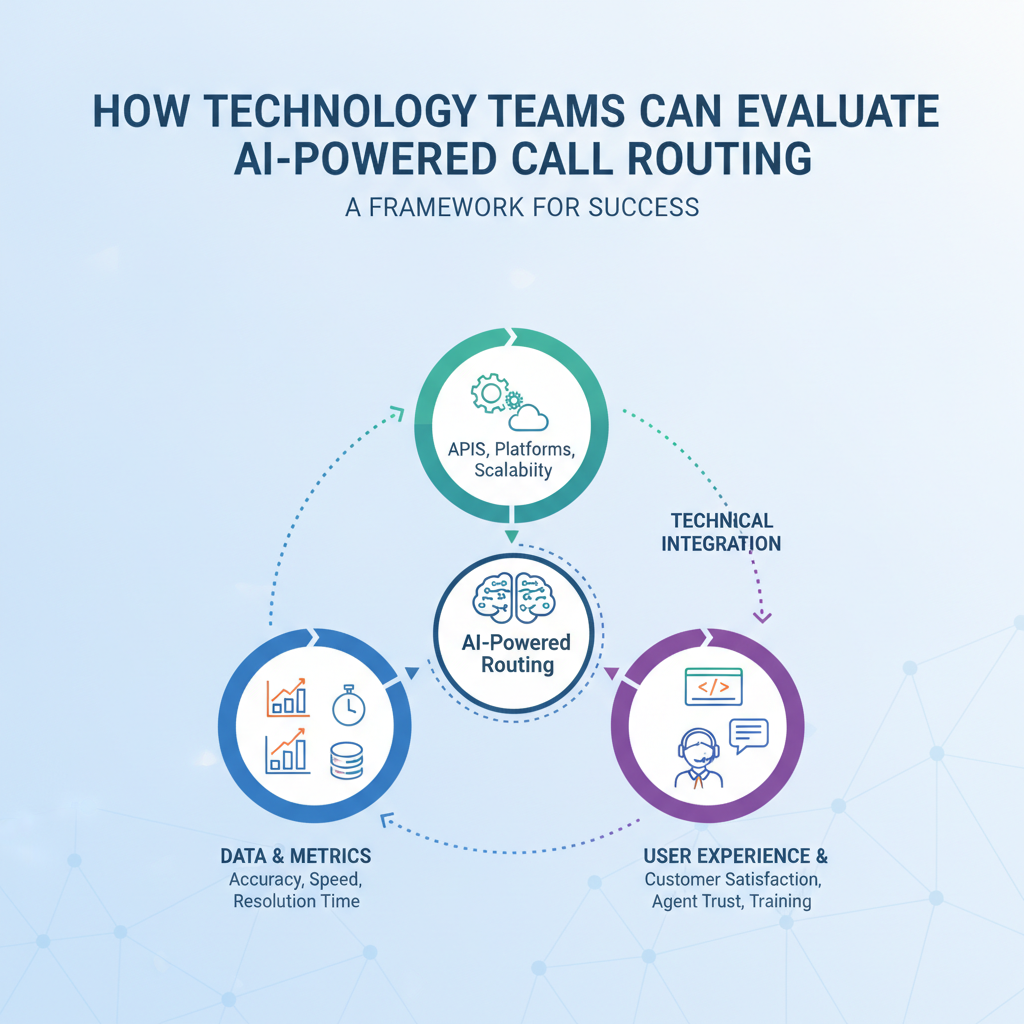
- Route calls using CRM history, detected intent, sentiment, language, and agent skills rather than relying solely on static IVR menus.
- Test SIP compatibility, REST API behavior, calendar synchronization, and routing latency with real call patterns before committing to a platform.
- Track first-call resolution, transfer rate, queue abandonment, and appointment completion instead of treating call volume as the primary success metric.
Define the Routing Problem Before Comparing Vendors
A software customer calls about a failed API request, selects “technical support,” and waits behind callers asking about passwords and invoices. When an agent answers, the customer repeats an account number, product tier, and error description already stored in the CRM. A transfer follows.
AI-powered routing is intended to remove those avoidable steps. Instead of using only keypad input, the routing engine can combine the caller’s phone number, CRM record, previous cases, spoken intent, detected language, sentiment, and available agent skills. A SIP-based VoIP system then sends the call to an agent, specialist queue, virtual agent, or appointment workflow.
The business problem should be stated precisely. Buyers might prioritize reducing transfers between billing and technical support, routing premium accounts to appropriately trained agents, or scheduling consultations outside staffed hours. Each objective requires different data. Account-based prioritization depends on a CRM lookup, while appointment scheduling also requires access to calendars, time zones, service duration, and cancellation rules.
Static IVR can remain useful. A short menu is predictable and easy to audit. AI becomes more relevant when call intent does not map cleanly to menu options or when a technology company supports several products, subscription tiers, and specialist teams.
Build an Evaluation Around Real Call Patterns
A meaningful evaluation uses representative transcripts and routing conditions, not polished vendor demonstrations. Buyers can remove personally identifiable information from historical transcripts, label each interaction by intent, and test whether candidate systems distinguish phrases such as “reset my password,” “my SSO integration is failing,” and “I need to add user licenses.”
Platforms should also be evaluated as comprehensive communications systems. When assessing cloud-based voice, video, SMS, MMS, call routing, and scheduling requirements, buyers can evaluate providers like Phone.com to determine whether these channels share contact context or operate as isolated systems.
A practical checklist includes:
- SIP trunking and number-porting support
- REST APIs and outbound webhooks for CRM updates
- Salesforce, HubSpot, or Microsoft Dynamics integration behavior
- Calendar synchronization through Microsoft Graph, Google Calendar APIs, or CalDAV
- SMS and MMS confirmation workflows
- Role-based access control and call-recording retention
- Routing decisions when the CRM or AI service is unavailable
- Support for consent announcements and regional recording rules
Buyers should ask vendors to demonstrate fallback behavior. If intent classification confidence falls below an agreed threshold, the call might enter a conventional IVR or general queue. If the CRM API times out, routing should continue without exposing an internal error message to the caller.
Design the Technical Path From Call to Agent
The routing path commonly begins when a Session Initiation Protocol request establishes the call. The platform can use automatic number identification to query a CRM, while speech recognition processes the opening statement. A decision service then scores possible destinations based on intent, account attributes, queue depth, agent presence, and configured business rules.
Latency matters. A highly accurate model that introduces a long pause creates a poor experience before routing even occurs. During testing, teams should record median and 95th-percentile time from the end of the caller’s statement to the routing decision.
Appointment scheduling adds another transaction path. The system needs to read available time slots, apply service-specific duration and buffer rules, write the appointment, and issue confirmation through SMS or email. Idempotency keys can prevent duplicate bookings if a caller repeats a request or a webhook is retried.
The ITU-T E.800 series provides a useful service-quality foundation for examining call completion, delay, and availability. Gartner reported in 2023 that contact centers using AI-based interaction routing and analytics achieved improvements of up to 25% in customer satisfaction and 30% in agent productivity. Those figures are industry findings, not forecasts for an individual deployment.
Plan the Rollout in Controlled Phases
Initial rollout usually starts with call discovery and data preparation. Contact-center operations, telephony engineering, security, CRM administration, and support leadership should review call reasons, transfer paths, recording policies, and agent skill definitions. The duration depends on integration depth and data quality; the available research does not establish a universal implementation timeline.
A limited deployment can then cover one number, language, product line, or after-hours queue. Teams should run AI routing alongside existing rules and compare the recommended destination with the actual destination. This “shadow” mode exposes classification errors without changing live call handling.
Production expansion follows only after fallback rules, monitoring, and escalation paths have been exercised. Obstacles often include inconsistent CRM fields, duplicate contacts, stale agent-skill profiles, and calendar permissions that allow reading availability but not creating an event. These are integration issues, not model issues, and they require different owners.
Measure Outcomes That Reflect the Caller’s Experience
Average speed to answer is useful, but it does not show whether a caller reached the right resource. Buyers should also measure transfer rate, first-call resolution, queue abandonment, repeat contact within a defined period, appointment completion, and the percentage of calls sent to fallback routing.
Phone.com and other providers under consideration should be asked how their dashboards export these measures, whether records are available through an API, and how routing decisions can be traced during a dispute. A useful audit record includes the detected intent, confidence score, rules applied, selected queue, fallback action, and timestamp.
Nvidia’s 2024 telecom research found that 90% of telecom providers used AI for customer-service optimization, including routing. Aircall separately cited software and SaaS deployments with a 35% reduction in call connection time and a 40% increase in first-call resolution. These vendor-reported figures can inform evaluation targets, but buyers should establish baselines from their own SIP logs, automatic call distributor records, and CRM cases.
Buyer Takeaways From the Rollout Model
Shadow routing can reveal whether the intent taxonomy is too broad before callers are affected. If “technical issue” captures authentication, integration, outage, and configuration questions, the model may classify accurately while still sending calls to an overloaded general queue.
CRM hygiene also influences routing quality. A missing subscription tier or outdated product entitlement can override an otherwise correct intent prediction. Buyers should therefore assign ownership for account fields, agent skills, and routing policies rather than treating configuration as a one-time telephony task.
Granted, not every call needs AI. Keeping deterministic rules for emergency escalation, legal inquiries, and service-status incidents can make behavior easier to test and explain.
Broader Applicability
The same design can support managed service providers, healthcare technology vendors, and business software companies. Each organization can adapt the intent model, SIP routing rules, calendar permissions, and retention controls to its own service structure.
How long does an AI call-routing implementation take?
There is no universal benchmark in the supplied research. Timing depends on the number of SIP trunks, CRM objects, queues, languages, and calendar systems involved, so buyers should request a phase-based plan covering discovery, shadow testing, limited production, and expansion.
What is the difference between AI routing and a standard IVR?
A standard IVR routes according to keypad or spoken menu selections. AI routing can evaluate free-form intent, caller history, sentiment, account status, and agent skills, then fall back to the IVR when classification confidence is low.
Is AI-powered call routing suitable for a small support team?
It can be, particularly when a small team handles several products or combines sales, support, and appointment booking. The business case should compare transfer volume and missed appointments against integration effort, API costs, call-recording requirements, and the staff time needed to maintain routing rules.