 ⬇️
⬇️
Key Takeaways
- Panthalassa is reportedly raising about $225 million at a valuation approaching $2 billion.
- Its floating nodes combine wave-energy generation, sealed AI servers, and seawater cooling.
- Ocean-based computing could ease grid constraints, but reliability, maintenance, security, and economics remain unproven at commercial scale.
The Information reports that Panthalassa is raising about $225 million at a valuation near $2 billion, only months after securing $140 million at a valuation of roughly $1 billion. InforCapital also reported the latest fundraising target and valuation. The rapid step-up reflects investor interest in one of AI infrastructure’s more unconventional propositions: putting compute capacity offshore and using ocean waves to power it.
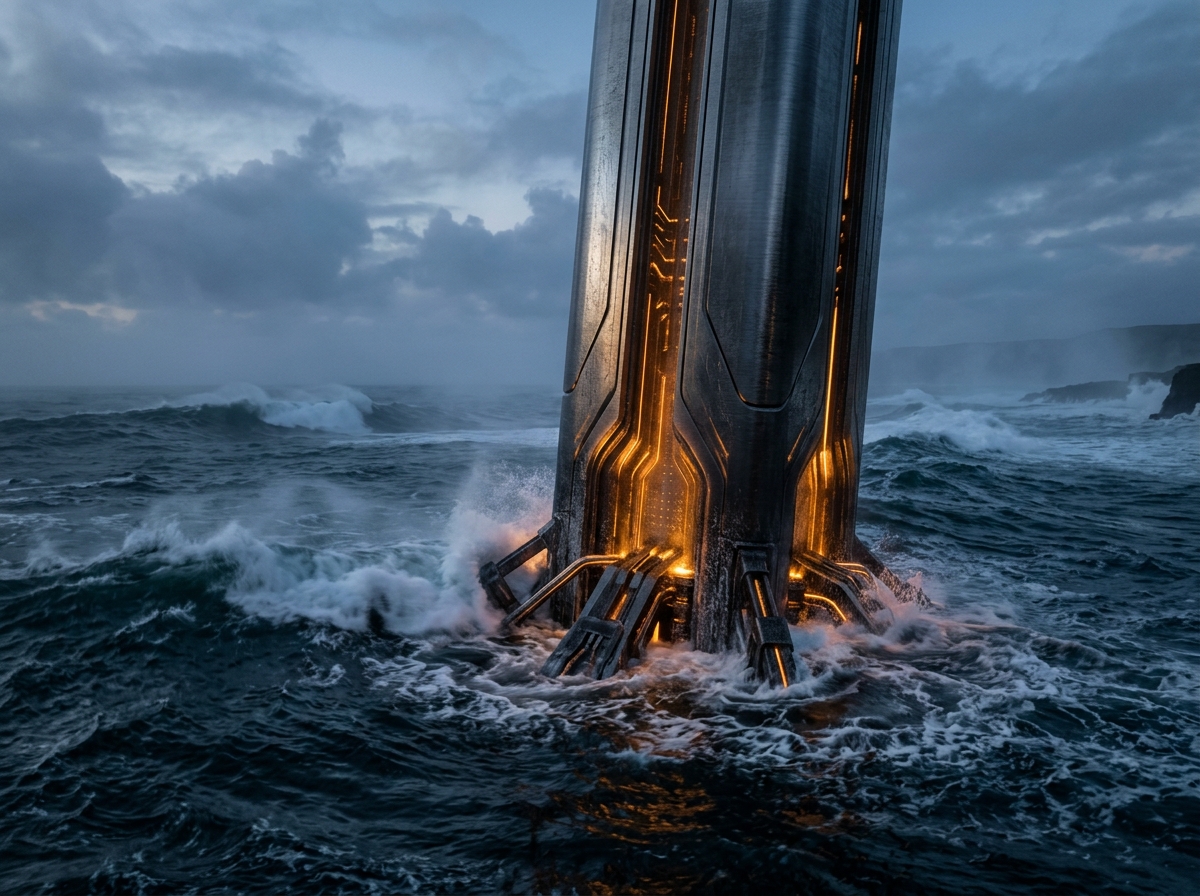
Panthalassa’s concept combines power generation and computing in a single floating node. A sphere sits at the surface while a steel structure extending below it moves with the waves. That motion causes water inside the tube to oscillate, driving turbines that generate electricity. A hermetically sealed AI server is housed within the structure and cooled by surrounding seawater.
The attraction is easy to understand. U.S. data centers consumed 176 terawatt-hours of electricity in 2023, according to Department of Energy figures. Consumption could reach between 325 and 580 TWh by 2028. Their share of national electricity use could consequently climb from 4.4% in 2023 to between 6.7% and 12% by 2028, depending on AI demand and efficiency improvements (source).
That is a big range, but every scenario points toward more pressure on generation, transmission, and local interconnection capacity. Wood Mackenzie has noted that insufficient electricity capacity is slowing some data-center development. For operators, waiting years for grid upgrades can be nearly as consequential as the cost of power itself.
Panthalassa is not simply proposing to move an ordinary facility onto a barge. It is attempting to package generation, cooling, and compute into a modular offshore system. The company aims to deploy operational floating prototypes to validate the system before targeting broader commercial deployment.
These deployments face substantial engineering hurdles. Operators must produce dependable power while protecting high-value computing hardware from saltwater, storms, corrosion, and persistent mechanical stress. The International Energy Agency notes that while wave energy remains technically promising, commercial deployment is still limited. Panthalassa will need to demonstrate not just energy capture, but also workload availability, remote management, connectivity, repair procedures, and predictable operating costs.
There is some useful precedent. Microsoft submerged a data center node in the Scottish Sea and recorded fewer hardware failures underwater than in its land-based control group before the project ended in 2024. The experiment suggested that sealed, controlled environments and seawater cooling could improve hardware reliability. Nautilus Data Technologies has explored a different approach through water-cooled data-center siting, showing that alternative cooling designs do not necessarily require fully submerged infrastructure.
The risk profile changes offshore, however. Researchers have warned that underwater isolation can make equipment harder to monitor and secure. Panthalassa told Fortune that such liabilities are mitigated in its design, citing solid-state components, pressure-vessel isolation, mechanical resilience, and environmental testing.
Enterprise buyers will still want comparable operating metrics. ISO 30134 measures such as power usage effectiveness could help evaluate the nodes against conventional facilities, although offshore power generation complicates direct comparisons. ASHRAE thermal guidance also offers a familiar reference point for server operating conditions. Beyond those benchmarks, buyers may ask about latency, data residency, physical access, spare capacity, environmental permitting, and recovery after a node failure.
Peter Thiel’s backing gives Panthalassa capital and visibility, but funding alone does not settle the engineering questions. If the floating nodes perform as intended during early deployments, Panthalassa could introduce a new infrastructure category. If maintenance or power variability overwhelms the cooling and siting advantages, the ocean frontier may remain an intriguing experiment rather than a practical extension of cloud and AI capacity.