⬇️
Key Takeaways
- Laser-trapped atoms offer a viable alternative to supercooled chips for managing quantum qubit errors.
- Optical systems, such as those tested at Harvard University, demonstrate pathways to more resilient quantum hardware.
- Major technology firms, including a Google lab in Santa Barbara, continue investing heavily to overcome quantum computing bottlenecks.
The development of practical quantum computers faces a critical hardware challenge regarding qubit stability. For years, the industry standard has relied on supercooled chips, which utilize superconducting circuits kept at temperatures near absolute zero. While this approach has driven early milestones, managing the high error rates of these fragile qubits requires extensive infrastructure and complex workarounds.
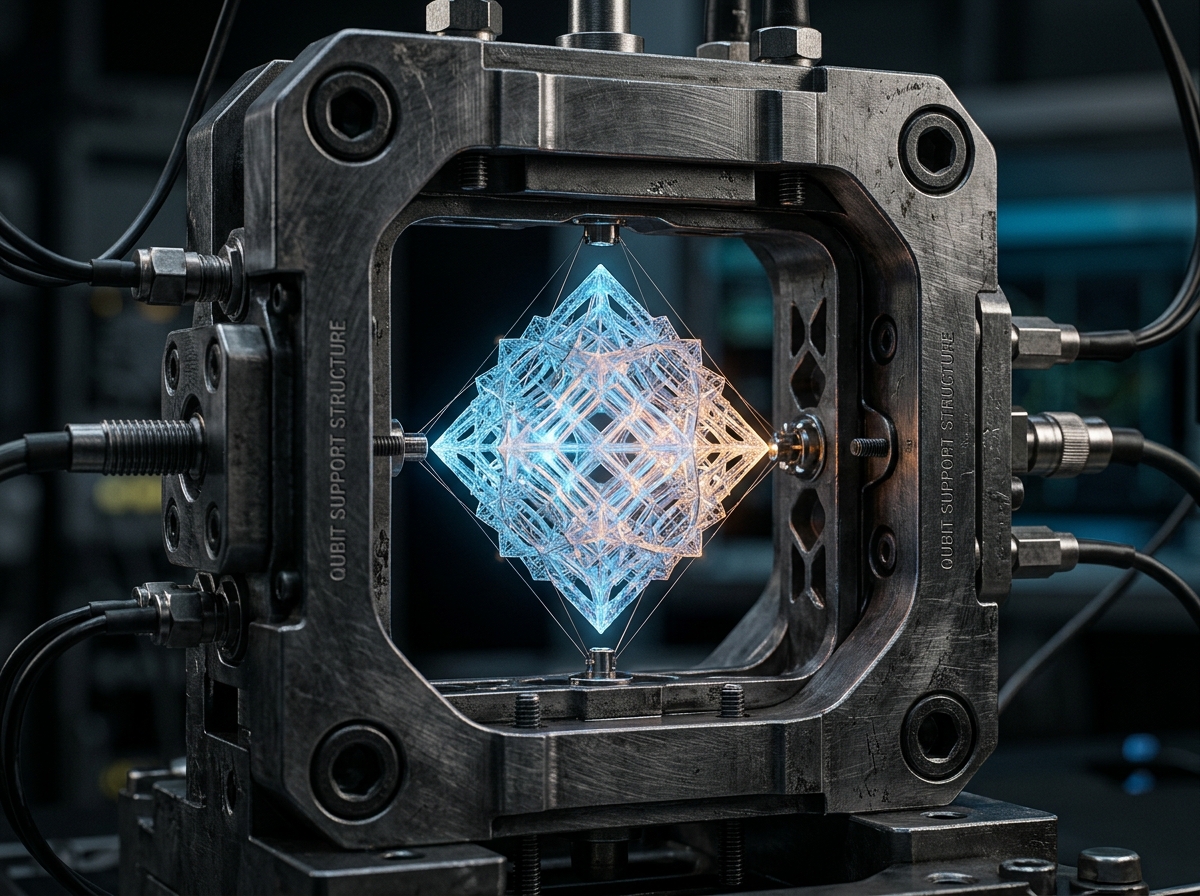
Recent hardware advancements suggest that quantum computers built from laser-trapped atoms may correct qubit errors more easily than their supercooled counterparts. This approach, often referred to as neutral atom quantum computing, uses tightly focused laser beams acting as optical tweezers to hold and manipulate individual atoms in a vacuum. Because these atoms do not inherently interact with their environment as strongly as superconducting circuits, they maintain their quantum states longer, providing a wider window for computational operations and error correction protocols.
The physical requirements of laser-trapped systems differ starkly from cryogenic chip designs. Instead of dilution refrigerators, these systems rely on precision optical tools. Research involving optical tools in a quantum computer at Harvard University illustrates the viability of this method. By dynamically moving atoms around during a computation, laser-trapped systems allow qubits to interact with multiple partners across an array. This high connectivity is an advantage for executing advanced quantum error correction codes, which demand complex entanglement between distant qubits.
The push to solve the error correction problem defines current quantum research. For almost a decade, a Google lab in Santa Barbara has been at the forefront of this effort, exploring the limits of quantum hardware and refining error-mitigation techniques. As researchers compare the operational realities of different qubit modalities, the ability to scale while keeping error rates manageable remains the primary metric for success.
Enterprise technology leaders monitoring the quantum computing space must evaluate these hardware shifts. The transition from noisy, intermediate-scale quantum devices to fault-tolerant systems will dictate when quantum computing becomes commercially viable for complex logistics, materials science, and cryptographic applications. If laser-trapped atoms can streamline error correction, the timeline to a usable machine could accelerate, altering how organizations prepare for quantum integration.
Integrating these distinct quantum architectures into existing enterprise data centers presents completely different logistical challenges. Supercooled chips demand highly specialized cooling units, liquid helium supply chains, and significant power footprints just to maintain operating temperatures. Conversely, systems built from laser-trapped atoms require advanced optical benches, ultra-high vacuum chambers, and precise vibration isolation. Evaluating these physical footprints is critical for infrastructure planners anticipating the arrival of hybrid classical-quantum data centers.
Furthermore, software abstraction layers are evolving to become hardware-agnostic. Enterprise developers writing quantum algorithms need assurance that their code will execute efficiently whether the underlying hardware uses supercooled chips or laser-trapped atoms. Compilers and middleware are adapting to handle the specific error correction overhead associated with each modality, allowing organizations to maintain flexibility as the hardware market matures.
Hardware developers are currently optimizing the lasers and vacuum systems required to scale neutral atom arrays. While optical systems avoid the severe cooling requirements of superconducting chips, they introduce distinct engineering challenges in laser stability and optical precision. The ongoing research underscores the dual-track nature of current quantum development, where established superconducting methods run parallel to emerging optical techniques.
The long-term viability of quantum computing relies on achieving fault tolerance. As the industry tests the limits of supercooled chips and evaluates the scalability of laser-trapped atoms, the focus remains on building resilient systems capable of sustaining complex calculations without collapsing under their own error rates.