 ⬇️
⬇️
Key Takeaways
- Combine review feeds, post-stay surveys, and call transcripts in a shared analytics layer rather than scoring each channel separately.
- Evaluate whether a platform can classify hospitality-specific topics such as room cleanliness, breakfast service, staff interactions, and check-in delays.
- Track sentiment alongside RevPAR, repeat bookings, service-ticket aging, and call-resolution data to determine whether insights affect operations.
Define the Problem Before Evaluating Platforms
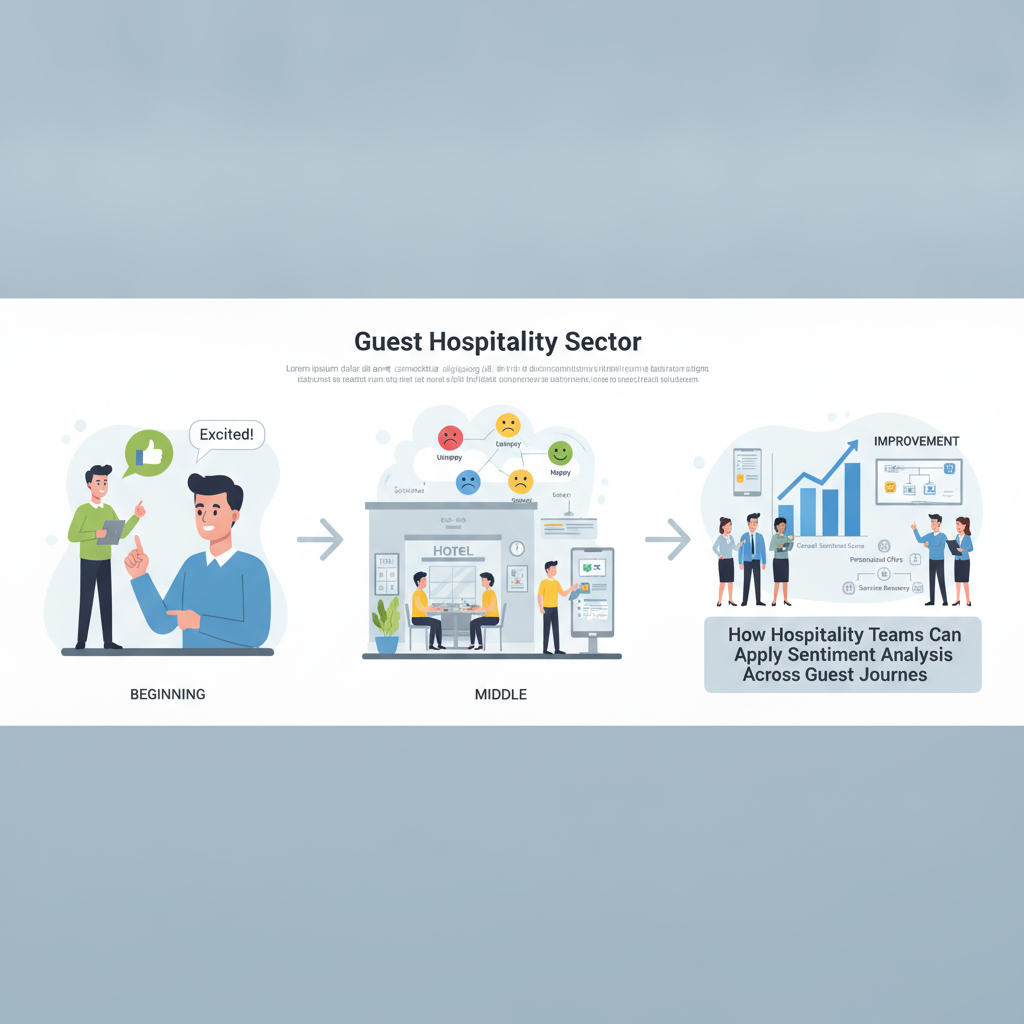
A negative review rarely begins on a review website. It may start with a guest calling about an unavailable room, continue when a front-desk request is entered incorrectly, and end with a low score on Booking.com after checkout.
Most hotels already possess fragments of this story. Call recordings reside in a unified communications platform, survey responses sit in a customer experience application, and public reviews arrive through Google, Expedia, TripAdvisor, or other channels. The problem is connecting those records quickly enough to change an operational decision.
A useful sentiment analysis program should therefore address a defined workflow. One hotel group might prioritize cleanliness complaints by routing negative mentions of bathrooms or linens to housekeeping. Another might analyze spoken conversations to identify repeated complaints about reservation changes. A third may compare breakfast sentiment across properties before revising menus or staffing levels.
The commercial case can be substantial. Research attributed to the Cornell Center for Hospitality Research found that a one-point increase in a hotel’s average review score on a five-point scale could support an 11.2% room-rate increase at constant occupancy. A separate Cornell study associated each 1% improvement in online reputation with a 1.42% lift in RevPAR. These are industry-level relationships, not forecasts for an individual property.
Build an Evaluation Around Real Guest Signals
Buyers should test platforms with representative data, not polished vendor demonstrations. A practical evaluation dataset can include anonymized WAV call recordings, UTF-8 survey exports, review text retrieved through REST APIs, and service records from a property-management or ticketing system.
Topic classification matters as much as positive or negative scoring. Research published in the Journal of Information System Research identifies room quality, staff friendliness, and breakfast service as recurring satisfaction drivers, with cleanliness and service delays appearing as prominent negative themes. Buyers can use those categories as an initial taxonomy, then add property-specific labels such as pool maintenance, resort fees, airport shuttles, or late checkout.
The evaluation should also examine spoken-word analytics. Call transcription accuracy can deteriorate when guests use speakerphones, switch languages, or speak over an agent. Test word-error handling, language detection, speaker diarization, and whether the model distinguishes “the room was not clean” from “the room was not ready for cleaning.”
Providers such as Unified Office, Inc. address this by connecting unified communications, real-time analytics, alerts, and spoken sentiment signals within the same operational environment. The relevant question is not whether a dashboard displays sentiment. It is whether a negative call segment can create an alert, preserve the transcript timestamp, and route context to an authorized hotel employee.
Plan the Data and Workflow Integration
During discovery, the project team should document each source, data owner, retention period, and integration method. Typical participants include hotel operations, revenue management, guest services, marketing, IT, privacy, and an executive sponsor who can resolve disputes over access and priorities.
Initial configuration usually covers API authentication, channel mapping, topic labels, and role-based access control. Review platforms may provide JSON records through APIs, while survey tools commonly export CSV files. Telephone systems may expose call metadata through webhooks and store audio in WAV or MP3 format.
Midway through implementation, teams should run human validation. Reviewers can label a sample of transcripts and comments, then compare those labels with model output using precision, recall, and an F1 score. If “cold breakfast” is repeatedly classified under room temperature, the taxonomy or training examples need adjustment before alerts reach property teams.
During production rollout, Unified Office, Inc. should be assessed on practical integration details such as webhook latency, transcript availability, alert routing, and retention controls. Buyers should also confirm whether personally identifiable information can be redacted before text enters an analytics repository.
Sentiment alerts can easily become just another ignored inbox. Routing a cleanliness complaint directly into an existing housekeeping queue is often more useful than creating a separate sentiment portal that supervisors must remember to check.
Decide Which Outcomes to Measure
Post-launch measurement should connect language signals to observable actions. Suitable operational metrics include the number of negative comments routed to the correct department, median alert-to-acknowledgment time, same-day closure rates, repeat mentions by topic, and the proportion of low-confidence classifications sent for human review.
Commercial measures can include average review score, direct-booking conversion, repeat stays, RevPAR, and rate changes at comparable occupancy. Because seasonality, renovations, promotions, and local events also influence those measures, buyers should avoid attributing every movement directly to sentiment software.
The ACM Transactions on the Web systematic review describes automated hotel-review sentiment analysis as a strategic tool for service delivery, loyalty, and competitiveness. Translating that potential into practice requires a closed loop: detect the issue, assign it, record the response, and determine whether the same topic appears again.
Because specific customer performance metrics are not always publicly disclosed by vendors, buyers should request reference architectures, sample alert workflows, supported data formats, and documented model-validation procedures rather than relying on assumed returns.
Buyer Takeaways
Start with one decision that staff can change, such as housekeeping dispatch or call escalation. A narrow workflow makes false positives visible and gives operators a clear reason to use the output.
Keep the original evidence. A sentiment score without the associated sentence, transcript timestamp, channel, and model confidence makes quality control difficult. For low-confidence classifications, a human review queue can prevent sarcastic comments or mixed-sentiment reviews from triggering the wrong action.
Finally, establish access and retention rules before ingesting calls. Encryption at rest, TLS for API traffic, role-based permissions, audit logs, and configurable deletion periods should be part of the evaluation, particularly when transcripts may contain payment, health, or identity information.
Broader Applicability
Restaurants, casinos, cruise operators, and managed vacation properties can adapt the same pattern by changing the topic taxonomy and operational destinations. The shared requirement is a reliable connection among text or voice capture, classification, and the system where employees act.
How long does hospitality sentiment analysis implementation take?
Timing depends on the number of channels, languages, and downstream systems. A single review feed can be configured faster than a program combining call transcription, surveys, CRM records, and property-management data, particularly when custom REST APIs or webhook routing require security review.
What should hotels test in a sentiment analysis proof of concept?
Use real, anonymized examples containing mixed sentiment, hospitality terminology, accents, and background noise. Score topic precision, negative-sentiment recall, transcription accuracy, alert latency, and the percentage of records that require manual review.
Is sentiment analysis useful for a small hotel group?
It can be, especially when managers cannot manually read every review and call transcript. A smaller team should begin with one or two high-volume sources, such as Google reviews and post-stay surveys, then add spoken-word analysis only when there is a defined escalation workflow.