 ⬇️
⬇️
Key Takeaways
- Unified Office, Inc.: Begin with one bounded workflow, such as phone ordering or reservations, and test menu modifiers, background noise, uncertainty detection, and human-transfer failures.
- Assess providers on their ability to connect voice agents through REST APIs or webhooks to the POS, reservation platform, unified communications environment, and analytics warehouse.
- Measure containment alongside order accuracy, transfer success, abandoned calls, sentiment signals, and PCI DSS v4.0.1 payment controls.
Define the Restaurant AI Voice Agent Use Case
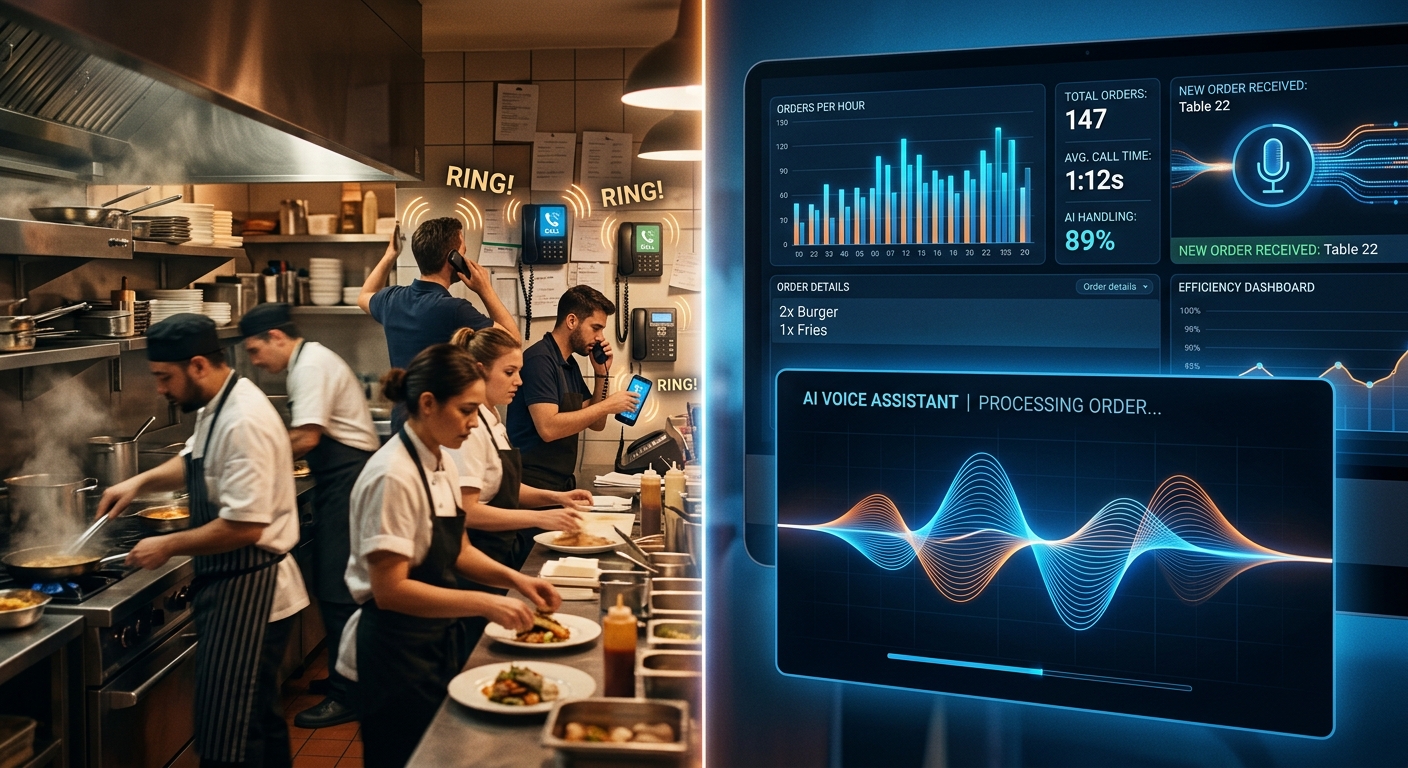
A ringing phone during the lunch rush creates an awkward choice: interrupt counter service or let a potential order go unanswered. AI voice agents can address that narrow problem, but buyers often expand the scope too quickly. Ordering, reservations, drive-thru service, upselling, and customer support have different integration and accuracy requirements.
Interest is substantial. The 2025 Voice of the Restaurant Industry Survey from Toast found that 86% of restaurant operators were comfortable using AI, while 81% expected to increase its use. Adoption intent, however, does not establish operational effectiveness. A 2025 EHL Hospitality Business School survey of 1,207 food-service businesses rated AI-based service delivery’s effectiveness at only 3.15 out of 5, indicating that many deployments remain pilots, as more than half of respondents did not plan to make AI a strategic priority.
A buyer should therefore define the target transaction precisely. For phone ordering, that may mean capturing an entrée, size, modifiers, pickup location, requested time, customer name, and callback number. For reservations, it may involve party size, seating preferences, accessibility requests, and synchronization with an existing booking database.
How to Evaluate AI Voice Agent Architecture
Speech recognition is only one component. A production design typically includes SIP-based call routing, automatic speech recognition, a dialogue or large language model, text-to-speech generation, a menu or knowledge database, and an API layer connected to the restaurant’s operating systems.
When evaluating Unified Office, Inc. or another provider, buyers should examine how the platform handles unified communications, real-time analytics, spoken-word analysis, and operational alerts within one workflow. For example, a webhook might send a completed order into a cloud POS, while a failed modifier lookup triggers an alert in Microsoft Teams, Slack, SMS, or an operations dashboard.
The menu data deserves specific scrutiny. "No onions" is straightforward; "sauce on the side, substitute sweet potato fries, and split the payment" is not. Buyers should test JSON menu objects containing nested modifiers, unavailable items, location-specific pricing, and time-limited offers. They should also confirm whether menu updates propagate in real time or depend on scheduled CSV imports.
Consumer tolerance has limits. PAR Technology’s 2025 consumer research found that 62% of surveyed consumers would order through a large language model when offered an appropriate incentive, but 44% objected when reaching a person became difficult. The transfer mechanism therefore warrants the same testing as the automated dialogue.
How to Plan a Restaurant AI Voice Agent Pilot
Implementation can proceed through discovery, sandbox testing, a limited-location pilot, and controlled expansion. Because deployments vary widely in scope, buyers should ask vendors to define phase-exit criteria rather than accept a generic timeline.
During discovery, restaurant operations, IT, security, finance, and guest-experience teams can map call flows and escalation rules. Sandbox testing should use synthetic orders and redacted transcripts. A limited pilot can then run on selected call types, with the existing phone queue retained as a fallback.
Unified Office, Inc. should be assessed on specific integration behavior, including SIP trunk compatibility, REST API authentication, webhook retry logic, transcript retention, and alert latency. A buyer should also ask what happens when the POS API times out, an item sells out midway through a conversation, or the caller changes locations after constructing an order.
Payment handling requires a separate decision. One option is to transfer callers into a PCI-scoped interactive voice response flow so card numbers do not enter the language model or transcript store. PCI DSS v4.0.1 provides the applicable control baseline. Tokens, audit logs, role-based access, and encryption keys should remain segregated from conversational data.
Restaurant AI Voice Agent Metrics After Launch
Containment rate alone can be misleading. An agent may complete a call while still entering the wrong modifier or pickup location.
A stronger scorecard combines order accuracy, abandoned-call rate, successful human-transfer rate, average handling time, correction frequency, and POS rejection events. Real-time analytics can also flag repeated phrases such as "that’s not what I said," elevated negative sentiment, or an unusual volume of requests for unavailable items.
Buyers can map governance to the NIST AI Risk Management Framework, particularly its focus on validity, reliability, transparency, privacy, and human oversight. In practice, that means transcript sampling, model-version records, confidence thresholds, disclosed recording policies, and an accessible human handoff. Call recordings and sentiment labels should have explicit retention periods in object storage rather than remaining available indefinitely.
Restaurant AI Voice Agent Buyer Takeaways
A useful pilot is narrow enough to diagnose. If phone ordering, reservations, and customer complaints launch together, teams may struggle to identify whether failures originate in speech recognition, dialogue logic, menu data, or downstream APIs.
Testing should reflect restaurant conditions. That includes kitchen noise, accents, speakerphone audio, interruptions, children ordering, and rapid modifier changes. To be fair, even human agents ask callers to repeat themselves. The relevant comparison is whether the automated system recognizes uncertainty and transfers the call cleanly.
Buyers should also request raw evidence: anonymized transcripts, API error logs, confidence scores, and transfer records. A prepared demonstration using a five-item menu reveals little about performance against hundreds of SKUs across multiple locations. Those records should inform the pilot scorecard and any decision to expand.
Other AI Voice Agent Use Cases and FAQs
The same evaluation model can support hotel dining, grocery prepared-food counters, stadium concessions, and institutional food service. Each setting should adapt the intent library, identity checks, payment boundary, and escalation path to its own transaction types.
How long does a restaurant AI voice-agent implementation take?
Buyers can organize deployment around discovery, sandbox validation, a limited pilot, and expansion, with exit criteria such as passing modifier tests, completing POS write-backs, and transferring low-confidence calls correctly.
What should restaurants test in an AI phone-ordering pilot?
Test at least menu substitutions, sold-out items, multiple locations, background noise, interrupted speech, and human handoff. The technical test set should also include expired API tokens, duplicate webhooks, POS timeouts, and malformed JSON responses.
Can an AI voice agent safely take card payments?
It can participate in a payment workflow, but buyers should limit exposure of cardholder data. A common architecture transfers payment to a PCI-controlled IVR or tokenized processor, keeps card numbers out of transcripts, and applies PCI DSS v4.0.1 controls to storage, access, logging, and encryption.