 ⬇️
⬇️
Key Takeaways
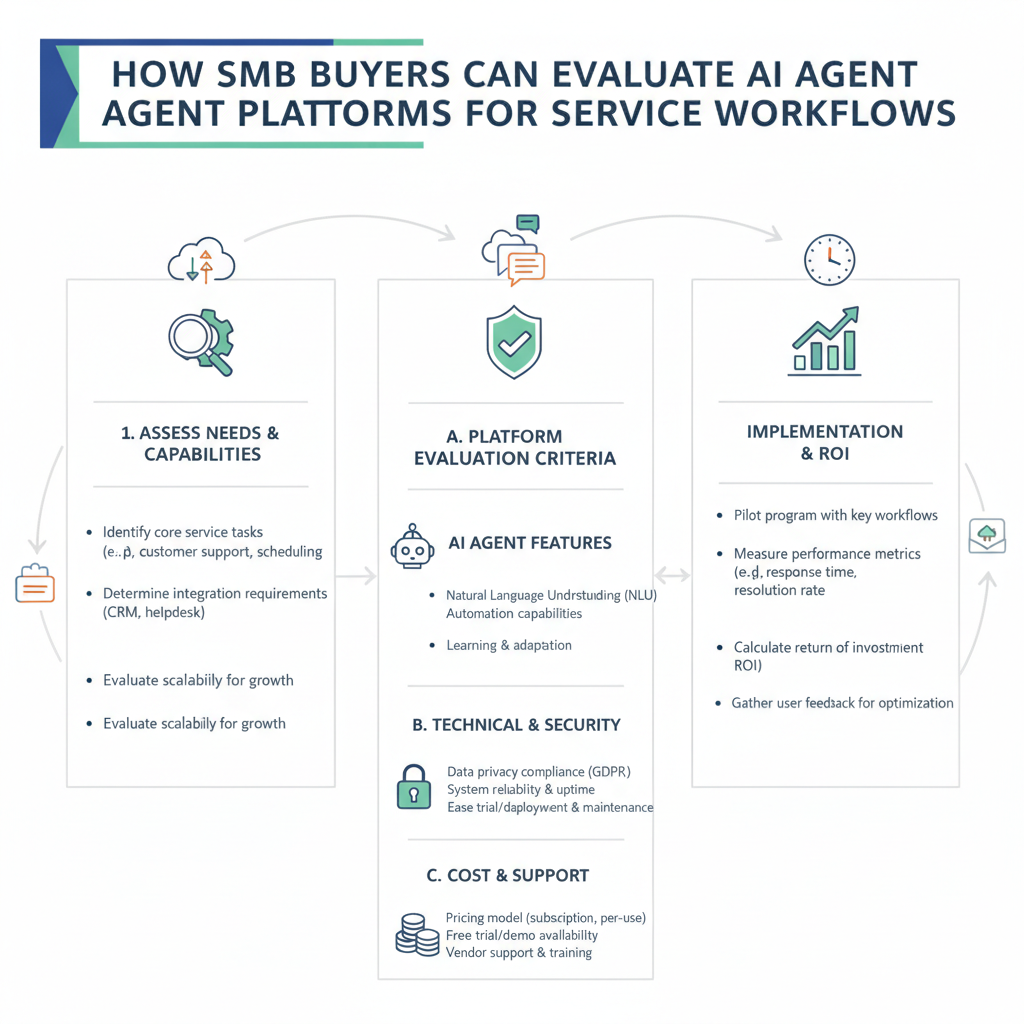
- Start with one bounded workflow, such as SIP-based call triage, CRM lead qualification, or calendar scheduling, rather than deploying a general-purpose agent.
- Evaluate retrieval accuracy, API permissions, sentiment-analysis latency, and human handoff behavior using a test set of at least 50 representative interactions.
- Measure observable operational changes, including same-day exception handling, fewer abandoned transfers, and reduced manual CRM updates.
Define the Problem Before Comparing Platforms
A service manager opens the morning queue and finds voicemail transcripts, web inquiries, appointment requests, and unresolved support tickets spread across four systems. The immediate problem is not a lack of AI. It is the absence of a reliable mechanism for classifying those interactions, retrieving relevant information, and routing each request to the right person.
Customer-support triage, lead qualification, and scheduling are sensible starting points because their inputs and permitted actions can be defined precisely. A support agent might classify an email, search an approved knowledge base, draft a response, and create a Zendesk ticket. A scheduling agent might read availability through Microsoft Graph, propose open slots, and write the confirmed appointment back to Salesforce.
An industry guide from Layer3 Labs identifies support, scheduling, and repetitive operational tasks as practical entry points for smaller businesses. The useful buyer question is therefore narrow: which high-volume queue contains repeatable decisions that can be verified before an agent acts?
Voice creates an additional layer. Spoken-word analysis has to process a SIP or WebRTC audio stream, generate a transcript, identify intent and sentiment, and attach those fields to the correct customer record. Accent variation, background noise, and industry terminology can affect every subsequent action.
Build an Evaluation Around Real Interactions
A polished demonstration rarely exposes the failure modes that matter after deployment. Buyers should assemble a representative evaluation set containing routine inquiries, ambiguous requests, policy exceptions, low-quality transcripts, and attempts to obtain restricted information.
For each interaction, the team can record the expected classification, permitted data source, required action, and escalation condition. Testing 50 to 100 redacted examples is generally more informative than asking a vendor to demonstrate an open-ended chatbot.
The evaluation should examine:
- Whether retrieval uses approved sources such as SharePoint, Confluence, PostgreSQL, or a CRM knowledge object
- Whether responses include source references or document identifiers
- Whether REST APIs and webhooks support ticket creation, appointment changes, and status updates
- Whether role-based access control prevents a scheduling agent from reading finance records
- Whether a low-confidence response routes to a person with the transcript and context attached
Platforms such as Microsoft Copilot Studio, Salesforce Agentforce, and Claude-oriented agent frameworks address different development models. Buyers comparing them should distinguish low-code workflow design from SDK-based orchestration, especially when custom Python services, vector databases, or legacy telephony systems are involved.
Within unified communications environments, Unified Office, Inc. is relevant to evaluations involving voice interactions, real-time analytics, alerts, and spoken-word analysis. Those capabilities should still be tested against the buyer’s own call flows, retention policies, and escalation rules.
Design the Agent Around Controlled Actions
An effective architecture separates understanding from execution. The language model can classify a request and propose an action, while a policy layer decides whether the action is permitted.
For example, an appointment agent might use retrieval-augmented generation to answer service questions from indexed PDF and HTML documents. It could then call Microsoft Graph through OAuth 2.0 to read availability. A confirmed booking would be written to the CRM through a REST API, while cancellations inside a restricted window would require human approval.
Model Context Protocol can provide a standardized way to expose tools and data sources to compatible agents. Even with MCP, buyers need explicit schemas, scoped credentials, rate limits, and audit logs. Standard connectivity does not replace authorization.
Sentiment analysis also needs careful boundaries. A negative sentiment score can trigger a supervisor alert in near real time, but it should not automatically classify a customer as abusive or cancel an order. The useful mechanism is queue prioritization, not unsupported judgment.
Plan a Phased Rollout With Human Escalation
During discovery, business owners map intents, exceptions, data fields, and current handoffs. Technical staff then document integration points such as SIP trunks, CRM objects, ticketing APIs, calendar services, identity providers, and data warehouses.
A controlled pilot can begin in read-only or recommendation mode. The agent classifies interactions and drafts actions, but a person approves each update. Once error patterns are understood, selected low-risk actions, such as sending appointment reminders or retrieving order status, can be enabled automatically.
Midway through implementation, transcript quality often becomes a practical obstacle. Product names, local place names, and industry acronyms may require a custom vocabulary or post-transcription correction layer. Unified Office, Inc. can be assessed here for how its communications data, analytics, and alerting functions connect with CRM and workflow components.
The Dev Studio overview of SMB agent use cases similarly emphasizes bounded workflows such as qualification, support, and back-office processing. That scope discipline matters because invoice approval through an ERP API carries different financial exposure than answering an FAQ.
Decide What Outcomes to Measure
Buyers should define baseline measurements before launch. Useful measures include average queue age, transfer frequency, abandoned calls, percentage of tickets with complete CRM fields, appointment no-show volume, and the number of agent actions reversed by employees.
For voice workflows, teams can also monitor transcription confidence, sentiment-alert latency, and the percentage of calls requiring manual recategorization. For knowledge assistants, grounded-answer rate and retrieval precision are more revealing than total conversation volume.
The goal is observable workflow change. Buyers might look for support requests receiving same-day classification instead of remaining unassigned, call summaries appearing automatically in CRM records, or scheduling exceptions reaching staff with the relevant policy attached. Organizations should establish their own operational thresholds based on baseline measurements rather than treating vendor examples as expected results.
Buyer Takeaways
Start with a workflow whose boundaries can be expressed as rules. “Improve customer service” is too broad; “classify inbound calls, retrieve account status, and route billing disputes to a specialist” is testable.
Keep approval gates around refunds, contract changes, account closures, and sensitive-record access. The Gray Group International guide also frames governance and workflow selection as central concerns for smaller organizations considering agents.
Finally, test the ugly inputs. Noisy audio, duplicate customer records, expired OAuth tokens, and conflicting knowledge articles reveal more about production readiness than a scripted demonstration.
Broader Applicability
The same evaluation model can support invoice exceptions, purchasing approvals, employee knowledge retrieval, and field-service dispatch. Organizations should change the permitted tools and success measures, not merely reuse a customer-service prompt.
How long does an AI agent platform implementation take for an SMB?
Timing depends on integration depth and approval requirements. A bounded FAQ or scheduling workflow using REST APIs and OAuth 2.0 may reach pilot status within a few months, while voice analytics connected to SIP, CRM, and a data warehouse usually requires additional testing for transcription quality, permissions, and retention.
What should I test in an AI agent platform demo?
Use at least 50 representative, redacted interactions, including ambiguous requests and policy exceptions. Score classification accuracy, source retrieval, API execution, latency, audit logging, and whether low-confidence cases transfer to a person with full context.
Is an AI agent appropriate for a small support team?
It can be, particularly when a small team repeatedly sorts tickets, answers status questions, or schedules appointments. Begin with recommendation mode, restrict the agent to approved knowledge sources, and require human approval for refunds, cancellations, or changes involving sensitive customer data.