 ⬇️
⬇️
Business calls contain valuable operational signals, but many organizations capture only a fraction of them. A customer explains why she may leave, a caller mentions a competitor, or an employee misses a required phrase. Then the conversation ends, leaving managers to rely on notes, recordings, and occasional call reviews.
That gap matters more as work spreads across offices, homes, mobile devices, and contact centers. In 2023, Gartner estimated the global unified communications and collaboration market, encompassing UCaaas, to exceed $60 billion. IDC reported in 2024 that over 70% of enterprises deploying cloud UCaaS viewed AI capabilities such as transcription, sentiment analysis, and intelligent routing as top investment priorities for the following 24 months.
AI unified communications, or AI-UC, is emerging in response. It turns communications infrastructure from a collection of calling tools into a source of searchable intelligence and workflow automation.
What Is AI Unified Communications?
Traditional unified communications brings business voice, video, messaging, presence, and collaboration into a common platform. AI-UC adds capabilities that interpret interactions, identify patterns, recommend actions, and automate selected tasks.
Those functions can include real-time transcription, call summaries, intelligent routing, smart interactive voice response, sentiment analysis, noise suppression, virtual agents, and performance analytics. The underlying calls commonly rely on SIP for signaling and WebRTC for browser-based voice and video.
Here's the thing: adding a transcription engine to a phone system does not automatically create a useful AI-UC strategy. The greater value comes from connecting communications data to business decisions. Can the platform identify a frustrated caller while the interaction is still recoverable? Can it alert a manager when a location misses calls or when a sales conversation includes a high-value buying signal?
That operational layer separates passive call recording from active communications intelligence.
How Total Connect Now and EngageIQ™ Work Together
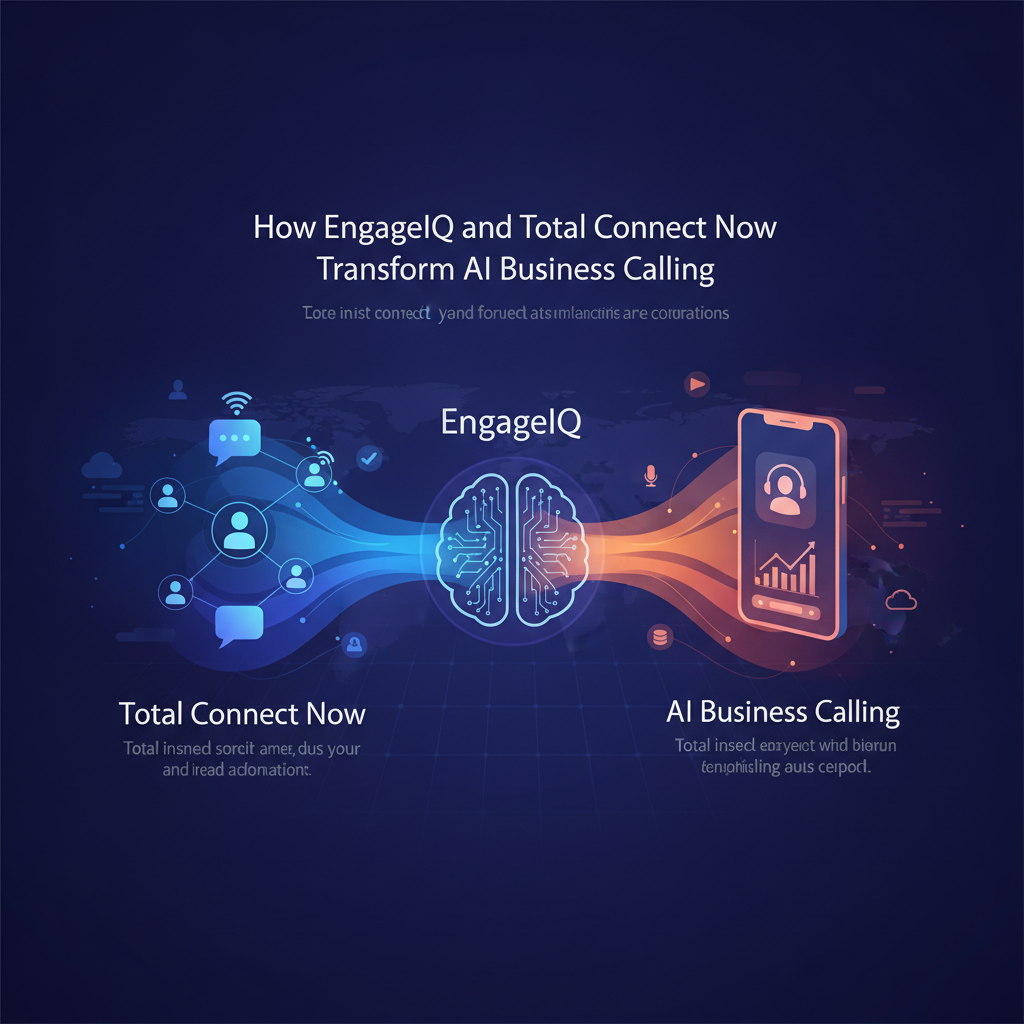
Unified Office, Inc. approaches AI-UC through an SDN-based hybrid cloud communications architecture. Its Total Connect Now, or TCN, platform provides managed Voice over IP and unified communications services, while EngageIQ™ adds AI applications that analyze conversations running through that environment.
EngageIQ™ is designed to analyze every call rather than a small sample selected for manual quality review. Its capabilities include spoken-word analysis, sentiment detection, real-time business analytics, alerts, and actionable data generation. Engagement and whisper-coach applications can also support employees during interactions by surfacing relevant guidance.
The distinction is important. Total Connect Now handles the communications layer. EngageIQ™ examines what happens within those communications and converts call content into structured operational signals.
Consider a multi-location service business. Management may want to know whether employees answer calls promptly, follow approved language, mention current offers, or respond appropriately when callers sound dissatisfied. AI analysis can identify those events across a much larger call population than supervisors could review manually.
AI voice agents extend the model further. They can handle defined conversational workflows, collect information, answer routine questions, or direct callers to an appropriate person. Human escalation still matters, especially for unusual, sensitive, or high-value situations.
Benefits and Practical Use Cases
Productivity is one of the clearest opportunities. McKinsey found in 2023 that AI-driven automation in customer-facing workflows could improve contact-center and communications productivity by 30% to 45%, primarily through self-service and smarter routing.
Other use cases vary by department:
- Customer service teams can detect negative sentiment, recurring complaints, and escalation risks.
- Sales leaders can identify product mentions, objections, competitor references, and missed follow-up opportunities.
- Operations teams can monitor call traffic, unanswered calls, location performance, and service patterns.
- Compliance managers can search conversations for required or prohibited language, subject to applicable recording and privacy rules.
- Supervisors can use broader interaction data to focus coaching on specific behaviors rather than anecdotal feedback.
Not every organization needs every function. A regional retailer may prioritize missed-call alerts and location analytics, while an enterprise service desk may care more about routing, summaries, and integrations with ticketing systems. The business problem should lead. AI comes second.
How Buyers Should Evaluate AI-UC Options
Decision-makers can begin with six practical questions.
- What data does the AI analyze? Determine whether the platform covers voice only or also video, messaging, and collaboration sessions. Ask whether it evaluates every eligible call or a sample.
- When are insights available? Post-call summaries are useful, but real-time alerts and coaching can affect an interaction before it ends.
- How reliable is the communications foundation? AI cannot compensate for poor audio, latency, dropped calls, or inconsistent network performance. Buyers should examine quality-of-service monitoring, redundancy, failover, and support.
- How are accuracy and context measured? Transcription and sentiment results can vary with accents, background noise, industry terminology, and conversation length. A pilot using representative calls provides more evidence than a polished demonstration.
- What governance controls are included? Organizations should review consent, retention, access permissions, encryption, model use, and deletion procedures. For VoIP calling, implementation also needs to account for FCC requirements involving E911, STIR/SHAKEN, and robocall mitigation.
- Can the system produce measurable action? Useful AI-UC platforms should connect insights to alerts, coaching, routing, reports, or business workflows. A dashboard that nobody checks is still shelfware, even if it looks impressive.
Buyers should define baseline metrics before deployment, such as unanswered-call rates, average handling time, escalation frequency, conversion indicators, or quality-review coverage. A phased rollout can then compare results without disrupting the full communications estate.
What Comes Next for AI-Powered Business Communication?
AI-UC is likely to move from retrospective analysis toward more real-time assistance and task execution. Summaries will increasingly feed CRM records, voice agents will handle bounded workflows, and analytics will connect conversation patterns with operational performance.
That said, adoption will depend on trust as much as technical capability. Enterprises will expect transparent controls, dependable calling, explainable outputs, and clear escalation to people. The winning approach is unlikely to be AI everywhere. It will be AI applied where communications data can improve a decision, shorten a workflow, or help an employee respond at the right moment.