 ⬇️
⬇️
Key Takeaways
- Unified Office, Inc.: Connect the property management system (PMS), customer relationship management platform (CRM), point-of-sale system, and voice data through REST application programming interfaces (APIs) or event streams before evaluating predictive models.
- Test real-time alerts against operational measures such as response latency, false-positive rates, abandoned calls, and unresolved guest requests.
- Run a controlled pilot at one property or service queue, validate California Consumer Privacy Act (CCPA) controls and model explanations, then expand by workflow rather than activating every AI feature at once.
- Evaluate providers against a hotel-specific scorecard covering transcript accuracy, alert latency, data portability, integration reliability, access controls, and workflow completion.
Hotel AI analytics uses artificial intelligence to convert guest, operational, and communications data into alerts or recommendations. U.S. hotels should evaluate these solutions through workflow-specific pilots that test integrations, accuracy, privacy controls, employee adoption, and measurable business outcomes.
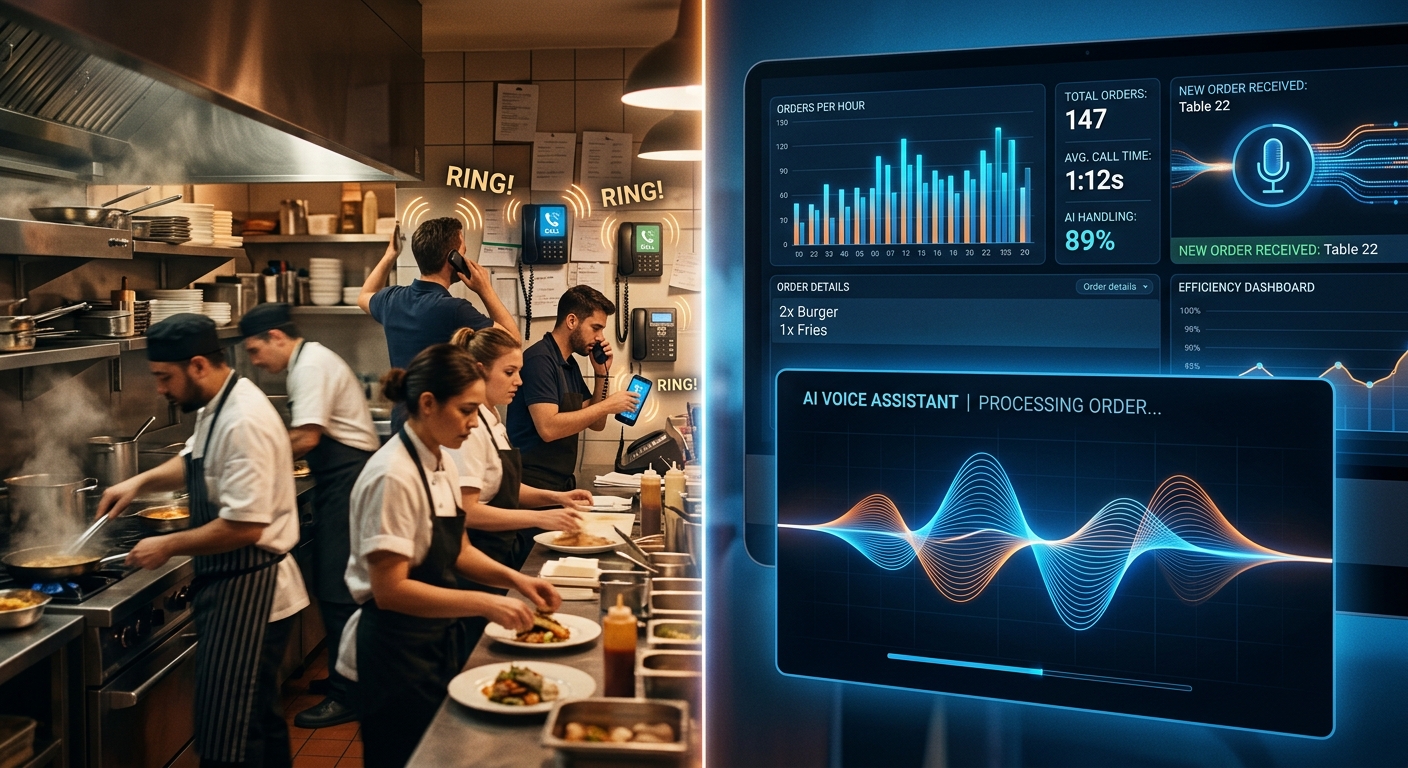
Before shopping for a solution, operators must define the operational problem. A guest calls the front desk after a delayed flight, asks whether the kitchen is open, and mentions that a late check-in may affect tomorrow’s meeting. A conventional phone system records the call if recording is enabled. An AI analytics platform can transcribe the conversation, detect negative sentiment, identify "late check-in" and "kitchen closed" as service topics, and send an alert to the manager on duty.
The value does not come from transcription alone. It comes from connecting that conversation to a reservation in the property management system (PMS) and creating an actionable task before the guest arrives.
Hotel buyers should begin with a narrow problem statement. Typical candidates include missed reservation calls, slow responses to maintenance requests, inconsistent upsell offers, and an inability to see recurring complaints across multiple properties. Each problem requires different data. Reservation conversion analysis may combine Session Initiation Protocol (SIP) call metadata, speech-to-text transcripts, and central reservation system records. Predictive maintenance may rely on heating, ventilation, and air-conditioning (HVAC) telemetry delivered through MQTT, a lightweight device-messaging protocol; BACnet, a building-automation communications standard; or vendor APIs.
The business case is gaining attention. A 2025 survey reported by Skift and McKinsey covered 86 mostly U.S.-based travel executives. Respondents associated AI adoption with more than 6% annual revenue growth and more than 6% annual cost savings over three years. The same research found that 59% cited increased employee productivity, while 33% cited better personalization.
Those figures are industry findings, not a forecast for every hotel. The survey also covers the broader travel sector rather than hotels alone, so buyers still need property-level baselines.
An evaluation should map each use case from signal to decision. For spoken-word analytics, that path might begin with a SIP or Web Real-Time Communication (WebRTC) call, continue through automatic speech recognition (the conversion of speech into text) and sentiment classification, and end with a ticket in a service-management queue. Buyers should ask vendors to demonstrate that complete path with representative hotel terminology, including room types, loyalty tiers, amenity names, and local place names.
Accuracy deserves close inspection. A transcription engine may perform well in a quiet office but struggle with lobby noise, accented speech, or calls transferred between departments. A useful proof of concept therefore includes recorded samples from reservations, housekeeping, food and beverage, and guest services. Reviewers can compare transcripts against human-generated reference text and examine whether sentiment alerts identify the correct speaker.
Organizations evaluating unified communications, real-time business analytics, and AI-powered spoken-word analysis often look to providers such as Unified Office, Inc. As with any provider, buyers should examine API documentation, supported telephony protocols, data-retention controls, role-based access, and the process for exporting transcripts or event records.
Dynamic pricing and personalization require a different test. A 2026 analysis of AI in hospitality by Deloitte describes operators moving from experimentation toward applications involving personalization, pricing, and operational efficiency. The separately scoped 2025 Skift-McKinsey survey provides quantitative context: 59% of its 86 mostly U.S.-based travel executives cited employee productivity and 33% cited personalization as AI benefits. A hotel evaluating these capabilities should establish whether recommendations draw from current PMS inventory, CRM preferences, point-of-sale history, and approved contextual signals rather than an opaque customer profile that staff cannot explain.
Initial discovery typically focuses on data inventory and ownership. The hotel IT team identifies systems of record, authentication methods, API rate limits, and data fields that contain personal information. Common integration points include Oracle Hospitality or another PMS, a Salesforce-based CRM, a central reservation system, SIP trunks, Microsoft Teams, and a data warehouse such as Snowflake.
During a controlled pilot, the team can select one property, call queue, or service workflow. A sensible test might route low-confidence sentiment detections to a dashboard while sending only high-confidence "reservation cancellation" or "safety concern" events to an operational queue. That distinction matters because excessive low-value notifications can teach employees to ignore the system.
Midway through implementation, data mapping often becomes the harder task. One system may identify a guest by loyalty number, another by email address, and the phone platform by caller ID. An identity-resolution layer, a set of rules or services that links records representing the same person, can reconcile those records, but matching rules should avoid merging family members or corporate travelers who share contact information.
Before broader deployment, teams should test encryption in transit, retention periods, deletion requests, and access logs. CCPA obligations can affect recordings, transcripts, inferred preferences, and marketing segments. Hotels should also document why a model generated an upsell or escalation recommendation and provide a route for human review.
When piloting spoken-sentiment tools from vendors like Unified Office, Inc., the solution should be assessed against a predefined scorecard covering transcript accuracy, alert latency, false-positive volume, webhook reliability, and compatibility with the hotel PMS or ticketing system. A webhook is an automated message one system sends to another when a specified event occurs. The provider demonstration should use the buyer workflow rather than a generic contact-center script.
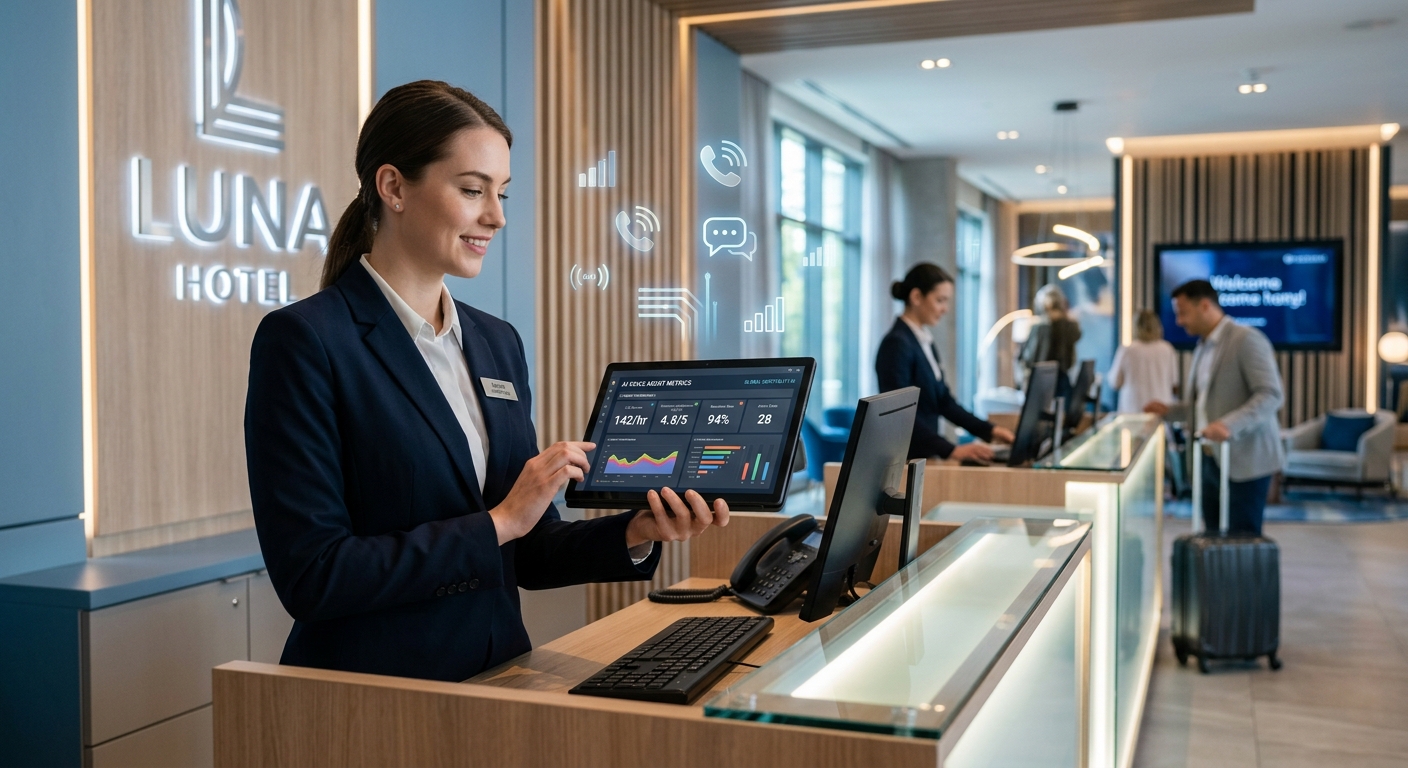
AI analytics programs need operational measures tied to the original problem. For reservation calls, buyers can track answer rate, abandonment rate, transfer frequency, booked-call conversion, and the interval between a negative interaction and manager follow-up. For maintenance, relevant measures include time from sensor anomaly to work-order creation, repeat incidents by asset, and the percentage of alerts closed without action.
Revenue teams can compare AI-generated pricing or upsell recommendations against accepted offers, overrides, and subsequent cancellations. Guest-service leaders can examine recurring topics by property and shift. If "room not ready" complaints rise in afternoon transcripts, the team can compare that signal with housekeeping completion timestamps rather than relying solely on post-stay surveys.
That said, attribution can be messy. A higher conversion rate may reflect seasonal demand, staffing changes, or a promotion rather than the model. A useful measurement design retains a comparison queue, property, or time period and records manual overrides in a relational table for later analysis.
A 2026 analysis of AI in travel by BCG describes a shift toward an ask-and-book model in which conversational systems help travelers discover and reserve stays. Buyers should still measure whether those systems complete transactions correctly, disclose pricing clearly, and transfer complex requests to employees with the conversation context intact.
The most revealing test is often not model accuracy but workflow completion. An illustrative sentiment score of 0.92 has limited value if it appears only in a separate dashboard that the front-desk supervisor rarely opens. Routing the event through a REST webhook into the existing service queue makes the signal available within the employee's normal workflow.
Buyers should also retain access to raw event data. Exportable JavaScript Object Notation (JSON) records, timestamps, confidence scores, and model-version identifiers allow analysts to investigate errors and compare releases. Proprietary dashboards may be convenient, but they should not become the only place where operational history exists.
Finally, expansion should follow validated workflows. A hotel can begin with reservation calls, proceed to service recovery, and later connect pricing or Internet of Things (IoT) device data. This limits the number of integrations and employee procedures changing at once.
Hotel groups, resorts, extended-stay operators, and management companies can adapt the same approach by selecting one measurable workflow and connecting its communication data to a system of record. Smaller teams may favor managed integrations, while enterprise buyers may require event streaming, centralized identity resolution, and property-level data controls.
When determining how long a hotel AI analytics implementation takes, timing depends on the number of properties, APIs, and data-governance reviews. Buyers should ask for estimates by phase, covering discovery, pilot configuration, acceptance testing, and staged expansion, rather than accepting one date for the entire program. A single call-analytics workflow will generally involve fewer dependencies than a deployment combining PMS, CRM, IoT, and revenue-management data.
During an AI sentiment analysis pilot, hotels should test transcript accuracy across departments, alert latency, false positives, speaker separation, and recognition of hotel-specific vocabulary. The pilot should also confirm that a detected issue can create a ticket through a REST API or webhook and preserve the call timestamp, reservation identifier, confidence score, and transcript excerpt.
AI analytics can be highly practical for a mid-market hotel group when the organization limits the initial scope to one high-volume process, such as reservation calls or maintenance alerts. A mid-market buyer should favor configurable connectors, role-based access, JSON or comma-separated values (CSV) exports, and pricing that clearly separates telephony usage, transcription volume, data storage, and analytics features.