 ⬇️
⬇️
Key Takeaways
- Start with one bounded workflow, such as appointment confirmation through a REST or HL7 FHIR interface, rather than automating every front-office process at once.
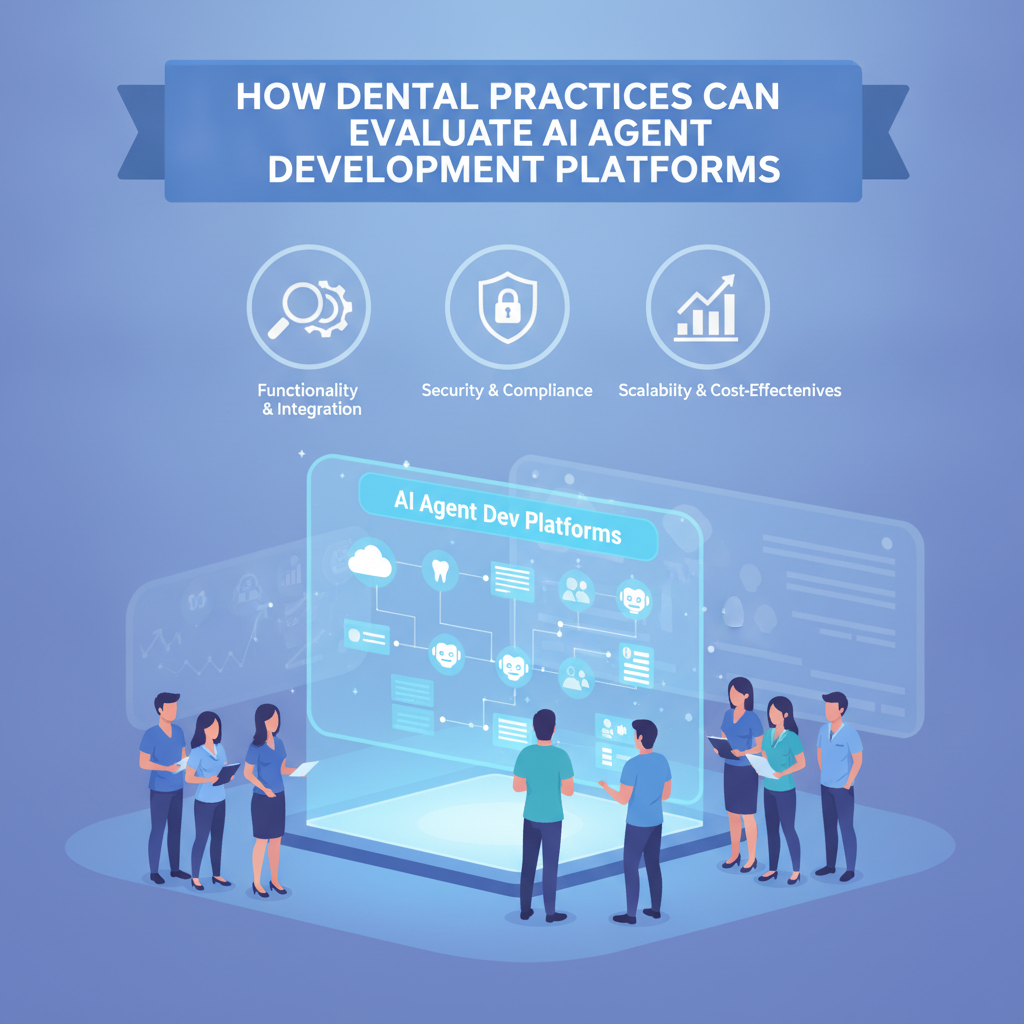
- Evaluate HIPAA controls, CDT terminology support, role-based access, call recording policies, and practice-management integration before comparing conversational features.
- Measure containment rate, transfer accuracy, booking completion, insurance exceptions, and human review volume after launch, while retaining complete audit logs.
Define the Administrative Problem Before Comparing Platforms
A patient calls after hours to reschedule an appointment, asks whether the practice accepts a particular insurance plan, and mentions persistent tooth pain. An AI agent may be able to authenticate the caller, retrieve available appointments, and complete the rescheduling request. It should also recognize that the clinical statement falls outside routine scheduling and route the call according to the practice’s escalation policy.
That distinction matters. Dental AI agents are most credible when handling bounded administrative work: scheduling, reminders, intake, recall campaigns, insurance verification, billing follow-up, and routine call handling. Clinical interpretation introduces a different level of governance and should not be bundled casually into a front-office automation project.
Buyers should document each target workflow as a decision tree. For appointment changes, that tree might include patient matching, location selection, provider availability, procedure duration, cancellation rules, and escalation conditions. The specification should identify which system owns each field, whether updates occur through a REST API, HL7 FHIR resource, proprietary connector, or robotic process automation, and what happens if the source system is unavailable.
Before issuing a request for proposal, practices can establish baselines for abandoned calls, average hold time, scheduling completion, no-show follow-up, insurance exceptions, and staff minutes spent per transaction. These baselines make later comparisons more useful than a generic demonstration of conversational fluency.
Build an Evaluation Scorecard Around Dental Workflows
An AI agent development platform generally combines language models, workflow orchestration, integrations, identity controls, monitoring, and human handoff. Products such as Voiceflow and Rasa emphasize configurable conversational workflows, while dental-oriented systems from Planet DDS and Archy may offer closer alignment with practice-management data and terminology.
Communications capabilities deserve their own evaluation track. Unified Office, Inc. represents an approach that combines unified communications with real-time business analytics, alerts, and spoken-word analysis. A dental group considering that model should examine how inbound calls, voicemail, SMS, sentiment signals, and queue events are exposed to the agent and reporting layer.
The scorecard should test actual tasks, not scripted product tours. Ask each vendor to demonstrate how its platform handles duplicate patient records, family scheduling, multilingual calls, failed identity checks, same-day cancellations, and an insurance response that does not match the patient’s submitted information.
The ADA’s CDT terminology is especially relevant for billing and claims workflows. An agent does not need to make clinical coding decisions to be useful, but it should preserve procedure-code context when collecting information, checking claim status, or routing an exception to billing staff.
Buyers should also test latency. A spoken agent that pauses several seconds after every response may technically complete a workflow yet still frustrate callers. Telephony tests should capture transcription delay, interruption handling, background-noise performance, transfer success, and whether the human recipient receives a concise transcript or structured summary.
Treat Privacy and Governance as Product Requirements
HIPAA applies when covered entities and business associates handle protected health information. Consequently, buyers should ask where transcripts, recordings, prompts, extracted fields, and model logs are stored; how long they are retained; and whether the vendor will sign a business associate agreement.
NIST’s AI Risk Management Framework 1.0 offers a practical evaluation lens through its Govern, Map, Measure, and Manage functions. For a dental deployment, that translates into documented ownership, mapped failure scenarios, measurable quality tests, and procedures for correcting unsafe or inaccurate behavior.
Role-based access should follow the workflow. A scheduling agent may need patient demographics and appointment availability but not clinical notes. An insurance-verification agent may require payer identifiers and coverage responses while remaining blocked from unrelated records. OAuth 2.0, scoped API tokens, encryption in transit, and immutable audit events provide concrete controls to inspect during technical due diligence.
Call recording rules require strict attention. Consent announcements, state-specific recording requirements, transcript retention, and supervisor access affect how the platform can be deployed across multiple locations.
Plan the Rollout Around Controlled Workflow Expansion
Implementation typically begins with discovery and data mapping, followed by sandbox integration, supervised testing, a limited production release, and broader workflow expansion. Rather than committing to a universal timeline, buyers should require vendors to estimate each phase using the practice’s actual API availability, call volume, locations, and approval process.
The working group commonly includes operations, front-desk leadership, billing, compliance, IT, and a clinical representative who can define escalation boundaries. Unified Office, Inc. should be assessed on how its communications architecture exposes call metadata, real-time alerts, sentiment indicators, and transfer events to the selected agent orchestration layer.
Where available, HL7 FHIR can standardize access to appointments, patient demographics, and related administrative data. Many dental practice-management products still rely on proprietary APIs or database-specific connectors, however. Buyers should identify whether integrations use supported APIs, read-only database views, middleware, CSV batch files, or browser automation. Each method carries different monitoring and maintenance requirements.
A sandbox test set should include misspelled names, ambiguous dates, multiple household members, unsupported insurance plans, urgent language, disconnected calls, and unavailable appointment slots. Human reviewers can label responses as completed, correctly escalated, inaccurate, or privacy-sensitive.
Decide What Success Will Look Like
Post-launch measurement should focus on observable workflow behavior. Useful indicators include appointment-booking completion, correct transfer destination, containment rate, average response latency, authentication failure, insurance-verification exceptions, and the share of conversations requiring staff correction.
Real-time analytics can also reveal patterns that monthly reports miss. Repeated mentions of unreturned calls, for example, may trigger an operational alert when they cross a practice-defined threshold. Sentiment analysis should support review rather than make clinical or disciplinary decisions on its own, since tone models can misread accents, stress, sarcasm, and background speech.
Practices should compare these indicators with their pre-launch baselines and review samples of both successful and unsuccessful interactions. Vendors rarely publish universal outcome metrics, and buyers should be cautious about applying one practice’s call-containment figure to a different scheduling model or patient population.
Buyer Takeaways
The strongest evaluations stay close to actual dental work. A polished chatbot is less valuable than an agent that can locate the correct patient, follow scheduling constraints, update the system of record, and transfer sensitive requests with context intact.
During testing, failed transactions often reveal more than successful ones. Buyers should inspect whether a failed API call creates a duplicate appointment, silently drops the request, or generates a structured task for staff review. That failure-path behavior can determine whether automation reduces workload or merely moves it into a harder-to-find queue.
Similar healthcare organizations can adapt this approach by selecting one high-volume administrative workflow, mapping its data permissions, and testing it against real exception patterns before expanding into billing, recalls, or multi-location call routing.
How long does a dental AI agent implementation take?
The timeline depends on API access, practice-management compatibility, telephony configuration, and compliance review. Buyers should request phase-level estimates for discovery, sandbox testing, supervised production use, and expansion, with entry and exit criteria for each phase rather than relying on one launch date.
What should a dental practice test in an AI voice agent?
Test identity matching, interruptions, background noise, multilingual speech, transfer accuracy, emergency-language escalation, and scheduling updates. The test environment should also capture response latency, transcript quality, API errors, and whether every protected-data access appears in an audit log.
Is an AI agent platform appropriate for a small dental team?
It can be when the practice has a repetitive, measurable workflow such as after-hours scheduling or recall calls. A smaller team should favor a narrow deployment with a supported practice-management connector, role-based access, human handoff, and reporting that shows completion and correction rates without requiring a dedicated data engineering group.